العودة للمدونة
India Robotics Automation · Part 3 of 9Industry Analysis
Service Robotics and Healthcare Robotics in India
This is the third installment in our comprehensive research series on robotics automation in India. While the first two parts covered the overall market landscape and industrial robotics by sector, this article examines the rapidly emerging world of service robotics — robots that operate outside of traditional manufacturing environments. This includes surgical robots, rehabilitation and assistive robots, hospitality and delivery robots, cleaning robots, education and companion robots, and security robots. India's service robotics market is projected to be the dominant segment by revenue, and it represents a fundamentally different growth story than factory automation.
1. Service Robotics: The Emerging Dominant Segment
1.1 Market Size and Context
According to Statista, the dominant segment of India's robotics market by revenue is service robotics, not industrial robotics. This may seem counterintuitive given the focus on factory automation, but service robotics encompasses a much broader range of applications — from surgical systems costing millions of dollars each to consumer cleaning robots selling for a few thousand rupees.
The global service robotics market is being driven by several forces that are particularly relevant to India:
- ●Aging populations in upper-income households demanding elderly care solutions
- ●A massive healthcare system serving 1.4 billion people with acute professional shortages
- ●Rapid digitization of logistics, delivery, and hospitality
- ●Rising disposable income creating a consumer market for domestic robots
1.2 How Service Robotics Differs from Industrial
Understanding India's service robotics opportunity requires recognizing how fundamentally different it is from industrial robotics:
| Dimension | Industrial Robotics | Service Robotics |
|---|---|---|
| Environment | Structured factory floor | Unstructured human environments |
| Users | Trained engineers/technicians | Consumers, nurses, waitstaff, delivery personnel |
| Regulation | Industrial safety standards (ISO 10218) | Medical device regulation, road transport rules, consumer safety |
| Business Model | Capital equipment purchase | Subscription, pay-per-use, RaaS |
| Scale | Thousands of units/year in India | Potentially millions (consumer segment) |
| Technology Focus | Precision, repeatability, payload | Navigation, human interaction, AI, perception |
| Key Challenge | ROI justification | Safety, reliability, regulation, user acceptance |
This difference matters because India's strengths in IT and software — which are less relevant for traditional industrial robotics OEM capability — become significant competitive advantages in service robotics, where AI, computer vision, natural language processing, and cloud connectivity are core technologies.
2. Surgical Robotics: India's Breakout Story
2.1 The Market
India's surgical robotics market is one of the most compelling sub-segments in the entire Indian robotics landscape:
- ●2024 Market Size: USD 169.1 Million (surgical robots specifically)
- ●2033 Projected Size: USD 569.0 Million
- ●CAGR (2025–2033): 14%
- ●Broader surgical robotics market (including services, maintenance, and disposables) ranges widely — from USD 169 Million (robots alone, Grand View Research) to significantly higher figures when services and consumables are included
India is the 4th largest and fastest-growing surgical robotics market in Asia Pacific. As of 2025, the country has over 300 surgical robots installed across hospital networks and performs approximately 60,000 robotic procedures annually.
2.2 The da Vinci Era
India's surgical robotics journey began in 2006 when the first Intuitive Surgical da Vinci system was installed at the All India Institute of Medical Sciences (AIIMS) in New Delhi. Since then, Intuitive's da Vinci platform has been the dominant surgical robot in India.
As of 2024–2025:
- ●Over 180 da Vinci systems have been installed across India, predominantly in private hospitals
- ●Major hospital chains operating da Vinci systems include Apollo Hospitals, Medanta, Fortis Healthcare, Max Healthcare, Narayana Health, and Aster DM Healthcare
- ●The da Vinci is used for urology (prostatectomy, nephrectomy), gynecology (hysterectomy), general surgery (hernia repair, colorectal), and cardiac procedures
However, the da Vinci system has significant limitations for the Indian context:
- ●Cost: Each system costs USD 1.5–2.5 Million, with annual maintenance costs of USD 100,000–200,000
- ●Instrument costs: Proprietary instruments have limited use cycles, adding USD 1,500–3,000 per procedure
- ●Procedure cost to patients: Robotic surgery in India typically adds INR 1.5–3 lakh (USD 1,800–3,600) over conventional laparoscopic surgery
- ●Monopoly dynamics: Until recently, Intuitive had a virtual monopoly, limiting price competition
2.3 SSi Mantra: India's Indigenous Surgical Robot
The most significant development in Indian surgical robotics is SSi Mantra, developed by SS Innovations International, Inc. (Nasdaq: SSII), founded by Dr. Sudhir Srivastava, a cardiac surgeon.
Key Milestones:
- ●138+ SSi Mantra systems installed across eleven countries (as of early 2026), with 103 robots installed in 2025 alone
- ●More than 7,300 surgical procedures successfully performed, including cardiac surgeries and telesurgeries
- ●2025 revenue of USD 42.5 Million — a 106% year-over-year increase — with India accounting for 91% of revenue
- ●In March 2025, SS Innovations unveiled India's first Mobile Tele-Surgical Unit at the SMRSC 2025 conference
- ●510(k) notification submitted to the FDA on December 5, 2025; EU CE Mark and additional country approvals in progress
- ●New regulatory approvals secured in Colombia, Oman, Sri Lanka, and Kenya (late 2025 through early 2026)
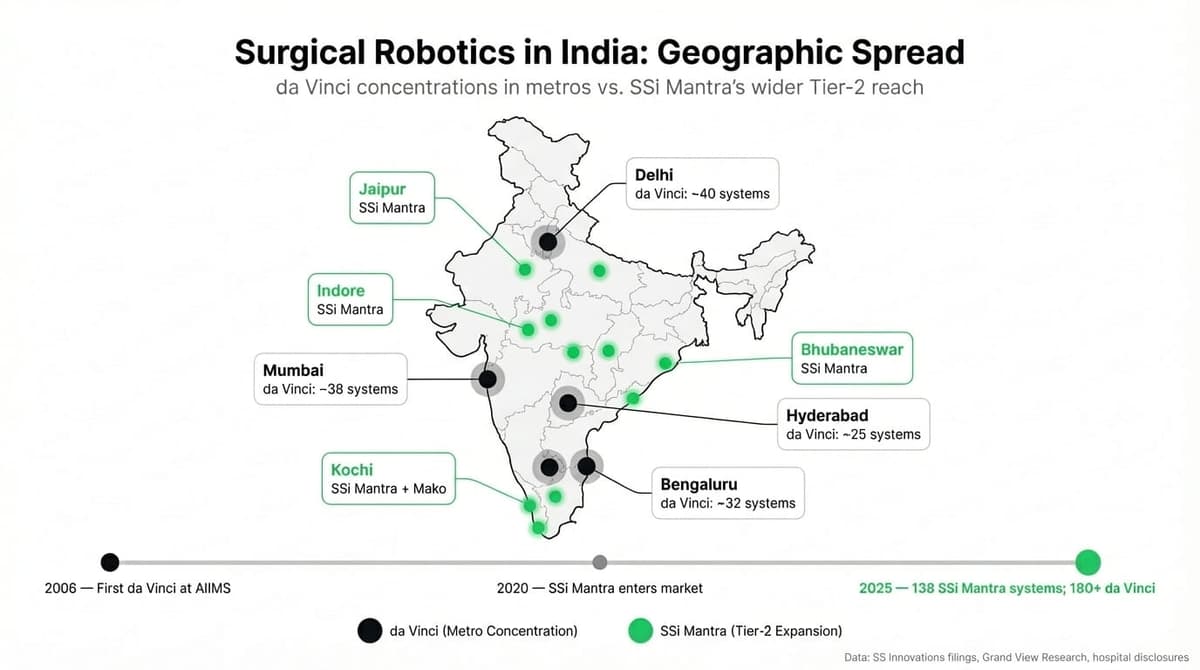
The SSi Mantra is priced at less than one-third the cost of a da Vinci system (approximately INR 5–8 crore vs. INR 15–20 crore), with lower consumable and maintenance costs as well — making robotic surgery economically viable for Tier-2 and Tier-3 city hospitals that could never justify a da Vinci purchase. It is also designed to be modular — hospitals can start with fewer arms and upgrade — which reduces the initial investment barrier.
The telesurgery capability is particularly relevant for India, where surgical expertise is concentrated in metropolitan centers while the patient population is distributed across the country. A skilled robotic surgeon in Mumbai or Chennai can potentially operate remotely on a patient at a district hospital 500 km away — if the connectivity and regulatory framework supports it.
Key Insight:
India has over 950 robotic-assisted trained surgeons — a growing pool, but still a fraction of the ~1.3 million registered doctors in the country. SSi Mantra's 138+ installations, 7,300+ procedures, and USD 42.5M in 2025 revenue make it India's flagship robotics success story — demonstrating that Indian companies can build world-class robotic platforms at globally competitive pricing.
2.4 Other Surgical Robot Players Entering India
The surgical robotics market in India is becoming increasingly competitive:
- ●Meril MIZZO Endo 4000: An Indian-developed next-generation soft-tissue surgical robot featuring AI-enabled imaging, 3D mapping, and 5G connectivity — unveiled September 2025. Meril is positioning MIZZO as a direct domestic competitor to both da Vinci and SSi Mantra
- ●Medtronic Hugo RAS: Received FDA clearance for urology in December 2025, with US commercialization beginning in 2026. India expansion underway with plans spanning general surgery and gynecology
- ●CMR Surgical (Versius): The UK-based company's modular surgical robot has dozens of installations in Indian hospitals and is building clinical depth
- ●Stryker (Mako): Orthopedic surgical robot gaining traction in India for knee and hip replacement procedures — orthopedics is the fastest-growing application segment
- ●Zimmer Biomet (ROSA): Another orthopedic surgical robot entering the Indian market
- ●Smith & Nephew (CORI): Orthopedic robotics platform
The orthopedic surgical robotics segment is growing particularly fast in India, driven by rising prevalence of osteoarthritis (India has one of the highest rates globally), increasing knee and hip replacement volumes, higher precision requirements that robotic platforms deliver, and growing medical tourism for joint replacement procedures.
2.5 Regional Distribution
South India dominates the surgical robotics market. Chennai, Bengaluru, and Hyderabad have the highest concentration of surgical robots, driven by advanced healthcare infrastructure, strong medical tourism, and presence of major hospital chains. North India (Delhi-NCR) is the second-largest concentration. Tier-2 cities like Kochi, Coimbatore, Jaipur, Indore, and Lucknow are emerging markets, particularly for lower-cost platforms like SSi Mantra.
3. Rehabilitation and Assistive Robotics
3.1 Market Opportunity
India's elder care and assistive robotics market is nascent but projected to grow substantially:
- ●India Elder Care Assistive Robots Market (2025): USD 190.6 Million
- ●2033 Projected Size: USD 588.5 Million
- ●CAGR (2026–2033): 15%
- ●Dominant segment: Socially Assistive Robots
3.2 The Demographic Imperative
India's aging population creates an unavoidable demand for assistive robotics:
- ●India's 60+ population is projected to reach 319 million by 2050 (from ~149 million in 2022)
- ●The elderly dependency ratio is rising while joint family structures are declining in urban India
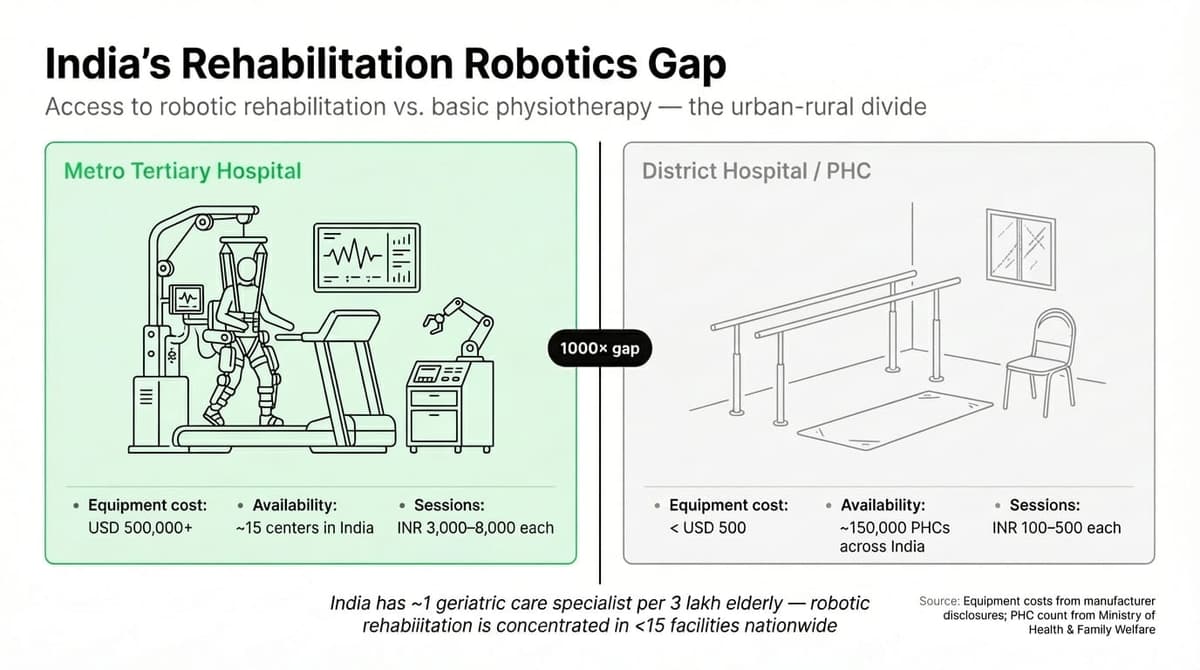
- ●India has approximately 1 geriatric care specialist per 3 lakh elderly — a catastrophic shortage
- ●Home healthcare and elder care services are growing at 20%+ annually but cannot scale through human workers alone
3.3 Current State
Rehabilitation robotics in India is in very early stages. Global platforms like Hocoma's Lokomat (gait rehabilitation), Ekso Bionics exoskeletons, and ReWalk systems are present in a handful of premium rehabilitation centers in major cities (AIIMS, Christian Medical College Vellore, NM Joshi Marg hospitals).
Most Indian rehabilitation facilities still rely on conventional physiotherapy with minimal robotic assistance. The reasons are primarily economic — a Lokomat system costs USD 500,000+, most rehabilitation centers operate on tight margins, and insurance coverage for robotic rehabilitation is limited to non-existent.
Indian Innovation in Assistive Robotics:
- ●GenRobotic Innovations (Kerala): Developed "Arise" — a lower-limb exoskeleton for paraplegic rehabilitation, one of India's few indigenous rehabilitation robots
- ●IIT research labs: IIT Madras, IIT Delhi, and IIT Bombay have active research programs in exoskeletons, prosthetics, and assistive devices, though commercialization remains limited
- ●TTK Prestige/IISc collaboration: Research into AI-powered assistive devices for daily living
3.4 Prosthetics and Bionics
India has a huge unmet need in prosthetics — an estimated 5–8 million amputees, most of whom use basic mechanical prostheses or none at all. The cost gap between international bionic prosthetics (USD 20,000–100,000) and affordable Indian solutions creates a vast market for low-cost 3D-printed prosthetics, myoelectric prosthetics adapted for Indian cost sensitivities, and AI-powered adaptive prosthetics. Organizations like Bhagwan Mahaveer Viklang Sahayata Samiti — behind the globally recognized Jaipur Foot — have pioneered affordable prosthetic solutions at scale.
4. Hospitality and Service Delivery Robots
4.1 Global Context
The global hospitality robots market was valued at approximately USD 512 Million in 2024 and is expected to reach USD 2,571 Million by 2034 (17.5% CAGR). This includes food delivery robots in restaurants, concierge/reception robots in hotels, and room service delivery robots.
4.2 India's Hospitality Robot Scene
India's adoption of hospitality robots is currently in the novelty/pilot phase rather than systematic deployment.
Hotels: A handful of premium hotels in India have deployed reception/concierge robots as novelty attractions (e.g., Westin, Novotel, and some ITC Hotels properties). These are primarily Softbank Pepper-type or Chinese-manufactured service robots (Pudu, Keenon). Deployment is typically limited to lobbies and restaurants rather than integrated into hotel operations, and the ROI case is weak given India's abundant, low-cost hospitality staff.
Restaurants: Robot-themed restaurants have appeared in several Indian cities (Chennai, Delhi, Bengaluru) as novelty concepts. Some quick-service restaurant chains are piloting automated serving and bussing robots, but the trend is more marketing-driven than operationally driven at this stage.
Airports: Major Indian airports (Delhi T3, Mumbai T2, Bengaluru T2) have deployed information kiosks and navigation robots. CISF and airport operators have experimented with surveillance robots. DigiYatra (biometric boarding) represents a different strand of automation — not robotics per se, but part of the same operational transformation.
4.3 The Economics Challenge
Hospitality robots face a fundamental economic challenge in India that doesn't exist in markets like Japan, South Korea, or Singapore: labor is abundant and cheap. A waiter in an Indian restaurant earns INR 12,000–20,000/month (USD 140–240). A hospitality robot costs INR 5–15 lakh upfront plus maintenance. The simple ROI calculation rarely favors the robot in standard Indian hospitality contexts.
Where hospitality robots may gain traction in India:
- ●Airport and railway station operations: High-traffic environments where scalability and 24/7 operation matter
- ●Hospital patient services: Medication delivery, food tray delivery in hospital wards
- ●Premium experiences: Luxury hotels using robots as part of a differentiated brand experience
- ●Contactless operations: Post-COVID awareness of hygiene-sensitive environments (though this driver has faded)
5. Consumer and Domestic Robots
5.1 Cleaning Robots
The India cleaning robot market is one of the most tangible consumer robotics categories:
| Metric | Value |
|---|---|
| 2024 Revenue | USD 159.4 Million |
| 2030 Projected | USD 680.1 Million |
| Key Brands | iRobot (Roomba), Ecovacs (Deebot), Xiaomi (Mi Robot), Eureka Forbes, Samsung, LG |
The cleaning robot market in India is driven by rising urban dual-income households where both partners work and domestic help is increasingly expensive or unreliable, apartment living with standard floor plans well-suited to robotic vacuuming, and growing awareness through e-commerce platforms like Amazon and Flipkart.
However, the market faces India-specific challenges:
- ●Domestic worker availability: India still has a large domestic help workforce; many households have a full-time or part-time maid for INR 3,000–8,000/month, making a INR 20,000–50,000 robot vacuum a harder sell
- ●Floor types: Indian homes often mix marble, tile, and occasional carpet — robots need to handle these transitions
- ●Furniture configurations: Dense furniture placement in typical Indian apartments can be challenging for navigation
5.2 Companion and Education Robots
Miko (valued at USD 550 Million) is an Indian robotics company creating AI-powered companion robots for children. Founded in Mumbai, Miko has developed the Miko 3 and Miko Mini — educational robots that engage children through conversation, learning activities, and emotional interaction. The Miko robots represent one of the few globally recognized Indian-designed consumer robot products.
India's education technology sector has spawned interest in robotics education kits and programmable robots. Companies like SP Robotics Maker Lab, Avishkaar, and RoboChamps offer STEM robotics kits. Schools are increasingly incorporating robotics into curricula (particularly in CBSE and ICSE board schools). However, deployment of actual teaching or tutoring robots remains minimal — the focus is more on learning about robotics (students building and programming robots) rather than robots as teachers.
6. Logistics and Delivery Robots
6.1 The Bigger Picture
Logistics robotics — encompassing warehouse automation, last-mile delivery, and drone delivery — sits at the intersection of service and industrial robotics. Given its critical importance to India's e-commerce economy, it will receive detailed treatment in a subsequent installment of this series. However, the service robotics context is important.
6.2 Last-Mile Delivery Robots
Autonomous last-mile delivery robots (sidewalk delivery bots) have been deployed by companies like Starship Technologies, Amazon Scout, and Nuro in Western markets. In India, the concept faces enormous challenges — Indian sidewalks are crowded, uneven, and often non-existent; traffic is chaotic; and the delivery ecosystem already relies on extremely low-cost human delivery (gig workers earning INR 15,000–25,000/month). No Indian company has achieved commercial-scale sidewalk delivery robot operations, though some pilots have occurred in gated campuses, tech parks, and university campuses.
6.3 Where Delivery Robots Make Sense in India
The applications where autonomous delivery and transport robots are finding traction in India are:
- ●Intra-campus delivery (corporate campuses, hospital complexes, university campuses)
- ●Hotel room service delivery in large resort properties
- ●Hospital medication delivery between pharmacy and wards
- ●Dark store/micro-fulfillment operations for quick-commerce companies (Blinkit, Zepto, Swiggy Instamart)
7. Security and Surveillance Robots
7.1 An Underappreciated Category
Security robots are a growing category globally and have particular relevance in India. The country has an estimated 9–12 million private security guards — one of the largest private security workforces globally. Guard wages and working conditions are poor, leading to high turnover and inconsistent performance. Large campuses (industrial complexes, residential townships, IT parks) need 24/7 perimeter surveillance.
Current deployments in India:
- ●Several Indian startups have developed surveillance/patrol robots for campuses — typically mobile platforms with cameras, thermal sensors, and communication capabilities
- ●DRDO and defense establishments have deployed surveillance robots for border and facility security
- ●Large IT parks and SEZs (Infosys, Wipro campuses) have piloted autonomous patrol robots
Key companies:
- ●Robosapiens Technologies (Delhi): Offers security and surveillance robots for campus applications
- ●iRobot Defence (Gridbots): Offers surveillance robots for defense and industrial applications
- ●EyeROV (Kerala): Underwater inspection and surveillance robots
7.2 The Opportunity
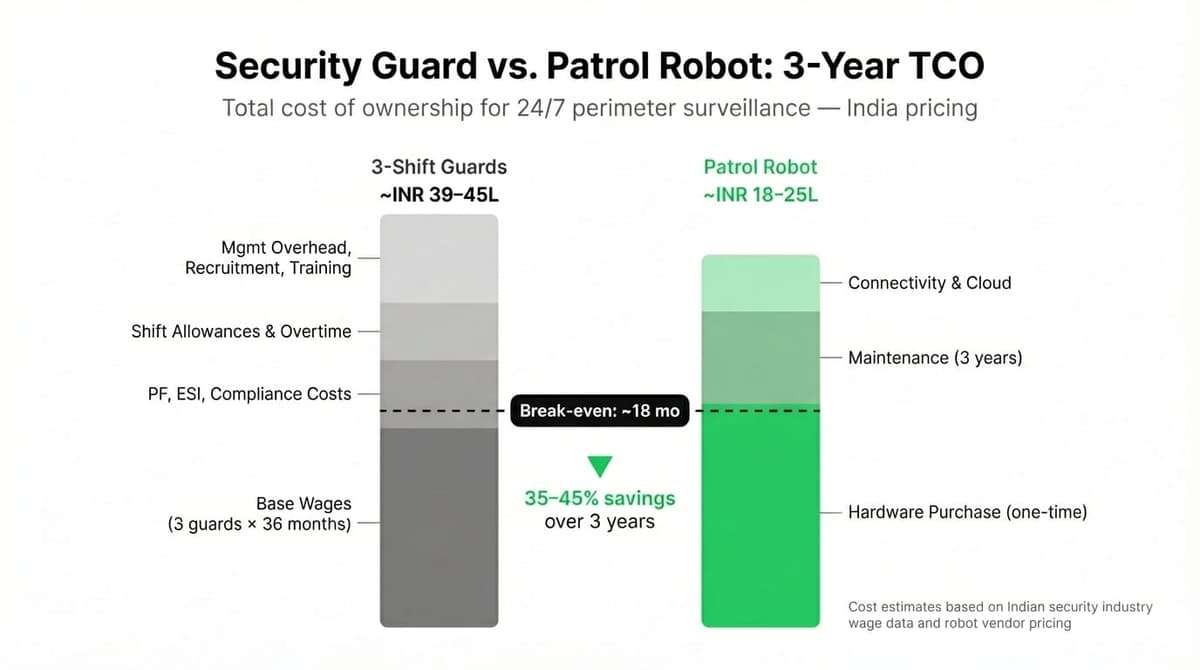
The economics of security robots in India are compelling. A security guard costs INR 15,000–25,000/month (with social costs like PF and ESI, closer to INR 30,000–40,000). A patrol robot operating 24/7 could replace 3–4 guard shifts. The ROI payback is approximately 2–3 years — competitive with many industrial robot applications. Crucially, unlike hospitality robots, security robots don't need to be charming — they need to be reliable, operate in all weather, and provide consistent surveillance.
8. Key India-Specific Dynamics for Service Robotics
8.1 The Labor Cost Paradox
The defining challenge for service robotics in India is the labor cost paradox: India has abundant, low-cost human labor for exactly the tasks that service robots perform. A delivery person, a security guard, a restaurant server, a cleaning staffer, a physiotherapy aide — all can be hired for USD 100–300/month in India.
This makes the ROI calculation for service robots fundamentally different from Japan (where labor is scarce and expensive), South Korea, or Europe. Indian service robots must either:
- 1Cost dramatically less than global products
- 2Provide capabilities humans cannot (24/7 operation without fatigue, hazardous environment operation, perfect consistency)
- 3Serve premium segments where the robot is part of the value proposition (surgical precision, brand experience)
- 4Address genuine labor shortages (skilled surgical teams, geriatric care specialists, 24/7 security coverage)
8.2 The Software and AI Advantage
India's deep bench of software and AI talent creates a unique opportunity in service robotics. Service robots are roughly 70% software and 30% hardware — the inverse of industrial robots. India produces world-class AI/ML engineers who can build perception, navigation, NLP, and decision-making systems. Cloud infrastructure for robot fleet management, data processing, and remote monitoring can leverage India's IT services capability. Companies like Miko have demonstrated that Indian teams can create globally competitive service robot products.
8.3 Regulation and Standards Gaps
India lacks a comprehensive regulatory framework for service robots:
- ●Surgical robots: Regulated under medical device rules (CDSCO), but approval processes are less mature than FDA/CE
- ●Autonomous vehicles/delivery bots: No specific regulation for sidewalk robots; automotive regulation does not cover autonomous delivery vehicles
- ●Drones: DGCA has a drone regulation framework (updated in 2021–2023), but it does not clearly cover ground-based delivery robots
- ●Data privacy: Service robots collect extensive data (video, location, personal interactions); compliance with the Digital Personal Data Protection Act (2023) is an emerging concern
- ●Liability: Who is responsible when a service robot causes injury or property damage? Indian law has not addressed this systematically
9. Key Takeaways
- 1Service robotics will outpace industrial robotics in India — driven by surgical robotics, consumer cleaning robots, elder care/assistive robots, and logistics robots.
- 2SSi Mantra is India's flagship robotics success story. 138+ installations across 11 countries, 7,300+ procedures, USD 42.5M in 2025 revenue. It demonstrates that Indian companies can build world-class robotic platforms.
- 3The surgical robotics market is real and growing. USD 169 Million in 2024, heading to USD 569 Million by 2033. India now has 300+ surgical robots and ~60,000 procedures/year. Multi-vendor competition (da Vinci, SSi Mantra, Meril MIZZO, Medtronic Hugo, CMR Versius, Stryker Mako) is intensifying.
- 4Elder care robotics is the sleeping giant. USD 190 Million in 2025, growing at 15% CAGR. India's 319 million elderly by 2050 and catastrophic geriatric care shortage make this inevitable.
- 5Hospitality and delivery robots face the labor cost barrier. Unlike Japan/Korea, India's abundant low-cost labor makes the ROI case difficult except in niche applications.
- 6Consumer cleaning robots are the volume play. USD 159 Million in 2024, heading to USD 680 Million by 2030. As domestic help becomes harder to find or more expensive in Tier-1 cities, robot vacuums will become mainstream.
- 7India's software/AI strength is a competitive advantage in service robotics — the segment where the technology stack is software-heavy and India has deep talent.
- 8Regulation lags technology. India needs a comprehensive service robot regulatory framework covering safety, data privacy, liability, and autonomous operation.
Closing Thoughts
If the first two installments of this series painted a picture of India's robotics market as factory-first, this article reframes that narrative. Service robotics — surgical systems, elder care robots, consumer cleaning devices, security patrol platforms — is where the revenue scale and the societal impact will be largest. The numbers bear this out: surgical robotics alone is on track for over half a billion dollars by 2033, and the elder care segment is growing at 15% annually into a 319-million-strong demographic reality by 2050.
What makes India's service robotics story distinctive is not just the demand side but the supply side. India's software and AI talent pool — the same engineers building perception systems, NLP pipelines, and cloud infrastructure for global tech companies — can be redirected toward service robot intelligence. SSi Mantra has already proven this: an Indian-designed surgical robot, priced 40–60% below the incumbent, expanding access to Tier-2 cities that were previously shut out. That is not incremental progress. That is the kind of cost-access breakthrough that reshapes markets.
The next installment in this series will shift to logistics and warehouse robotics — examining how India's explosive e-commerce growth, quick-commerce operations, and supply chain modernization are creating a parallel robotics demand curve that sits at the intersection of service and industrial automation.
References & Further Reading
اشترك في مدونتنا
احصل على أحدث الرؤى حول الروبوتات والذكاء الاصطناعي مباشرة في بريدك الإلكتروني.
لا رسائل مزعجة. إلغاء الاشتراك في أي وقت.
You Might Also Like
View all posts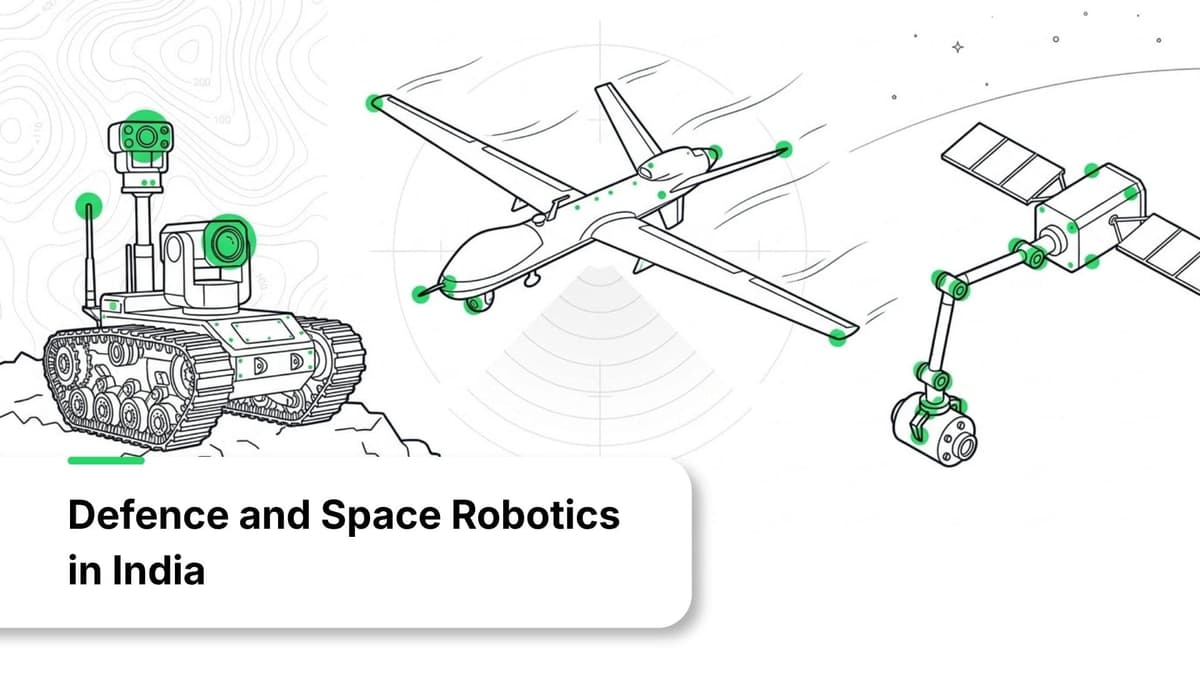
Industry Analysis
Defence and Space Robotics in India
A strategic analysis of India's defence and space robotics ecosystem — military UAVs (IdeaForge, Adani-Elbit Hermes 900, DRDO TAPAS-BH, HAL CATS), unmanned ground vehicles (AeroArc Robotic MULE, Bhairav Robotics Shvana), underwater robotics (DRDO MP-AUVs, EyeROV TUNA), swarm drones, the Atmanirbhar Bharat defence push (1,000+ startups, USD 247M investments in 2025), ISRO's Pragyan lunar rover, SpaDeX robotic arm in space, Vyommitra humanoid for Gaganyaan, and India's 2035 space station roadmap.
Apr 19, 202623 min read
Industry Analysis
Agriculture, Warehouse, and Logistics Robotics in India
A data-driven analysis of India's most distinctive robotics opportunities — agricultural drones (Kisan Drone, Namo Drone Didi, 38,500+ registered drones), warehouse automation (USD 560M market, Addverb, GreyOrange, Unbox Robotics, quick-commerce fulfillment), cold chain robotics, drone delivery, and the farm-to-consumer automation chain.
Apr 9, 202623 min read
Industry Analysis
Industrial Robotics Across Sectors in India: Deep Dive by Industry
A sector-by-sector analysis of industrial robotics adoption in India — automotive, electronics, semiconductor, metals, plastics, pharma, food processing, textiles, and heavy engineering. Where robots are deployed, what's working, and where the next wave comes from.
Mar 30, 202625 min read
هل أنت مستعد لبناء شيء مؤثر؟
دعنا نناقش كيف يمكن لفريقنا المساعدة في تحويل رؤيتك للذكاء الاصطناعي والروبوتات إلى واقع.