Volver al Blog
India Robotics Automation · Part 4 of 9Industry Analysis
Agriculture, Warehouse, and Logistics Robotics in India
This is the fourth installment in our comprehensive research series on robotics automation in India. It covers two domains that represent India's most distinctive robotics opportunities — agriculture (which employs ~42% of India's workforce across 150+ million farms) and warehouse/logistics (which is being reshaped by e-commerce, quick-commerce, and global supply chain shifts). These sectors have fundamentally different adoption dynamics than factory-floor industrial robotics and warrant dedicated analysis.
1. Agricultural Robotics and Drones: India's Fields Meet Technology
1.1 Why Agriculture is Unique for Robotics in India
India's agricultural sector presents a paradox that does not exist in any other major economy:
- ●42% of India's workforce (roughly 250+ million people) works in agriculture
- ●Agriculture contributes only ~17% of GDP — a productivity gap that has persisted for decades
- ●India has ~140+ million landholdings, of which roughly 86% are small and marginal farms (under 2 hectares / 5 acres)
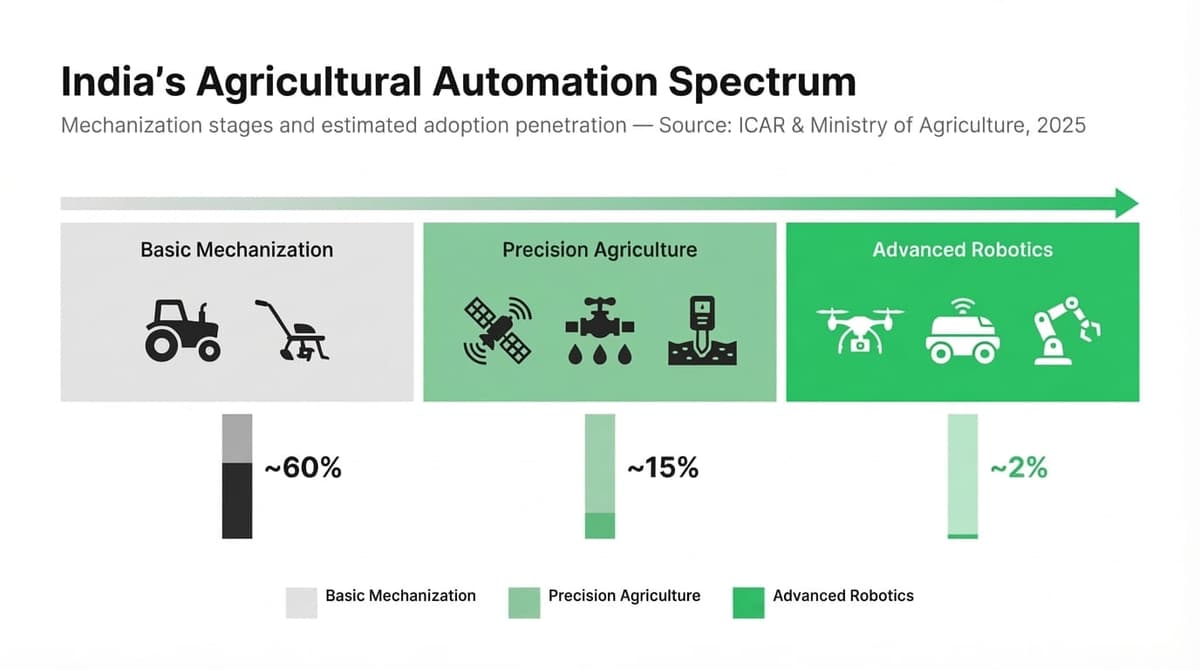
- ●Farm mechanization levels are estimated at only 40–45% (compared to 90%+ in the US, EU, and China's large-scale operations)
These structural characteristics mean that the robotics solutions relevant to Indian agriculture are fundamentally different from the large autonomous tractors and combine harvesters used in American or Australian farming. India needs small, affordable, modular automation that works on fragmented, small-acreage plots with diverse crops and terrain.
1.2 Agricultural Drones: India's Most Visible Agri-Robotics Category
Agricultural drones are by far the most prominent robotics technology being adopted in Indian agriculture. Unlike ground-based robots (which face challenges with India's diverse terrain, irregular field shapes, and fragmented plots), drones can cover any terrain and field geometry.
Market Context:
- ●The global agriculture drone market is projected to grow at a 22.8% CAGR through 2030
- ●India's government Kisan Drone scheme provides 40–50% subsidies on agricultural drone purchases — 50% for agricultural graduates operating CHCs and 40% for other farmers, with up to 90% for SC/ST farmers
- ●The government has allocated INR 6,000+ crore for farm infrastructure and machinery upgrades, including drones
- ●The Sub-Mission on Agricultural Mechanization (SMAM) and the Promotion of Agricultural Mechanization Scheme support drone adoption specifically
- ●As of February 2026, India's drone ecosystem includes 38,500+ DGCA-registered drones and 39,890 certified remote pilots
Key Applications of Drones in Indian Agriculture:
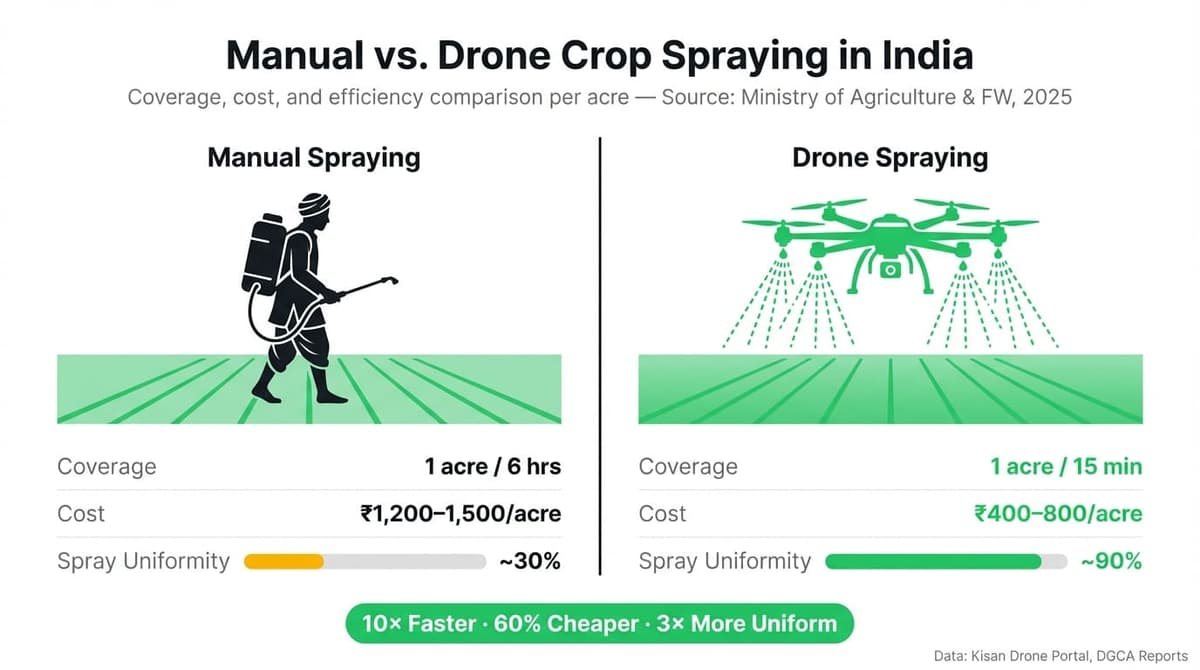
- 1Crop Spraying: The primary use case. Drones reduce pesticide and fertilizer use by up to 40% compared to manual spraying through precision application. They also eliminate sprayer exposure to chemicals — a major health hazard for manual sprayers.
- 2Field Mapping and Monitoring: Multispectral, thermal, and hyperspectral sensors detect crop stress, nutrient deficiencies, and pest infestations before they're visible to the naked eye.
- 3Direct Seeding: Emerging drone models perform aerial seeding, particularly valuable for reforestation projects and hard-to-access hilly terrains.
- 4Yield Estimation: Analyzing crop maturity and growth via drone data allows farmers to predict yields and plan harvests.
- 5Insurance and Disaster Assessment: Drones support crop insurance claim verification by providing objective damage assessment after floods, hailstorms, or droughts.
Key Indian Agricultural Drone Companies:
| Company | Location | Key Products | Notable Features |
|---|---|---|---|
| Marut Drones | Hyderabad | AG 365 multi-utility agri drone | India's 1st multi-utility DGCA-certified agri drone; USD 6.35M total funding (Series A Oct 2024); 140+ employees |
| General Aeronautics | Bengaluru | GA-DK10 | AI-integrated, soil & crop analysis, RTK positioning |
| IoTechWorld Avigation | Gurugram | Agribot | INR 4–5 lakh range, GPS mapping, real-time kinematic |
| Garuda Aerospace | Chennai | Kisan Drone | Automated routes, GPS, real-time imaging; export licenses secured for US, Australia, Middle East; defence drone facility inaugurated Aug 2025 |
| Dhaksha Unmanned Systems | Chennai | Multi-purpose drones | Defense and agriculture dual-use |
| Skylark Drones | Bengaluru | Data processing platform | Focus on analytics and mapping rather than hardware |
Price Range and Accessibility:
| Drone Model | Price Range (INR, 2025) | Payload | Coverage/Hour |
|---|---|---|---|
| DJI Agras T40 | ₹10–12 lakh | 40 kg | 22 acres |
| General Aeronautics GA-DK10 | ₹8–9 lakh | 10 L | 10 acres |
| Marut Agritech S90 | ₹5–6 lakh | 10 L | 7 acres |
| IoTechworld Agribot | ₹4–5 lakh | 10 L | 7 acres |
| Garuda Kisan Drone | ₹6–7 lakh | 10 kg | 8 acres |
| Krishi-Hawk X12 (entry-level) | ₹1.8–2.5 lakh | 2.5 kg | 2.5 acres |
With government subsidies of 40–50%, a farmer or FPO can acquire a functional spraying drone for INR 2–4 lakh — making it accessible for medium-sized farms and cooperative organizations.
1.3 The Custom Hiring Centre (CHC) Model
Recognizing that individual farmers often cannot justify purchasing a drone (even with subsidies), India has embraced the Custom Hiring Centre model:
- ●CHCs are local centers that own agricultural equipment (including drones) and rent them to farmers on a per-acre/per-hour basis
- ●This is effectively a Robotics-as-a-Service (RaaS) model adapted for agriculture
- ●Farmers pay INR 400–800 per acre for drone spraying services — significantly less than owning a drone
- ●The government supports CHC establishment through the Sub-Mission on Agricultural Mechanization (SMAM)
The CHC model is particularly relevant for India because it overcomes the dual barriers of capital cost and technical skill. The CHC operator handles drone operation, maintenance, and regulatory compliance; the farmer simply books the service.
1.4 The Namo Drone Didi Scheme
One of the most innovative government programs is the Namo Drone Didi scheme, which specifically trains rural women (organized through Self-Help Groups / SHGs) to operate agricultural drones:
- ●Launched November 30, 2024, with an allocation of ₹1,261 crore for FY 2025–26
- ●Provides up to 80% subsidy on drone packages (capped at ₹8 lakh per SHG cluster), with remaining financed through the Agriculture Infrastructure Fund at 3% interest support
- ●Targets 15,000 drones distributed to women SHGs across India
- ●Includes a 15-day training program (5 days drone pilot certification + 10 days agriculture application training)
- ●SHGs expected to earn ₹1 lakh+ additional annual income as drone service entrepreneurs
- ●Creates a new income source for rural women as drone service providers, combining gender empowerment with agricultural technology adoption
This scheme represents a uniquely Indian approach to technology adoption — using existing social infrastructure (SHGs) to distribute new technology rather than relying solely on market mechanisms.
1.5 Ground-Based Agricultural Robots: Early Stage
Beyond drones, ground-based agricultural robots are in much earlier stages in India:
Autonomous/Semi-Autonomous Tractors:
- ●Mahindra, TAFE, and Escorts (now Kubota India) have been developing GPS-guided tractor capabilities
- ●Full autonomy remains impractical for most Indian farms due to small field sizes, irregular plot shapes, and mixed-use landscapes
- ●Semi-autonomous features (auto-steering, GPS-guided rows) are more realistic near-term applications
Weeding and Harvesting Robots:
- ●Globally, companies like Naïo Technologies, FarmWise, and Carbon Robotics build specialized weeding/harvesting robots
- ●In India, this category is almost entirely in the research phase (IIT Kharagpur, IARI research projects)
- ●The fundamental challenge is India's crop diversity — a single district may grow 10–20 different crops, each requiring different robot configurations
Precision Irrigation:
- ●IoT-based precision irrigation systems (sensor-controlled drip irrigation, soil moisture monitoring) represent a form of automation gaining traction
- ●Companies like Fasal, CropIn, and Jain Irrigation integrate sensor data with automated irrigation control
- ●While not "robots" in the traditional sense, these systems represent the same automation principles applied to agriculture
1.6 Challenges Specific to Indian Agricultural Robotics
- 1Land fragmentation: Average farm size of 1.08 hectares (2.67 acres) makes many robotic solutions designed for large farms irrelevant
- 2Infrastructure: Lack of reliable electricity, internet connectivity, and GPS accuracy in rural areas limits IoT-connected robotics
- 3Crop diversity: India grows 600+ crop varieties; robots designed for single-crop monoculture are of limited use
- 4Affordability: Farmer incomes average INR 10,000–15,000/month; payback periods must be very short for adoption
- 5Digital literacy: Many farmers lack the technical skills to operate digital platforms, let alone configure robots
- 6Regulatory gaps: Drone operations in agricultural areas (near power lines, populated areas, controlled airspace) face regulatory complexity
2. Warehouse and Logistics Robotics: India's Automation Sweet Spot
2.1 Market Size and Growth
India's warehouse automation market represents one of the most dynamic segments in the entire robotics landscape:
- ●2025 Market Size: USD 560 Million
- ●2026 Projected: USD 659.96 Million
- ●2031 Projected: USD 1.5 Billion
- ●CAGR (2026–2031): 17.84%
Key Market Breakdown (2025):
| Segment | Market Share / Metric | Notes |
|---|---|---|
| Hardware | 60.55% of revenue | Conveyors, shuttle racks, robotic arms |
| Software | Fastest growth (27.4% CAGR) | WMS, digital twins, AI engines |
| Picking & Sorting | 34.1% by function | Largest operational application |
| E-commerce & 3PL | 35.1% by end-user | Dominant demand driver |
| Pharma & Healthcare | Fastest growing end-user (26.8% CAGR) | Compliance-driven adoption |
| Semi-automated | 48.6% by automation level | Bridging manual-to-robotic transition |
| Fully automated | Fastest growing (27.1% CAGR) | Leading in pharma, cold chain |
Source: Mordor Intelligence, January 2026
2.2 Why Warehousing is India's Automation Sweet Spot
Several factors make warehouse automation particularly compelling in India compared to other robotics segments:
1. Quick-Commerce Revolution: India's quick-commerce market size stands at USD 3.65 billion in 2026 (Mordor Intelligence) and is forecast to reach USD 6.64 billion by 2031. Led by Blinkit (50%+ market share as of September 2025), Zepto, Swiggy Instamart, and the rapidly scaling Flipkart Minutes, the sector has opened 1,200+ dark stores across the top-20 cities. Sub-10-minute fulfillment accounts for 62% of orders. These operations process thousands of orders per hour from facilities of 3,000–10,000 sq ft in dense urban areas. Manual picking and packing at this speed is nearly impossible; automation is an operational necessity, not an optimization.
2. E-Commerce Scale: India's e-commerce market reached USD 159.25 billion in 2026 (Mordor Intelligence, Jan 2026), projected to reach USD 332.94 billion by 2031 at 15.89% CAGR. Amazon India, Flipkart (Walmart), Meesho, and JioMart operate networks of large fulfillment centers where the volume justifies AMRs, sortation systems, and automated storage.
3. GST-Led Consolidation: The Goods and Services Tax (GST), implemented in 2017, eliminated the incentive for companies to maintain small warehouses in every state (to avoid inter-state tax). This has driven consolidation into larger, centralized warehouses — which are economically viable for automation.
4. Labor Economics are Favorable (Unlike Manufacturing): While manufacturing labor in India costs USD 100–300/month, warehouse workers in Tier-1 logistics hubs (Bhiwandi, Sriperumbudur, Bilaspur) earn INR 15,000–25,000/month with significant overtime, plus benefits, turnover costs, and training expenses. Annual attrition rates in warehousing can reach 50–80%. At these effective labor costs, the ROI for AMRs and sortation systems is often 18–24 months.
5. Rising Wage Inflation in Logistics: Wage inflation in Tier-1 logistics hubs is running at 8–12% annually, tightening the payback window for automation investments each year.
2.3 Addverb Technologies: India's Warehouse Robotics Champion
Addverb Technologies is the most significant Indian-origin robotics company in warehouse automation and arguably the single most important Indian robotics company overall:
Company Profile:
- ●Founded: 2016 by Sangeet Kumar and Satish Shukla in Noida, Uttar Pradesh
- ●Funding: Reliance Retail acquired a 54% stake with a USD 132 Million investment (January 2022) — one of the largest single investments in an Indian robotics company, valuing the company at USD 265–270 Million
- ●Products exported to: 25+ countries
- ●Revenue target: ₹800 crore for FY 2025–26
- ●Employees: ~900+ (as of early 2025)
Product Portfolio:
| Product | Type | Application |
|---|---|---|
| Dynamo | Autonomous Mobile Robot (AMR) | Goods-to-person material transport |
| Zippy | Robotic Sorter | Package/parcel sortation |
| Veloce | Multi-carton picking robot | Multi-item order fulfillment |
| Atom | Sortation Robot | High-speed package sorting |
| Cruiser 360 | Pallet Shuttle | High-density pallet storage/retrieval |
| FlowT | Autonomous Forklift | Automated pallet movement |
| Trakr | Quadruped Robot | Inspection and patrol in industrial environments |
| Elixis-W | Wheeled Humanoid Robot | Autonomous operation in unstructured industrial environments |
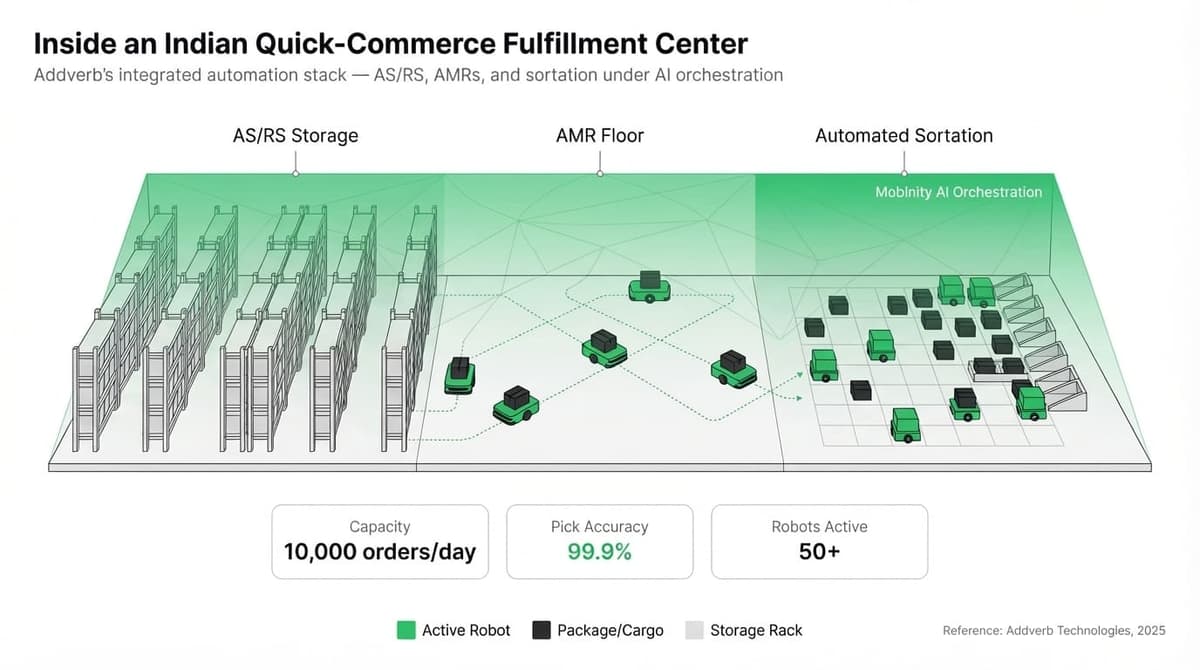
| Mobinity | Software (AI Orchestration) | Fleet management for multi-vendor robots |
| Optimus | WMS Software | Warehouse management integration |
Strategic Significance:
- ●Addverb's USD 132M investment from Reliance Retail signals that India's largest retailer views warehouse automation as critical infrastructure
- ●The company has entered humanoid robotics — unveiling Elixis-W (a Made-in-India wheeled humanoid) at LogiMAT India 2026 (February 2026), designed for autonomous operation in unstructured industrial environments and human collaboration. The company expects ₹800 crore in revenue and projects 20% growth from humanoid product additions
- ●Addverb's Atom sortation robot is exported to over 25 countries, demonstrating that Indian warehouse robotics companies can compete globally
- ●The company brings AI and edge computing to warehouse robotics, building homegrown technology
- ●Addverb operates one of the largest robotics manufacturing facilities in India — robots are designed and substantially manufactured domestically, not merely assembled from imported components
Key Insight:
Addverb Technologies — with USD 132M from Reliance, products in 25+ countries, a domestic manufacturing base, and ambitions in humanoid robotics — is arguably India's most important robotics company. Like SSi Mantra in surgical robotics, Addverb proves Indian companies can build globally competitive robotic platforms.
2.4 Other Major Players in Indian Warehouse Robotics
GreyOrange:
- ●Founded in India in 2012 (now headquartered in Suwanee, Georgia, USA)
- ●Total funding: USD 545M across 9 rounds (latest: Series D, December 2023)
- ●Developed the Butler goods-to-person system — one of the most deployed warehouse robots globally
- ●1,051 employees globally (as of March 2026), with 586 in India
- ●India remains a key market, with deployments at major e-commerce and 3PL clients
Unbox Robotics:
- ●Pune-based startup developing UnboxSort — a patented AI-powered robotic sorting system using swarm intelligence and ML algorithms for parcels and packages
- ●Raised USD 28 million in Series B funding (January 2026) led by ICICI Venture, with participation from RedStart Labs, F-Prime, 3one4 Capital, and others — total funding USD 28.2M across 10 rounds
- ●Operates across India, Europe, and the US in e-commerce, retail, and logistics
- ●Key differentiation: designed specifically for the Indian/South Asian package sorting environment (variable package sizes, high volumes); rapid installation in under two weeks
Global Players Localizing in India:
- ●Daifuku (Japan): Launched a manufacturing plant in Maharashtra in April 2025, trimming import duties and cutting lead times by 30%
- ●Swisslog: Partnering with Indian civil contractors for turnkey carton shuttle installations
- ●Honeywell Intelligrated: Bundling IoT sensors with WMS connectors for data-driven 3PL operations
2.5 The Competitive Landscape
The market is moderately fragmented:
- ●The top 5 vendors (Addverb, GreyOrange, Daifuku, Swisslog, Honeywell Intelligrated) held roughly 31% of 2025 revenue combined
- ●Domestic companies like Alligator Automations, Alstrut India, Armstrong Machine Builders, and Clearpack India serve specific niches
- ●The competition is increasingly about software and AI orchestration rather than hardware alone — vendors pitch AI-augmented orchestration layers that unify AS/RS, AMRs, and yard-management under one UI
- ●Flexible pricing (pay-per-pick, revenue-sharing) is widening SME access to warehouse automation
2.6 Quick-Commerce: The Killer Application
India's quick-commerce sector deserves special attention because it creates a robotics demand profile that is unique globally:
10-Minute Delivery Economics:
- ●Companies like Blinkit (Zomato), Zepto, Swiggy Instamart, and the fast-growing Flipkart Minutes promise 10–30 minute delivery from dark stores (micro-fulfillment centers)
- ●A typical dark store processes 1,000–5,000 orders per day from a 3,000–10,000 sq ft facility
- ●This requires picking speeds of 200+ items/hour per picker — approaching the limits of human capability without technological assistance
- ●AMRs, put-to-light systems, and automated sortation enable these throughput rates
Dark Store Automation:
- ●Current dark store automation is primarily semi-automated — humans pick items guided by handheld devices, with AMRs handling transport between picking zones and packing stations
- ●Full automation (automated picking of groceries, fresh produce, and varied SKUs) remains technically challenging due to product diversity and fragility
- ●The evolution path: manual → pick-assist AMRs → automated replenishment → partial automated picking → full automation
This is analogous to how automotive manufacturing evolved from fully manual to fully robotic over decades — quick-commerce may follow a similar trajectory on a compressed timeline.
2.7 Third-Party Logistics (3PL) Automation
India's 3PL industry is professionalizing rapidly, with companies investing in automation:
| 3PL Company | Automation Investments | Scale |
|---|---|---|
| Delhivery | Automated sortation hubs, AMRs | Largest private express parcel delivery network |
| Flipkart Supply Chain (Ekart) | Robotic sortation, goods-to-person | Pan-India fulfillment network |
| Amazon India | Automated fulfillment centers, AMRs, sortation | Multiple large FCs across India |
| Blue Dart / DHL | Automated package handling, sortation | Express logistics |
| Rivigo / Ecom Express | Semi-automated hub operations | E-commerce-focused last-mile |
2.8 Cold Chain Robotics
India's cold chain infrastructure — critical for food safety, pharmaceutical distribution, and vaccine supply — represents a growing niche for warehouse robotics:
- ●Cold chain warehouses (operating at -20°C to +4°C) create uncomfortable and low-productivity conditions for human workers
- ●Robotic systems (AMRs, robotic palletizers, automated storage) that operate in cold environments improve both throughput and worker welfare
- ●The National Cold Chain Development Plan is driving expansion of cold storage infrastructure — creating new greenfield facilities where automation can be designed in from the start
- ●Pharmaceutical cold chain compliance (GDP — Good Distribution Practices) increasingly requires automated tracking and documentation
3. Drone Delivery and Logistics
3.1 Beyond Agriculture: Drone Delivery
While agricultural drones are the primary drone application in India, drone delivery is an emerging category:
Medical and Emergency Delivery:
- ●The government has piloted drone delivery of medicines and vaccines to remote areas
- ●Companies like Marut Drones have developed Healthcare Logistics Drones specifically for medicine delivery
- ●ICMR and state health departments have experimented with drone delivery of blood samples and lab supplies in hilly states (Meghalaya, Uttarakhand, Himachal Pradesh)
Commercial Delivery:
- ●Dunzo (now Swiggy) piloted drone delivery in select Indian cities
- ●Swiggy has tested drone delivery for food from nearby restaurants
- ●Regulatory constraints (DGCA airspace regulations, urban flying restrictions) limit commercial drone delivery to controlled pilots rather than scale operations
3.2 Drone Regulations in India
India's drone regulatory framework has evolved significantly:
- ●2021: Liberalized Drone Rules simplified registration and operation; PLI scheme for drones and drone components approved (INR 120 crore outlay over FY 2021–24)
- ●2022: DGCA Drone Certification Scheme (DCS) established type certification requirements
- ●2023: PLI incentive disbursements for qualifying manufacturers at 20% of value addition
- ●2025: Draft Civil Drone (Promotion and Regulation) Bill released (September 2025) — proposing standalone legislation for civil UAS under 500 kg
- ●Remote Pilot Certificate (RPC) is mandatory for commercial drone operations; 39,890 DGCA-certified pilots and 60+ approved training schools as of February 2026
- ●BVLOS (Beyond Visual Line of Sight) operations — essential for large-scale agricultural and delivery applications — are being gradually permitted with safety requirements
- ●As of February 2026: 38,500+ registered drones (UIN) in India's regulated ecosystem (PIB)
4. Last-Mile and Sidewalk Delivery Robots
4.1 Current State in India
Autonomous last-mile delivery robots (sidewalk bots) have been deployed in controlled environments globally (Starship Technologies in US/Europe, Amazon Scout). In India:
- ●No company has achieved commercial-scale sidewalk delivery robot operations
- ●Challenges are immense: Indian sidewalks are crowded, uneven, or non-existent; traffic is chaotic; stray animals and pedestrians create unpredictable environments
- ●The delivery ecosystem relies on gig economy workers (Zomato, Swiggy delivery partners) earning INR 15,000–25,000/month — making robots a hard sell on cost alone
4.2 Where Autonomous Delivery Works in India
Limited-environment autonomous delivery is finding some traction:
- ●Corporate campuses: Large IT parks (Infosys, TCS, Wipro campuses) where roads are controlled and traffic is limited
- ●Hospital complexes: Automated trolleys/AGVs for internal logistics
- ●Hotel resorts: Room service delivery in large resort properties
- ●University campuses: Controlled pilot environments for testing
5. Integration and Cross-Domain Opportunities
5.1 Farm-to-Warehouse-to-Consumer Automation
The most powerful vision for India is an integrated automation chain connecting:
- 1Farm: Drone-based crop monitoring → precision spraying → yield estimation
- 2Post-Harvest: Automated sorting, grading, and packaging at farm-gate collection centers
- 3Cold Chain: Robotic palletizing and automated cold storage
- 4Warehouse: AMR-enabled goods-to-person picking and automated sortation
- 5Last-Mile: Efficient route optimization (if not yet autonomous delivery)
Each link in this chain exists independently in India today. The opportunity lies in integrating them, using IoT, data platforms, and AI to create seamless visibility and automation across the supply chain — from field to consumer.
5.2 The Data Backbone
Both agriculture and logistics robotics depend on a data infrastructure that India is actively building:
- ●AgriStack: Government's digital agriculture initiative creating a federated database of farmers, land records, and crop data
- ●ONDC (Open Network for Digital Commerce): Government-backed open protocol for digital commerce that standardizes logistics data exchange
- ●DigiLocker / ULIP: Unified Logistics Interface Platform connecting logistics stakeholders
These platforms, while not robotics per se, create the data backbone that makes robotic systems more intelligent and useful.
6. Key Takeaways
- 1Agricultural drones are India's most adopted robotic technology in agriculture — driven by 40–50% government subsidies (up to 90% for SC/ST), 38,500+ registered drones, multiple drone companies (Marut, Garuda, General Aeronautics, IoTechWorld), the Custom Hiring Centre model, and the ₹1,261-crore Namo Drone Didi scheme.
- 2Ground-based agricultural robots are years away from meaningful adoption in India due to land fragmentation, crop diversity, and cost constraints. The path is drones first, then IoT-connected precision systems, then robots.
- 3Warehouse automation is India's "sweet spot" for robotics. USD 560M market in 2025 (Mordor Intelligence), growing at 17.8% CAGR to USD 1.5B by 2031, driven by quick-commerce (USD 3.65B in 2026, led by Blinkit with 50%+ share), e-commerce (USD 159B in 2026), and 3PL professionalization.
- 4Addverb Technologies is India's most important robotics company. USD 132M Reliance investment (54% stake, USD 265–270M valuation), products exported to 25+ countries, ₹800 crore revenue target, manufacturing in India, and the Elixis-W humanoid unveiled at LogiMAT India 2026.
- 5Quick-commerce creates uniquely Indian demand. 10-minute delivery from 1,200+ dark stores requires automation levels that don't exist in traditional warehousing. Flipkart Minutes has joined Blinkit, Zepto, and Swiggy Instamart — making this India's most competitive automation frontier.
- 6The semi-automated middle ground is where most adoption happens. 48.6% of warehouse automation in India is semi-automated, bridging the gap between manual operations and full robotics. This pragmatic approach matches India's capital and skill constraints.
- 7Software is the high-growth segment — growing at 27.4% CAGR vs. hardware's established base. AI orchestration, digital twins, and WMS platforms are where future value will concentrate.
Closing Thoughts
If the previous installments examined robotics where it is most visible — factory floors and hospital operating rooms — this article covers where India's robotics opportunity is most distinctive. Two hundred and fifty million agricultural workers on 140 million fragmented farms. A quick-commerce ecosystem demanding 10-minute delivery from micro-fulfillment centers. The structural dynamics are unlike any other major economy.
Agricultural drones are the clearest early success — government subsidies (up to 90% for SC/ST farmers), the Custom Hiring Centre model, and the ₹1,261-crore Namo Drone Didi scheme have created an adoption pathway that works with India's realities rather than against them. With 38,500+ registered drones and nearly 40,000 certified pilots as of February 2026, the ecosystem is maturing rapidly. Ground-based agricultural robots remain a distant prospect. The parallel story in warehouse automation is different: here, Addverb Technologies (₹800 crore revenue target, Elixis-W humanoid), GreyOrange (USD 545M funded), and Unbox Robotics (USD 28M Series B) have built globally competitive platforms. Quick-commerce — now a USD 3.65 billion market with 1,200+ dark stores — is creating demand that cannot be met without automation, and the economics are increasingly favorable as warehouse wages climb 8–12% annually.
The next installment in this series will examine defence and space robotics — where sovereignty, national prestige, and strategic necessity drive adoption dynamics that are fundamentally different from commercial markets.
References & Further Reading
Suscríbete a nuestro Blog
Recibe las últimas novedades sobre robótica e IA en tu correo.
Sin spam. Cancela cuando quieras.
You Might Also Like
View all posts
Industry Analysis
The State of Robotics Automation in India: Market Overview and Global Position
A comprehensive data-driven analysis of India's robotics market — market size, growth trajectory, global positioning, robot density gap, sectoral composition, key players, government policy, and structural challenges as of early 2026.
Mar 8, 202626 min read
Industry Analysis
Industrial Robotics Across Sectors in India: Deep Dive by Industry
A sector-by-sector analysis of industrial robotics adoption in India — automotive, electronics, semiconductor, metals, plastics, pharma, food processing, textiles, and heavy engineering. Where robots are deployed, what's working, and where the next wave comes from.
Mar 30, 202625 min read
Industry Analysis
Defence and Space Robotics in India
A strategic analysis of India's defence and space robotics ecosystem — military UAVs (IdeaForge, Adani-Elbit Hermes 900, DRDO TAPAS-BH, HAL CATS), unmanned ground vehicles (AeroArc Robotic MULE, Bhairav Robotics Shvana), underwater robotics (DRDO MP-AUVs, EyeROV TUNA), swarm drones, the Atmanirbhar Bharat defence push (1,000+ startups, USD 247M investments in 2025), ISRO's Pragyan lunar rover, SpaDeX robotic arm in space, Vyommitra humanoid for Gaganyaan, and India's 2035 space station roadmap.
Apr 19, 202623 min read
¿Listo para Construir Algo con Impacto?
Hablemos sobre cómo nuestro equipo puede ayudar a hacer realidad su visión de IA y robótica.