ブログに戻る
Computer Vision Models for Industry · Part 5 of 6Computer Vision
The Industry Playbook: Choosing the Right Computer Vision Model for Your Business
After four posts dissecting architectures, transformer innovations, foundation models, and benchmark methodologies, we arrive at the question that matters most: Which model should you actually deploy?
The answer is never universal. A model that excels in manufacturing quality control may struggle in retail environments. A solution perfect for autonomous vehicles may be wildly inappropriate for agricultural monitoring. This guide translates technical capabilities into industry-specific recommendations, providing decision frameworks for practitioners across six major sectors.
Key Insight:
The best model isn't the one with the highest benchmark score—it's the one that best matches your operational constraints, data characteristics, and business requirements.
The Model Selection Framework
Before diving into industry-specific recommendations, let's establish the evaluation criteria that consistently drive model selection decisions.
Critical Decision Factors
| Factor | Questions to Ask | Why It Matters |
|---|---|---|
| Latency requirements | What's the maximum acceptable inference time? | Real-time applications (autonomous driving, surgical assistance) demand sub-100ms inference |
| Accuracy threshold | What's the cost of a false positive vs. false negative? | Medical diagnostics penalize false negatives heavily; quality control may penalize false positives |
| Edge vs. cloud | Where will inference run? | Edge deployment constrains model size; cloud enables larger models but adds network latency |
| Data availability | How much labeled training data exists? | Limited data favors foundation models with strong transfer learning |
| Class vocabulary | Are detection classes fixed or dynamic? | Dynamic classes require open-vocabulary models like YOLO-World or Grounding DINO |
| Integration complexity | What's the engineering capacity for deployment? | Simpler architectures reduce integration risk and maintenance burden |
The Speed-Accuracy-Flexibility Triangle
Every model represents a trade-off between three competing priorities:
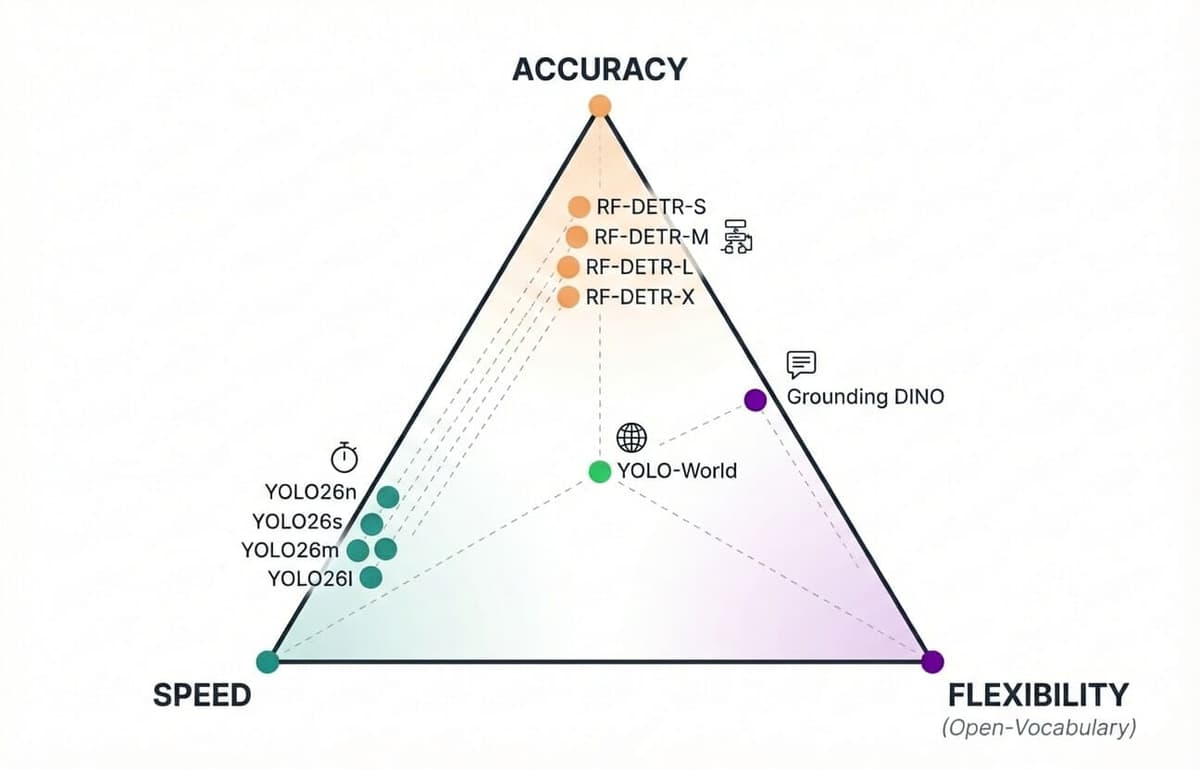
- ●YOLO26 variants: Optimize for speed and accuracy; fixed vocabulary
- ●RF-DETR variants: Optimize for accuracy and flexibility; moderate speed
- ●YOLO-World: Balances speed and flexibility; moderate accuracy
- ●Grounding DINO: Maximizes flexibility and accuracy; lower speed
Understanding where your application falls on this triangle guides model selection.
Manufacturing and Industrial Quality Control
Manufacturing environments demand reliability, consistency, and integration with existing production systems. The stakes are high: a missed defect costs money; a false positive disrupts production.
Defect Detection and Quality Inspection
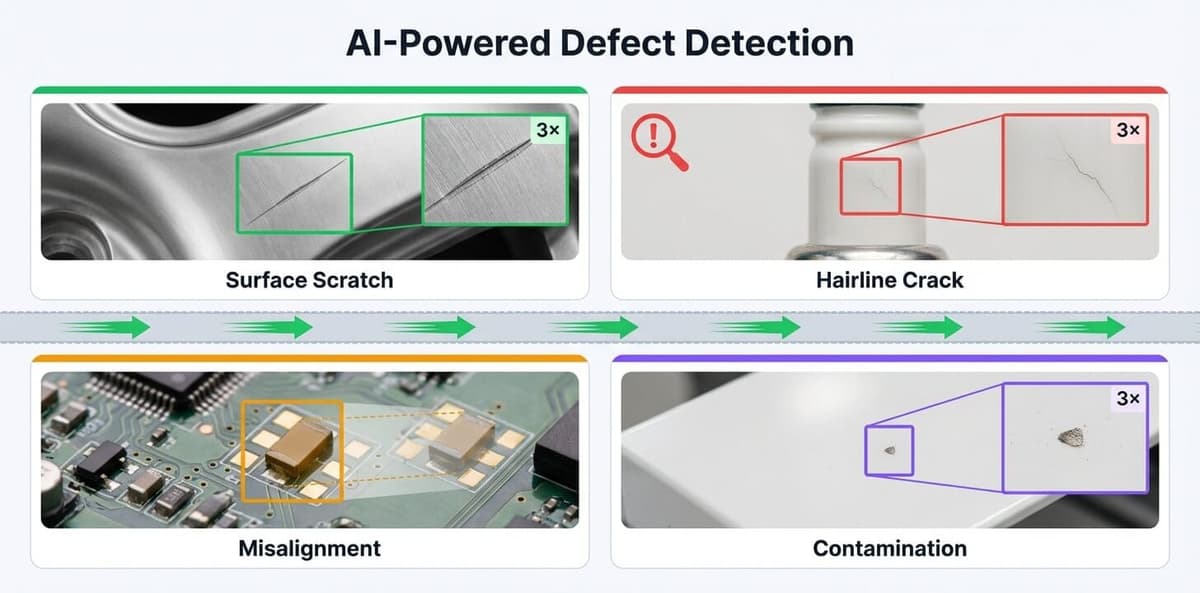
The Challenge: Identifying scratches, cracks, misalignments, and surface anomalies across high-speed production lines, often with subtle visual differences between acceptable and defective products.
Key Requirements:
- ●Sub-100ms inference to match line speeds (often 60+ units/minute)
- ●Extremely high precision to minimize false alarms
- ●Robustness to lighting variations and camera positioning changes
- ●Integration with programmable logic controllers (PLCs) and manufacturing execution systems (MES)
Recommended Models:
| Priority | Model | Performance | Rationale |
|---|---|---|---|
| Balanced | YOLO26m | 51.5% mAP @ 4.7ms GPU | Optimal accuracy-speed balance for most production lines |
| Maximum accuracy | RF-DETR-B | 53.3% mAP @ 4.5ms | Transformer attention captures subtle defect patterns; DINOv2 backbone excels on textured surfaces |
| Edge deployment | YOLO26s | 47.0% mAP @ 2.5ms | Runs efficiently on NVIDIA Jetson Orin; enables camera-local processing |
Real-World Evidence: A 2025 study published in Procedia CIRP demonstrated YOLOv8 achieving 97.2% mAP50 and 64.7% mAP50-95 on assembly line defect detection, with the larger model variant providing only 2.6–3.8% improvement in mAP50-95 at 3× the training time—illustrating that larger isn't always better for industrial applications.
Implementation Considerations:
- 1Lighting standardization: Industrial vision systems typically use controlled lighting (ring lights, backlighting) rather than ambient illumination. Models trained on natural images may require significant fine-tuning.
- 2Class imbalance handling: Defective products are typically rare (0.1–5% of production). Use focal loss or class-weighted sampling during training.
- 3Multi-camera fusion: Production lines often require 3–6 cameras per inspection station. Consider parallel inference across cameras with centralized decision logic.
# Example defect detection configuration for production line
model_config = {
  "model": "yolo26m",
  "imgsz": 640,
  "conf_threshold": 0.7,  # High threshold for precision
  "iou_threshold": 0.5,
  "classes": ["scratch", "crack", "dent", "misalignment", "contamination"],
  "device": "cuda:0",
  "half": True  # FP16 for production speed
}
PPE (Personal Protective Equipment) Compliance
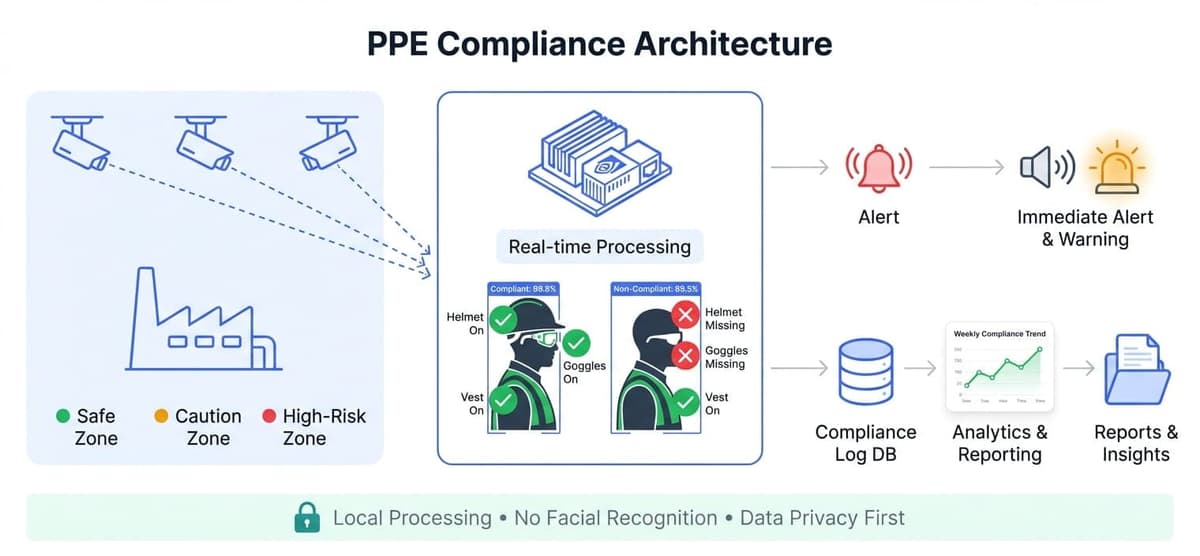
The Challenge: Ensuring workers wear required safety equipment—hard hats, safety vests, goggles, gloves—in real-time, with immediate alerting for violations.
Key Requirements:
- ●Person detection with PPE attribute classification
- ●Real-time video processing (15–30 FPS minimum)
- ●Privacy considerations (avoid facial recognition)
- ●Outdoor and indoor operation
Recommended Models:
| Priority | Model | Rationale |
|---|---|---|
| Standard deployment | YOLO26m | Strong person and object detection; 4.7ms GPU latency supports multi-camera processing |
| Pose-based detection | YOLO26m-pose | Keypoint detection enables checking whether protective equipment is worn correctly (e.g., helmet on head, not in hand) |
| Dynamic PPE types | YOLO-World | Zero-shot detection for varying PPE requirements across different work zones |
Research Validation: A 2024 Taylor & Francis study found YOLOv8x and YOLOv8l excelled in PPE detection, particularly for person and vest categories, with the larger models providing meaningful accuracy improvements for safety-critical applications.
Privacy-Preserving Design:
- ●Process frames locally; transmit only detection metadata
- ●Blur faces in any stored imagery
- ●Configure person bounding boxes only, not individual identification
- ●Aggregate statistics rather than tracking individuals
Assembly Verification
The Challenge: Confirming all components are present and correctly positioned before products proceed to the next production stage.
Recommended Models:
| Priority | Model | Rationale |
|---|---|---|
| Best accuracy | RF-DETR-L | 56.5% mAP @ 6.8ms; attention mechanism handles complex spatial relationships between parts |
| With segmentation | RF-DETR-Seg-L | Precise boundary detection for verifying component fit and alignment |
| Fast verification | YOLO26s | 2.5ms latency enables integration into high-speed pick-and-place cycles |
Deployment Pattern: Two-stage verification is common:
- 1Fast check: YOLO26s confirms expected number of components detected
- 2Detailed verification: RF-DETR-L validates spatial arrangement only when fast check passes
Healthcare and Medical Imaging
Healthcare applications face unique constraints: regulatory requirements (FDA, CE marking), interpretability demands, and zero tolerance for errors that could harm patients.
Radiology and Diagnostic Imaging
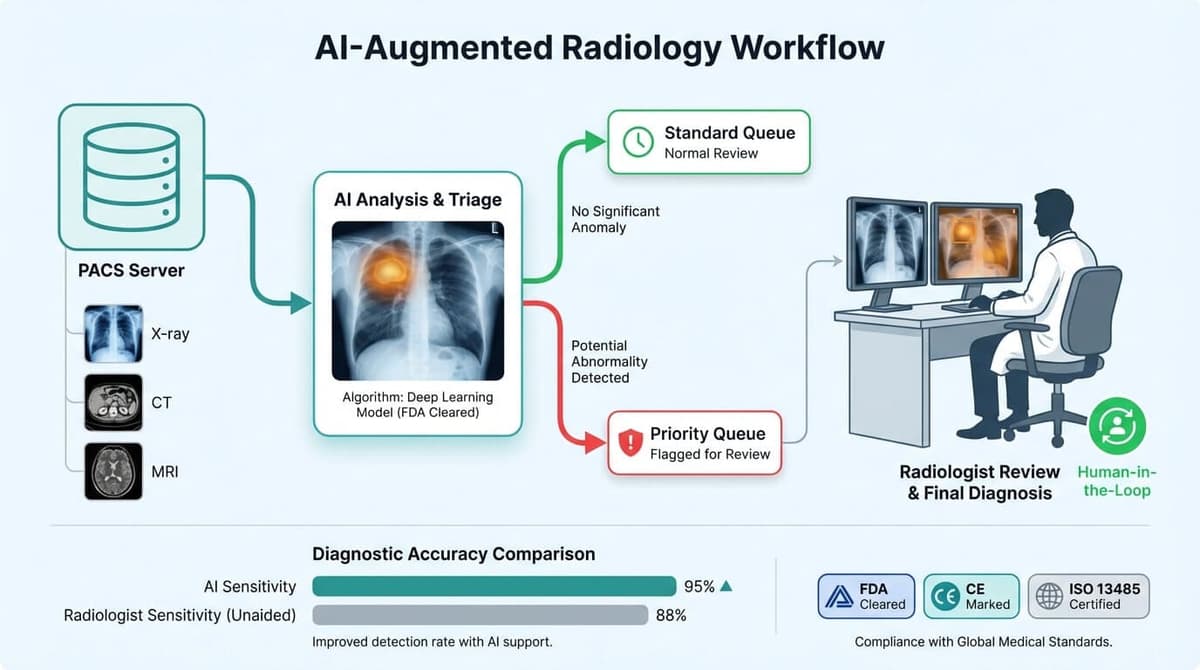
The Challenge: Detecting abnormalities in X-rays, CT scans, and MRIs while maintaining high sensitivity (catching true positives) and providing interpretable results for clinicians.
Recommended Models:
| Priority | Model | Rationale |
|---|---|---|
| Best accuracy | RF-DETR-L | DINOv2 backbone trained on diverse imagery transfers exceptionally well to medical domains; attention maps provide interpretability |
| Balanced | YOLOv9-C | Strong performance with cross-stage partial networks; smaller than RF-DETR for faster iteration |
| Rare findings | Grounding DINO | Zero-shot capability enables detection of unusual presentations described in text |
Clinical Evidence: A comprehensive review in PMC (2024) documented AI systems achieving AUROC of 0.91 for prostate cancer detection on MRI—outperforming radiologists' 0.86—and detecting 6.8% more significant cancers at equal specificity. For lung nodule detection, systematic reviews show AI models achieving 86–98% sensitivity compared to radiologist baselines of 68–76%, with Qure.ai's qXR-LN demonstrating 83.5% sensitivity in multi-center studies.
Critical Implementation Notes:
- 1Regulatory pathway: Medical device classification typically requires clinical validation studies, quality management system (ISO 13485), 510(k) clearance (US) or CE marking (EU), and post-market surveillance.
- 2Interpretability requirements: Clinicians need to understand why a model flagged a region. Transformer attention maps provide this naturally.
- 3Bias considerations: Medical AI models must be validated across diverse patient populations to ensure equitable performance across demographics.
# Extracting attention for interpretability
import torch

def get_attention_maps(model, image):
  """Extract attention maps for clinical interpretability."""
  hooks = []
  attention_maps = []

  def hook_fn(module, input, output):
      # Capture attention weights from transformer layers
      if hasattr(output, 'attentions'):
          attention_maps.append(output.attentions)

  # Register hooks on attention layers
  for layer in model.encoder.layers:
      hooks.append(layer.self_attn.register_forward_hook(hook_fn))

  with torch.no_grad():
      output = model(image)

  # Clean up hooks
  for hook in hooks:
      hook.remove()

  return attention_maps
Surgical Assistance and Instrument Tracking
The Challenge: Real-time tracking of surgical instruments, anatomy, and surgeon movements during procedures.
Recommended Models:
| Application | Model | Rationale |
|---|---|---|
| Instrument tracking | YOLO26m + ByteTrack | Detection + tracking pipeline; ByteTrack handles occlusions effectively through two-stage association |
| Anatomy segmentation | RF-DETR-Seg-M | Precise boundary delineation for surgical planning overlays |
| Real-time guidance | YOLO26s | Minimal latency for augmented reality overlays |
Tracking Pipeline: ByteTrack, presented at ECCV 2022, uses a two-step matching algorithm that recovers both high and low-confidence detections, making it ideal for surgical scenarios where instruments may be partially occluded.
# Surgical instrument tracking configuration
from ultralytics import YOLO

model = YOLO("yolo26m.pt")
results = model.track(
  source="surgical_video.mp4",
  tracker="bytetrack.yaml",
  persist=True,
  conf=0.3,  # Lower threshold for recall
  iou=0.5
)
Pathology and Cell Analysis
The Challenge: Analyzing histopathology slides containing thousands of cells, detecting anomalies, and providing quantitative measurements.
Recommended Models:
| Priority | Model | Rationale |
|---|---|---|
| Cell detection | RF-DETR-B | Strong small object detection; handles dense cell populations |
| Segmentation | RF-DETR-Seg-M | Precise cell boundary delineation for morphological analysis |
| Tiled processing | YOLO26n | Efficient processing of tiled WSI regions on GPU |
Whole-Slide Processing Strategy:
def process_whole_slide(wsi_path, model, tile_size=1024, overlap=256):
  """Process gigapixel whole-slide image through tiled inference."""
  import openslide

  slide = openslide.OpenSlide(wsi_path)
  width, height = slide.dimensions

  all_detections = []

  for y in range(0, height, tile_size - overlap):
      for x in range(0, width, tile_size - overlap):
          # Extract tile
          tile = slide.read_region((x, y), 0, (tile_size, tile_size))
          tile = tile.convert('RGB')

          # Run inference
          results = model(tile)

          # Adjust coordinates to global space
          for det in results[0].boxes:
              det_global = adjust_coordinates(det, x, y)
              all_detections.append(det_global)

  # Merge overlapping detections
  final_detections = non_maximum_suppression(all_detections)
  return final_detections
Retail and Inventory Management
Retail computer vision faces unique challenges: highly variable products, frequent inventory changes, and the need for scalability across hundreds or thousands of stores.
Shelf Monitoring and Planogram Compliance
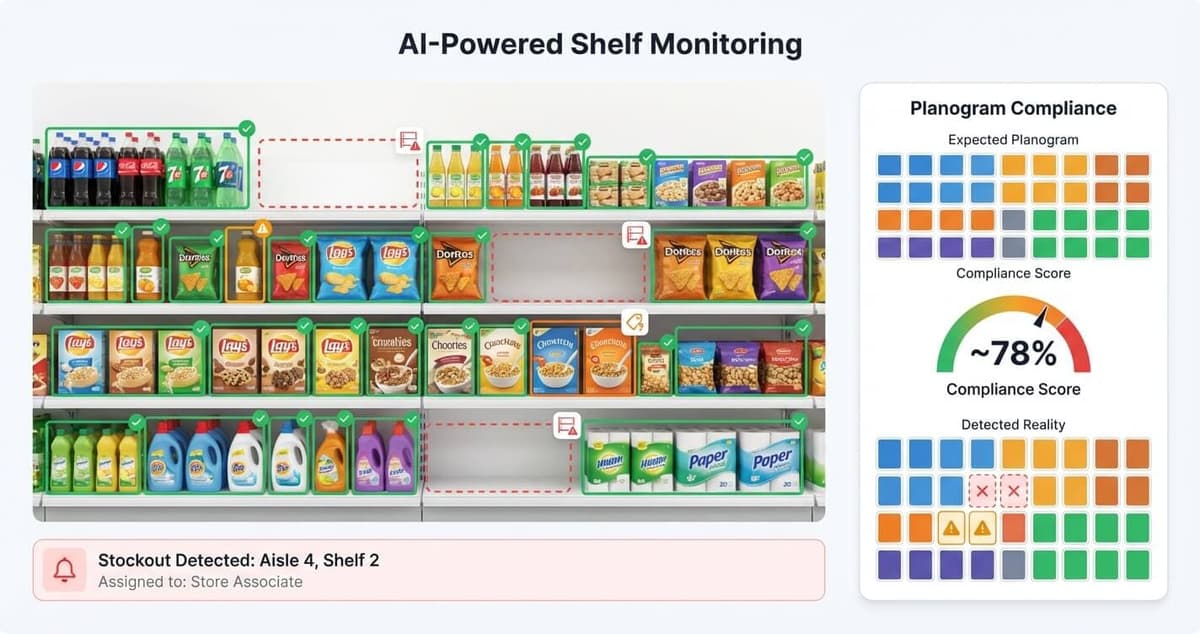
The Challenge: Detecting out-of-stock items, verifying product placement matches planograms, and identifying pricing/signage issues.
Recommended Models:
| Priority | Model | Rationale |
|---|---|---|
| Fixed SKU set | YOLO26m | Fast inference for known product catalog; 4.7ms enables real-time mobile scanning |
| New products | YOLO-World | Zero-shot detection via text prompts; immediate deployment without training data |
| High accuracy | RF-DETR-B | Transformer attention handles product occlusion and varied orientations |
Industry Deployment: A 2025 Nature publication documented an end-to-end planogram compliance framework using deep learning for shelf detection, product detection, and classification—processing 99,135 training images for product detection alone across 471 product categories.
Real-World Results: Dataoids reported 22% improvement in refill SLA adherence through AI-powered shelf monitoring deployed across 250+ retail stores, with automated stockout detection and real-time alerts to store associates.
Self-Checkout and Loss Prevention
The Challenge: Self-checkout systems account for a growing share of retail transactions, but they also concentrate shrinkage risk. Industry data consistently shows that self-checkout lanes experience 4–6% shrinkage rates compared to 1–2% at staffed registers. The most common schemes—"sweethearting," "pass-arounds," and outright skip-scanning—are difficult to catch with weight-based verification alone because many products share similar weights. Computer vision offers a fundamentally different verification signal: visual confirmation that the item placed in the bagging area matches the item registered by the POS system.
Recommended Models:
| Priority | Model | Rationale |
|---|---|---|
| Balanced | YOLO26s | 2.5ms GPU latency fits checkout processing window; good accuracy for common SKUs |
| High precision | RF-DETR-S | Fewer false positives; transformer attention handles overlapping and occluded items well |
| Multi-store deployment | YOLO-NAS-S | AutoML-optimized architecture adapts to varied hardware profiles across store locations |
The cost asymmetry in loss prevention is extreme: a single false accusation can generate far more damage—through customer complaints, social media exposure, and potential litigation—than the value of many successfully caught thefts. This asymmetry should drive every architectural decision. Set model confidence thresholds high (0.85+) and implement a two-stage verification pipeline: the primary model flags suspicious discrepancies between scanned and detected items, while a secondary confirmation step (either a higher-accuracy model or an attendant notification) handles the flagged events.
Key Insight:
In practice, retailers deploying vision-based loss prevention report 60–70% reductions in shrinkage at self-checkout stations while maintaining false positive rates below 0.1% of transactions. The key is treating the system as a decision-support tool for store associates rather than an autonomous enforcement mechanism.
Customer Analytics
The Challenge: Understanding customer behavior through foot traffic analysis, dwell time measurement, and heatmap generation—while preserving privacy. Brick-and-mortar retailers have long envied the granular analytics available to e-commerce platforms. Computer vision closes this gap by extracting analogous metrics from physical spaces: how many people enter the store, which aisles they visit, how long they dwell at specific displays, and where congestion forms. The critical constraint is that all of this must happen without identifying individuals.
Recommended Models:
| Application | Model | Rationale |
|---|---|---|
| Foot traffic counting | YOLO26n | At only 2.6M parameters, it handles person counting with minimal compute — enabling deployment on low-cost edge devices like Raspberry Pi 5 or NVIDIA Jetson Nano |
| Path tracking | YOLO26n + ByteTrack | ByteTrack's two-stage association recovers low-confidence detections from partial occlusions, providing reliable trajectory tracking without requiring re-identification |
| Engagement analysis | YOLO26n-pose | Keypoint detection enables body language understanding — distinguishing a customer actively examining a product from one merely passing by — without needing facial features |
Privacy-First Implementation:
Privacy isn't an optional feature in customer analytics—it's a legal and ethical prerequisite. Under GDPR (EU), CCPA (California), and analogous regulations worldwide, video analytics that could identify individuals triggers data protection obligations that are prohibitively expensive for most retail deployments. The solution is to architect the system so that personally identifiable information never enters the pipeline in the first place.
Process all frames locally on edge devices; transmit only aggregate statistics (counts, dwell times, heatmap coordinates) to the cloud. Aggregate data into 15-minute or hourly time buckets—granularity fine enough for business insights but coarse enough that individual reconstruction is impossible. Document the entire data flow in a Data Protection Impact Assessment (DPIA) and display clear signage informing customers that anonymous foot traffic analytics are in use.
Autonomous Vehicles and Transportation
Transportation applications demand the highest reliability standards, operating in safety-critical environments with zero tolerance for failures.
Perception for Autonomous Driving
The Challenge: Detecting vehicles, pedestrians, cyclists, traffic signs, and lane markings in real-time under all conditions (day, night, rain, fog, snow).
Recommended Models:
| Component | Model | Rationale |
|---|---|---|
| Primary detection | YOLO26l | NMS-free architecture ensures deterministic latency; 53.4% mAP @ 6.2ms |
| Pedestrian detection | RF-DETR-B | Superior person detection; attention handles occlusions in crowded scenes |
| Traffic sign recognition | YOLO26m | Good small object detection for distant signs |
Research Context: A 2025 review in the Journal of Computational and Cognitive Engineering documented extensive use of CNN and transformer architectures for autonomous driving, with datasets like KITTI, BDD100K, and Cityscapes serving as primary benchmarks.
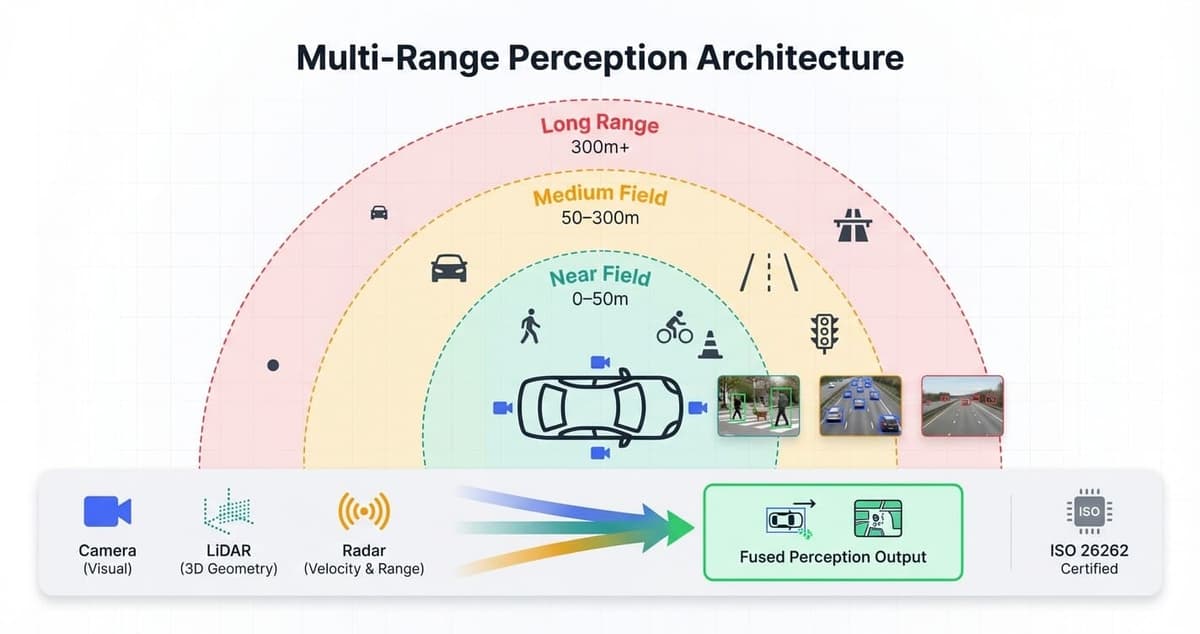
Multi-Camera Architecture: Modern autonomous vehicles use multiple detection models optimized for different ranges:
| Range | Resolution Focus | Model | Purpose |
|---|---|---|---|
| Long (300m+) | High-res center crop | YOLO26l | Early detection of vehicles, obstacles |
| Medium (50–300m) | Full frame | YOLO26m | Primary driving scene understanding |
| Near (0–50m) | Wide-angle | YOLO26s | Pedestrians, close obstacles, parking |
Key Insight:
Production autonomous vehicle systems use sensor fusion (cameras + LiDAR + radar), not vision-only solutions. Detection models are one component of a larger perception stack that includes 3D object detection from LiDAR, radar-based velocity estimation, multi-sensor fusion algorithms, and temporal tracking and prediction.
Traffic Monitoring and Smart Cities
The Challenge: Monitoring traffic flow, detecting incidents, and enforcing regulations across city-wide camera networks with thousands of feeds. Unlike controlled industrial environments, urban traffic systems face extreme variability—weather conditions, time-of-day lighting changes, camera degradation over years of outdoor exposure, and the sheer diversity of vehicle types, pedestrian behaviors, and road configurations.
Recommended Models:
| Application | Model | Rationale |
|---|---|---|
| Vehicle detection | YOLO26s | Efficient processing across many streams; 2.5ms per frame |
| Incident detection | YOLO26m | Higher accuracy for stopped vehicles, debris, accidents |
| License plate detection | YOLO26s + OCR | Detection + text recognition pipeline |
Research Validation: The AWD-YOLO model, based on YOLOv8n with a dual-backbone fusion strategy, demonstrated significant improvements in object detection under adverse weather conditions—critical for 24/7 urban deployment.
Scalability Architecture for city-wide deployments processing thousands of streams:
- 1Tiered processing: Edge devices run YOLO26n for activity detection (triggers on motion + vehicle presence); regional servers run YOLO26s for event classification; central GPU servers run YOLO26m for detailed analysis of flagged events.
- 2Batch processing: Centralized GPU servers process multiple streams via dynamic batching.
- 3Smart scheduling: Allocate processing resources based on traffic patterns (more capacity during rush hours).
Agriculture and Environmental Monitoring
Agricultural applications must handle outdoor conditions (weather, lighting variations) and often operate in remote locations with limited connectivity.
Crop and Plant Disease Detection
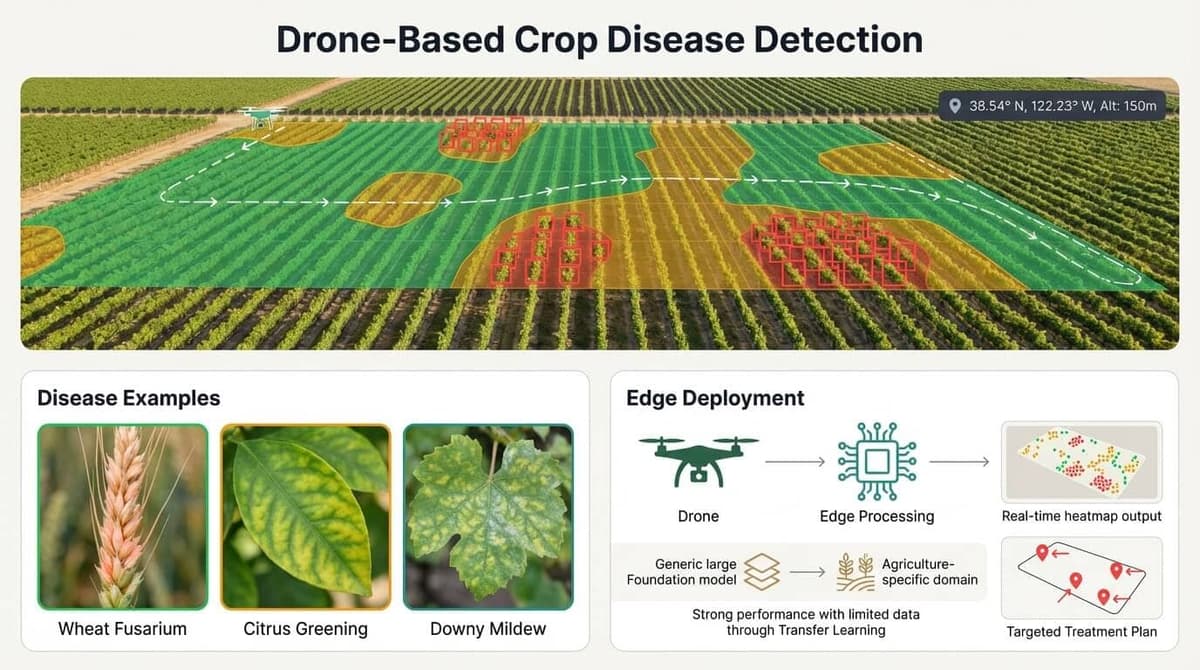
The Challenge: Identifying diseases, pests, and nutrient deficiencies in crops from drone or ground-based imagery for early intervention.
Recommended Models:
| Platform | Model | Rationale |
|---|---|---|
| Drone-mounted | YOLO26n | Runs on NVIDIA Jetson; battery-efficient for extended flight times |
| Ground vehicle | YOLO26m | Higher accuracy for detailed analysis during slower traversals |
| Cloud processing | RF-DETR-B | Maximum accuracy for archived imagery analysis; DINOv2 backbone transfers well to agricultural domains |
Research Evidence: The SCS-YOLO model, deployed on NVIDIA Jetson Nano for real-time agricultural disease detection, demonstrated practical edge deployment for wheat fusarium head blight detection. Multiple studies have validated YOLO variants for crop disease detection on drone-captured imagery, with applications spanning citrus greening, downy mildew in viticulture, and wheat yellow rust.
Key Insight:
Transfer Learning Advantage: Foundation model backbones (DINOv2 in RF-DETR, CLIP in YOLO-World) trained on diverse imagery transfer exceptionally well to agricultural domains, enabling strong performance even with limited domain-specific training data.
Aerial and Satellite Imagery Analysis
The Challenge: Detecting objects of interest (buildings, vehicles, ships, infrastructure) in aerial and satellite imagery where objects appear at arbitrary orientations.
Recommended Models:
| Priority | Model | Performance | Rationale |
|---|---|---|---|
| Best accuracy | YOLO26x-obb | 56.7% mAP, 81.7% mAP50 on DOTAv1 | Native oriented bounding box support; highest accuracy |
| Efficient | YOLO26l-obb | 56.2% mAP, 81.6% mAP50 | Nearly equivalent accuracy at 2× lower compute |
| Edge deployment | YOLO26n-obb | 52.4% mAP, 78.9% mAP50 @ 2.8ms | Suitable for drone onboard processing |
Processing Strategy for Large Images:
def process_aerial_image(image_path, model, tile_size=1024, overlap=256):
  """
  Process large aerial/satellite image through tiled inference
  with oriented bounding box detection.
  """
  from PIL import Image
  import numpy as np

  img = Image.open(image_path)
  width, height = img.size

  all_detections = []

  for y in range(0, height, tile_size - overlap):
      for x in range(0, width, tile_size - overlap):
          # Extract tile with overlap
          tile = img.crop((x, y,
                         min(x + tile_size, width),
                         min(y + tile_size, height)))

          # Run OBB inference
          results = model(tile)

          # Adjust coordinates to global image space
          for det in results[0].obb:
              # xywhr format: center-x, center-y, width, height, rotation
              det_global = (
                  det.xywhr[0] + x,  # Adjust center x
                  det.xywhr[1] + y,  # Adjust center y
                  det.xywhr[2],      # Width unchanged
                  det.xywhr[3],      # Height unchanged
                  det.xywhr[4]       # Rotation unchanged
              )
              all_detections.append(det_global)

  # Merge overlapping detections using rotated NMS
  final_detections = rotated_nms(all_detections, iou_threshold=0.3)
  return final_detections
Security and Surveillance
Security applications require high reliability, continuous operation, and often edge deployment for privacy and latency reasons.
Intruder Detection
The Challenge: Detecting unauthorized persons in restricted areas, triggering alerts, and providing video evidence—with minimal false alarms.
Recommended Models:
| Scenario | Model | Rationale |
|---|---|---|
| Standard surveillance | YOLO26s | Good person detection; efficient for multi-camera setups |
| Low-light environments | YOLO26m | Higher accuracy compensates for challenging imaging conditions |
| Perimeter security | RF-DETR-S | Better handles distant/small persons at facility boundaries |
Two-Stage Detection Pattern:
- 1Primary detection: YOLO26n triggers on any motion + person detection (high recall)
- 2Secondary verification: YOLO26m confirms detection with higher confidence threshold (reduces false positives)
This pattern maximizes recall while minimizing false alarms through cascaded verification.
Anomaly and Threat Detection
The Challenge: Identifying suspicious objects (abandoned bags, weapons) or behaviors (fighting, falling) in public spaces—often without prior training examples.
Recommended Models:
| Application | Model | Rationale |
|---|---|---|
| Known threats | YOLO26m | General object detection with custom threat classes |
| Open-ended threats | Grounding DINO | Zero-shot detection via natural language ('abandoned backpack', 'person with weapon') |
| Behavior analysis | YOLO26-pose + action classifier | Pose estimation feeds into action recognition for detecting fights, falls, loitering |
Zero-Shot Advantage: Security scenarios often involve rare events without training data. Grounding DINO enables detection of novel threats through natural language prompts:
# Grounding DINO for security applications
from transformers import AutoProcessor, AutoModelForZeroShotObjectDetection

processor = AutoProcessor.from_pretrained("IDEA-Research/grounding-dino-base")
model = AutoModelForZeroShotObjectDetection.from_pretrained(
  "IDEA-Research/grounding-dino-base"
)

# Detect novel threats without training
security_prompts = [
  "abandoned bag",
  "unattended backpack",
  "person with weapon",
  "person climbing fence",
  "smoke or fire"
]

def detect_security_threats(image, prompts):
  inputs = processor(
      images=image, text=". ".join(prompts), return_tensors="pt"
  )
  outputs = model(**inputs)
  return processor.post_process_grounded_object_detection(
      outputs,
      inputs.input_ids,
      threshold=0.3
  )
Research Validation: Grounding DINO has demonstrated practical applications in security and surveillance contexts, with studies showing effective zero-shot detection for CCTV and dashcam footage analysis.
Quick Reference: Industry Selection Matrix
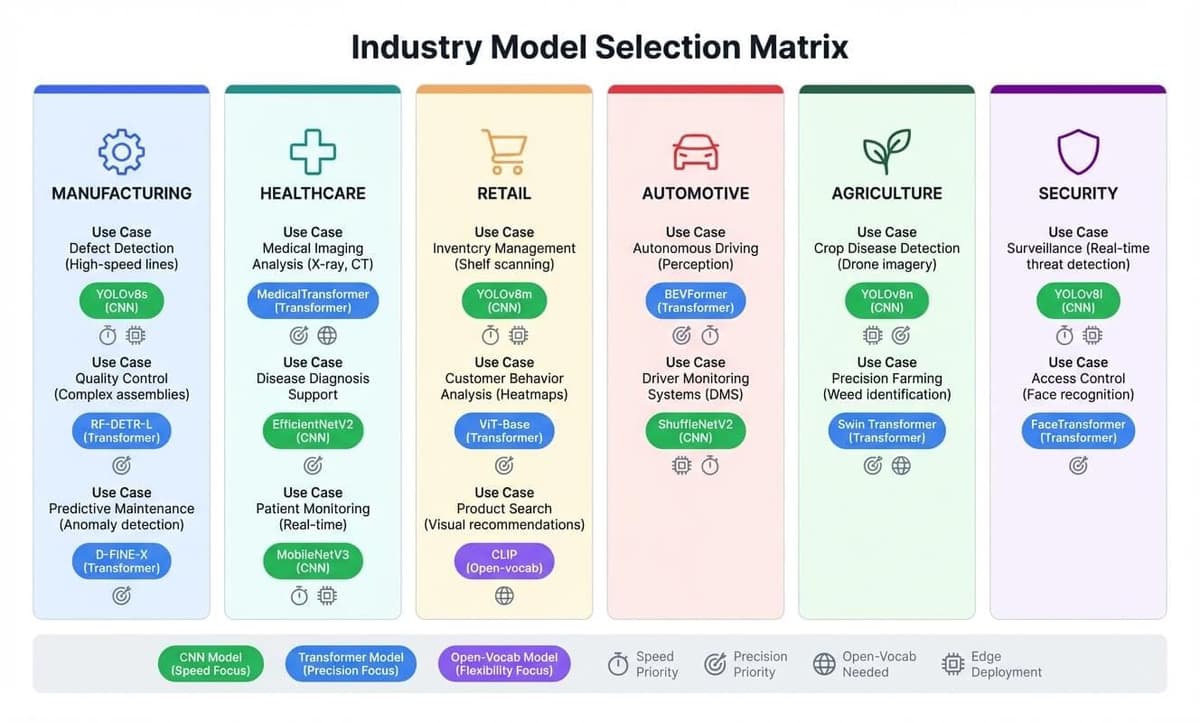
| Industry | Primary Use Case | Recommended Model | Alternative | Key Consideration |
|---|---|---|---|---|
| Manufacturing | Defect detection | YOLO26m | RF-DETR-B | Precision over recall |
| Manufacturing | PPE compliance | YOLO26m-pose | YOLO-World | Real-time requirement |
| Manufacturing | Assembly verification | RF-DETR-L | YOLO26s | Spatial relationship detection |
| Healthcare | Radiology | RF-DETR-L | YOLOv9-C | Interpretability required |
| Healthcare | Surgical assistance | YOLO26m + ByteTrack | YOLO26s | Sub-50ms latency |
| Healthcare | Pathology | RF-DETR-B | RF-DETR-Seg-M | Gigapixel processing |
| Retail | Shelf monitoring | YOLO-World | YOLO26m | New products without retraining |
| Retail | Self-checkout | YOLO26s | RF-DETR-S | Precision for loss prevention |
| Retail | Customer analytics | YOLO26n | YOLO26n + ByteTrack | Privacy-first design |
| Automotive | Autonomous driving | YOLO26l | RF-DETR-B | Deterministic latency |
| Transportation | Traffic monitoring | YOLO26s | YOLO26n | Multi-stream efficiency |
| Agriculture | Disease detection | RF-DETR-B | YOLO26m | Transfer learning benefit |
| Agriculture | Aerial imagery | YOLO26x-obb | YOLO26l-obb | Oriented bounding boxes |
| Security | Intrusion detection | YOLO26s | RF-DETR-S | High recall priority |
| Security | Threat detection | Grounding DINO | YOLO-World | Zero-shot capability |
Implementation Roadmap
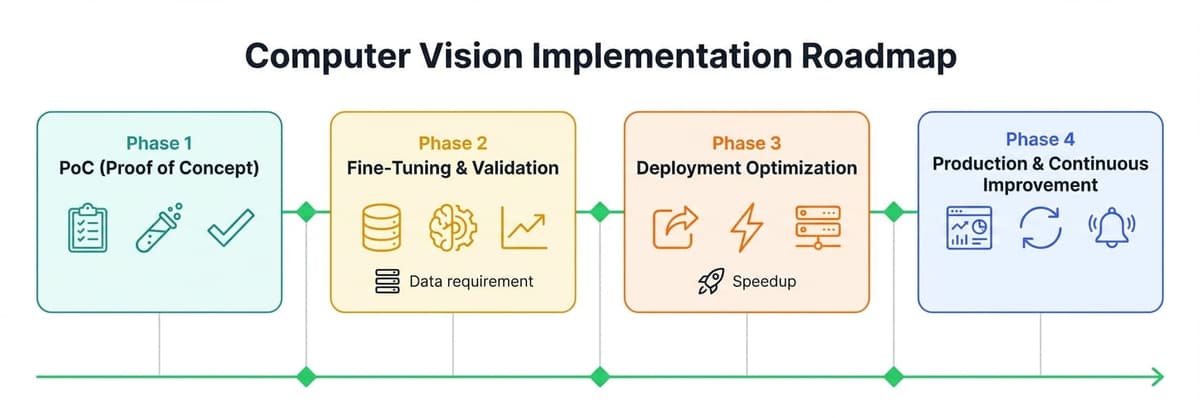
Regardless of industry, successful computer vision deployment follows a consistent progression:
Phase 1: Proof of Concept (2–4 weeks)
Objectives: Validate technical feasibility, identify data requirements, and establish baseline performance.
- 1Model selection: Use this guide to identify 2–3 candidate models
- 2Baseline testing: Evaluate candidates on sample data from your domain
- 3Performance validation: Measure accuracy and latency against requirements
- 4Integration assessment: Evaluate compatibility with existing systems
Phase 2: Fine-Tuning and Validation (4–8 weeks)
Data Requirements by Application:
| Application | Minimum Images/Class | Annotation Complexity |
|---|---|---|
| Simple object detection | 500–1,000 | Bounding boxes |
| Fine-grained detection | 2,000–5,000 | Detailed bounding boxes |
| Instance segmentation | 1,000–2,000 | Polygon masks |
| Pose estimation | 5,000–10,000 | Keypoint annotations |
Phase 3: Deployment Optimization (2–4 weeks)
Export Targets by Deployment Environment:
| Environment | Recommended Format | Typical Speedup |
|---|---|---|
| NVIDIA GPU (datacenter) | TensorRT FP16 | 2–3× vs PyTorch |
| NVIDIA Jetson (edge) | TensorRT INT8 | 3–4× vs PyTorch |
| Intel CPU | OpenVINO INT8 | 2–4× vs PyTorch |
| Apple Silicon | CoreML | 2–3× vs PyTorch |
| Web deployment | TensorFlow.js | Enables browser inference |
Phase 4: Production and Continuous Improvement (Ongoing)
Key Metrics to Monitor:
| Metric | Purpose | Alert Threshold |
|---|---|---|
| Inference latency (P99) | Performance | >2× baseline |
| Detection confidence distribution | Model drift | Significant shift from baseline |
| False positive rate | Accuracy | Industry-specific |
| False negative rate | Accuracy | Industry-specific |
| Throughput | Capacity | <80% of requirement |
Conclusion: Matching Models to Missions
The state of computer vision in 2026 offers unprecedented choice. YOLO26 variants deliver exceptional speed-accuracy balance for real-time applications. RF-DETR brings transformer power to scenarios demanding maximum accuracy. YOLO-World and Grounding DINO enable open-vocabulary detection for dynamic environments.
The key insight: There is no universally "best" model. Excellence comes from matching model capabilities to operational constraints:
- ●Latency-constrained applications (autonomous driving, surgical assistance): YOLO26 variants with NMS-free inference
- ●Accuracy-critical applications (medical diagnostics, defect detection): RF-DETR variants with transformer attention
- ●Dynamic environments (retail, security): Open-vocabulary models (YOLO-World, Grounding DINO)
- ●Edge deployment (drones, mobile): Lightweight variants (YOLO26n/s) with aggressive quantization
The framework and recommendations in this guide provide a starting point. Your specific data, constraints, and requirements will ultimately determine the optimal configuration. Start with proof-of-concept testing, iterate based on real-world performance, and maintain continuous monitoring in production.
The next installment of this series will provide the complete deployment guide—covering model optimization, edge deployment, containerization, monitoring, and scaling strategies for production computer vision systems.
Our Perspective
At Robolabs AI, we've deployed computer vision systems across manufacturing floors, agricultural fields, retail environments, and autonomous platforms. The recommendations in this guide reflect patterns we've validated through real-world implementation.
What we've consistently found across industries:
- ●The gap between proof-of-concept and production scales with regulatory complexity. A defect detection prototype takes weeks; a medical imaging deployment takes months of additional validation, documentation, and compliance work.
- ●Domain expertise trumps model sophistication. We've seen simple YOLOv8 pipelines built by teams who deeply understand their inspection criteria outperform state-of-the-art models deployed without domain knowledge.
- ●Multi-model architectures are becoming the norm. Our most successful deployments typically combine 2–3 specialized models rather than forcing one model to handle every detection scenario.
- ●Edge deployment constraints should drive model selection from day one. Teams that prototype on cloud GPUs and then try to squeeze models onto edge hardware waste months on optimization that could have been avoided.
The right model for your business isn't the one with the highest benchmark score—it's the one that solves your specific problem within your specific constraints. Start with the operational requirements, then work backward to model selection.
References & Further Reading
Ashourpour, M., & Azizpour, G. (2025). Edge-Deployed Deep Learning for Automated Quality Control in Industrial Assembly. Procedia CIRP, 134, 735-740.
Personal protective equipment detection using YOLOv8. (2024). Taylor & Francis Online.
RF-DETR Official Documentation. (2026). Roboflow.
Deep Learning in Radiology: A Comprehensive Review. (2024). PMC.
Zhang, Y., et al. (2022). ByteTrack: Multi-Object Tracking by Associating Every Detection Box. ECCV 2022.
Real-time retail planogram compliance application using computer vision. (2025). Nature Scientific Reports.
Real-Time Shelf Monitoring with AI Agents in Retail. (2025). Dataoids.
Advances in Deep Learning for Autonomous Vehicle Perception. (2025). JCCE.
AWD-YOLO enhancing autonomous driving perception reliability in adverse weather. (2026). Scientific Reports.
SCS-YOLO: A real-time detection model for agricultural diseases. (2025). Computers and Electronics in Agriculture, 238, 110794.
AI in Agricultural Drones: Disease Detection. (2024). LinkedIn Professional.
Ultralytics YOLO26-OBB Documentation. (2026). Ultralytics.
Teacher–Student Model: Grounding DINO, YOLO for Object Detection. (2024). MDPI Applied Sciences, 14(6), 2232.
Ultralytics YOLO26 Documentation — Official guides for training, export, and deployment.
Open-vocabulary YOLO-World model weights and training recipes.
MVTec Anomaly Detection Dataset — Standard benchmark for industrial defect detection.
NVIDIA TensorRT Documentation — GPU inference optimization and quantization.
FDA AI/ML-Based Software as Medical Device — Regulatory guidance for medical AI deployment.
ブログを購読
ロボティクスとAIの最新情報をメールでお届けします。
スパムなし。いつでも解除可能。
You Might Also Like
View all posts
Computer Vision
The Benchmarking Reality Check: What the Numbers Really Mean for Your Computer Vision Deployment
A comprehensive technical deep-dive into object detection benchmarks, metrics, and real-world performance. Understand mAP, latency, hardware-specific results, and how to build a practical model selection framework for production deployments.
Feb 25, 202625 min read
Computer Vision
YOLO in 2026: The Complete Evolution from Research Prototype to Industry Standard
A comprehensive technical deep-dive into YOLO's decade-long evolution. Understand what each version does, why it matters, and which models deserve your attention for production deployments.
Feb 17, 202618 min read
Computer Vision
From Prototype to Production: The Complete Guide to Deploying Computer Vision Models at Scale
A comprehensive deployment guide covering model licensing, export optimization (TensorRT, OpenVINO, CoreML), video object tracking (ByteTrack, OC-SORT), cloud GPU cost analysis, edge deployment strategies, production architecture patterns, and monitoring best practices for computer vision systems.
Mar 1, 202633 min read