블로그로 돌아가기
Computer Vision Models for Industry · Part 4 of 6Computer Vision
The Benchmarking Reality Check: What the Numbers Really Mean for Your Computer Vision Deployment
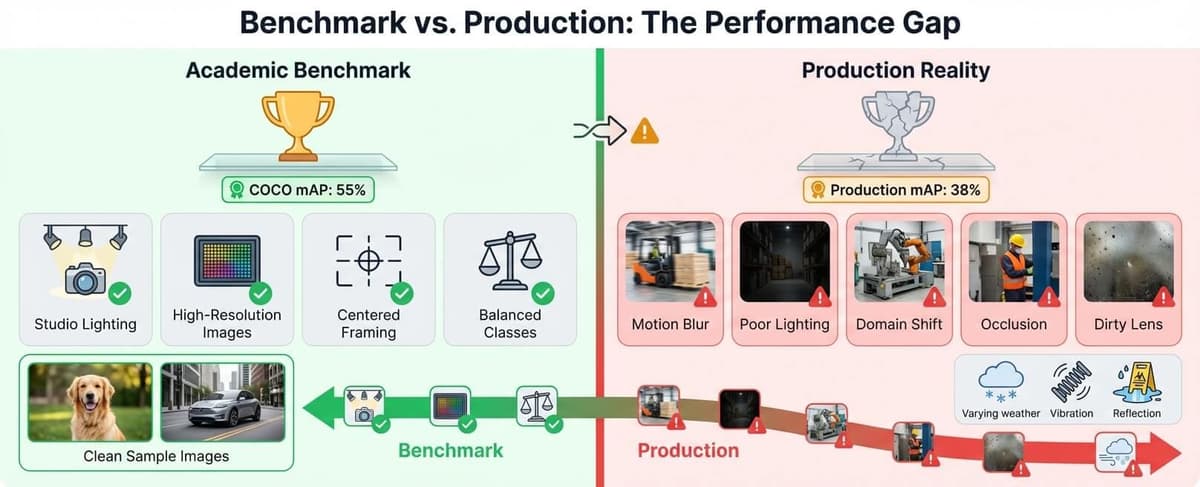
Every week, a new object detection model claims to "beat" its predecessors on COCO benchmarks. Marketing materials showcase impressive mAP numbers, and GitHub repositories fill with promises of "state-of-the-art" performance. Yet when these models reach production environments—factory floors, autonomous vehicles, medical imaging systems—the reality often diverges sharply from academic results.
The gap between benchmark performance and production reality is not merely academic curiosity. A model that achieves 55% mAP on COCO may struggle dramatically with your specific defect detection task. A detector claiming 100 FPS on an A100 GPU may deliver only 15 FPS on your edge deployment hardware. Understanding how to interpret benchmarks—and when to distrust them—is essential for making sound model selection decisions.
This fourth installment of our series cuts through the benchmark fog. We will examine what metrics actually measure, compare leading models across standardized tests, explore performance on diverse real-world domains, and provide frameworks for evaluating models in your specific deployment context.
Part 1: Understanding What Benchmarks Measure
Before comparing model performance, we must understand precisely what each metric captures—and what it misses.
Mean Average Precision (mAP): The Core Metric
Mean Average Precision is the primary accuracy metric for object detection, but its interpretation requires nuance. mAP measures both localization precision (how accurately boxes fit objects) and classification accuracy (whether the correct class is assigned).
The calculation proceeds as follows:
- 1For each class, sort predictions by confidence score
- 2Compute the Precision-Recall curve based on whether each prediction matches a ground truth box
- 3Calculate Average Precision (AP) as the area under this curve
- 4mAP is the mean of AP values across all classes
The devil lies in the IoU threshold—the required overlap between predicted and ground truth boxes for a match:
| Metric | IoU Threshold | Interpretation |
|---|---|---|
| mAP@50 | ≥ 0.50 | Lenient — 'roughly correct' detections |
| mAP@75 | ≥ 0.75 | Strict — requires precise boundaries |
| mAP@50:95 | Average over 0.50 to 0.95 | Standard COCO metric |
Key Insight:
Why this matters for industry: If your application involves robotic grasping, where exact object boundaries determine gripper placement, mAP@75 or mAP@50:95 provides more relevant signal than mAP@50. Conversely, for presence detection in surveillance, mAP@50 may suffice since approximate location is acceptable.
Size-Stratified Accuracy
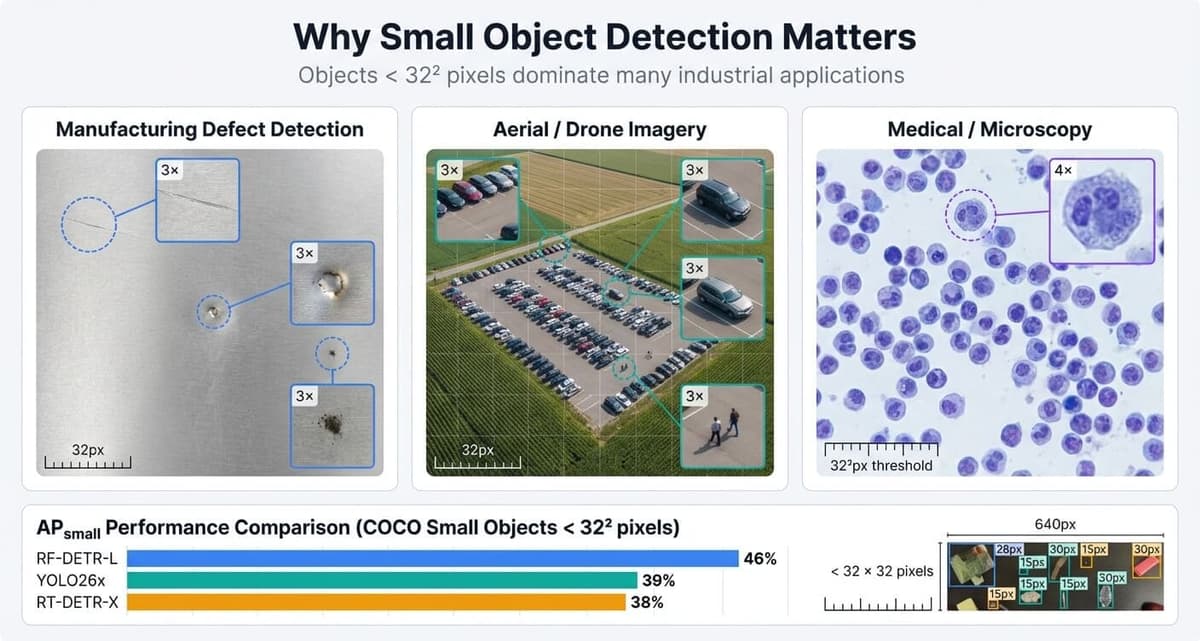
COCO evaluates AP separately by object size:
- ●AP_small: Objects with area < 32² pixels
- ●AP_medium: Objects with area between 32² and 96² pixels
- ●AP_large: Objects with area > 96² pixels
This breakdown is critically important because many models achieve high overall mAP while struggling with small objects. A model with 55% overall mAP might show only 35% AP_small—devastating for applications like aerial imagery analysis, manufacturing defect detection, or cell counting in microscopy where small objects dominate.
Latency vs. Throughput: Understanding Speed Metrics
Speed metrics cause significant confusion in model comparisons. Two related but distinct concepts require clarity:
End-to-End Latency: Total time from receiving an image to producing final detections, including:
- ●Pre-processing (resize, normalize)
- ●Model inference
- ●Post-processing (NMS, confidence filtering)
Throughput: Images processed per second, typically measured with batching.
These metrics diverge significantly under batching:
| Scenario | Latency | Throughput |
|---|---|---|
| Single image, no batching | 5ms | 200 FPS |
| Batch size 8 | 20ms per batch (2.5ms per image amortized) | 400 FPS |
For real-time video processing where you need results for each frame before the next arrives (autonomous driving, robotics), latency is the constraint. For batch processing of archived images (quality inspection of recorded footage), throughput matters more.
Key Insight:
Critical caveat: Many benchmarks report inference-only time, excluding pre-processing and NMS. A model claiming 100 FPS based on inference-only might achieve only 60 FPS end-to-end. Always verify what the reported speed includes.
Hardware Context: Numbers Mean Nothing Without It
A model's speed is meaningless without knowing the hardware:
| Platform | Typical Use | Common Optimization |
|---|---|---|
| NVIDIA A100 | High-performance cloud | TensorRT FP16/INT8 |
| NVIDIA T4 | Cost-effective cloud inference | TensorRT FP16 |
| NVIDIA Jetson Orin | Edge AI, robotics | TensorRT FP16 |
| Intel Xeon CPU | General servers without GPU | ONNX Runtime / OpenVINO |
| Apple M-series | Desktop/mobile development | CoreML |
| Raspberry Pi 5 | Ultra-low-cost edge | INT8 quantized models |
The NVIDIA T4 has emerged as the de facto standard for cloud inference benchmarks due to its prevalence in cloud deployments. When comparing models, ensure latency numbers are measured on equivalent hardware with equivalent optimization (TensorRT, FP16, etc.).
Part 2: State-of-the-Art COCO Comparison (February 2026)
The MS COCO dataset remains the standard benchmark for object detection, containing 80 object categories with 118,000 training and 5,000 validation images. While imperfect, COCO provides a common baseline for comparing model architectures.
High-Performance Models: GPU Deployment
The following comparison uses NVIDIA T4 GPU with TensorRT FP16 optimization—the standard cloud inference configuration:
| Model | mAP@50:95 | mAP@50 | Latency (T4) | Params | Architecture |
|---|---|---|---|---|---|
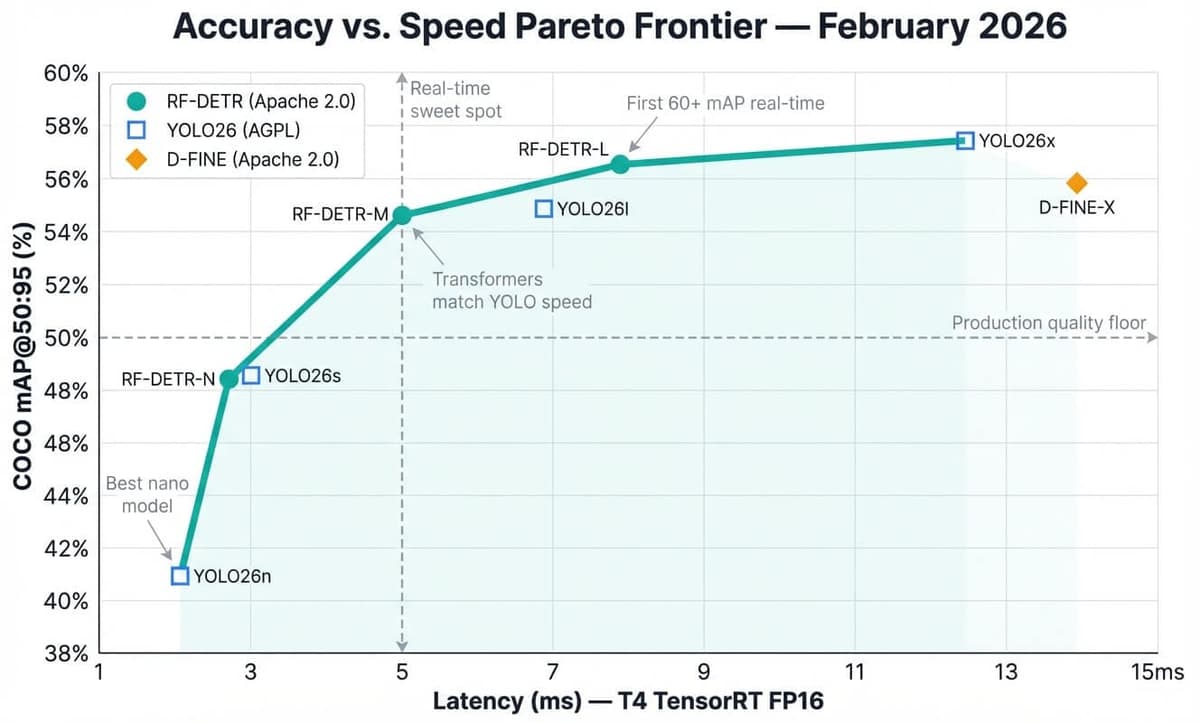
| RF-DETR-L | 56.5% | 88.2% | 6.8ms | 33.9M | Transformer |
| RF-DETR-M | 54.7% | 87.4% | 4.4ms | 33.7M | Transformer |
| YOLO26x | 57.5% | — | 11.8ms | 55.7M | CNN |
| YOLO26l | 55.0% | — | 6.2ms | 24.8M | CNN |
| YOLOv12-X | 55.2%* | — | ~6ms | ~58M | Attention-CNN Hybrid |
| D-FINE-X | 55.8%** | — | 12.89ms | 62M | Transformer |
| RT-DETR-R101 | 54.3% | — | 13.5ms | 76M | Transformer |
| YOLO11x | 54.7% | 73.2% | 11.9ms | 56.9M | CNN |
*YOLOv12-N achieves 40.5% mAP at 1.62ms, outperforming YOLO11-N by 1.1% mAP at comparable speed (NeurIPS 2025).
**D-FINE-X achieves 59.3% mAP when pretrained on Objects365+COCO; 55.8% mAP is for COCO-only training.
Key observations from the 2025–2026 landscape:
- 1RF-DETR leads real-time accuracy: Released by Roboflow in March 2025 and published at ICLR 2026, RF-DETR was the first real-time detector to exceed 60 AP on COCO according to Roboflow (RF-DETR-XL achieves 58.6% mAP@50:95, 77.4% mAP@50). Its DINOv2 backbone provides superior feature representations.
- 2Transformers have caught CNN speed: The longstanding assumption that transformers trade speed for accuracy no longer holds. RF-DETR-M achieves 54.7% mAP at 4.4ms—faster than comparably-accurate YOLO models.
- 3NMS-free architectures dominate: Models without Non-Maximum Suppression (RF-DETR, YOLO26, D-FINE) show more predictable latency and better dense-object handling. YOLO26 eliminated NMS through its native end-to-end predictor.
- 4YOLO26 optimizes for edge: With its MuSGD optimizer (inspired by LLM training from Moonshot AI's Kimi K2) and removal of DFL for simpler regression, YOLO26 achieves 43% faster CPU inference than YOLOv8 while improving accuracy.
Efficient Models: Edge and Mobile Deployment
For deployment on edge devices, embedded systems, or CPU-only environments:
| Model | mAP@50:95 | CPU Latency (ONNX) | T4 Latency | Params |
|---|---|---|---|---|
| YOLO26n | 40.9% | 38.9ms | 1.7ms | 2.4M |
| YOLO26s | 48.6% | 87.2ms | 2.5ms | 9.5M |
| YOLO11n | 39.5% | 56.1ms | 1.5ms | 2.6M |
| RF-DETR-N | 48.4% | — | 2.3ms | 30.5M |
| YOLO-NAS-S | 47.5% | — | 2.4ms | 12.9M |
Edge deployment insights:
- 1YOLO26n is the new edge champion: 40.9% mAP with only 38.9ms CPU latency represents a 43% reduction from YOLOv8n while improving accuracy by 3.6 mAP points.
- 2RF-DETR Nano beats expectations: At 48.4% mAP, RF-DETR-N (released with newer model sizes in 2025) outperforms comparable nano-sized models at similar latency.
- 3Quantization-friendly architectures matter: YOLO-NAS was designed with INT8 quantization in mind, minimizing accuracy loss when compressed for edge deployment.
Part 3: Beyond COCO — Real-World Generalization
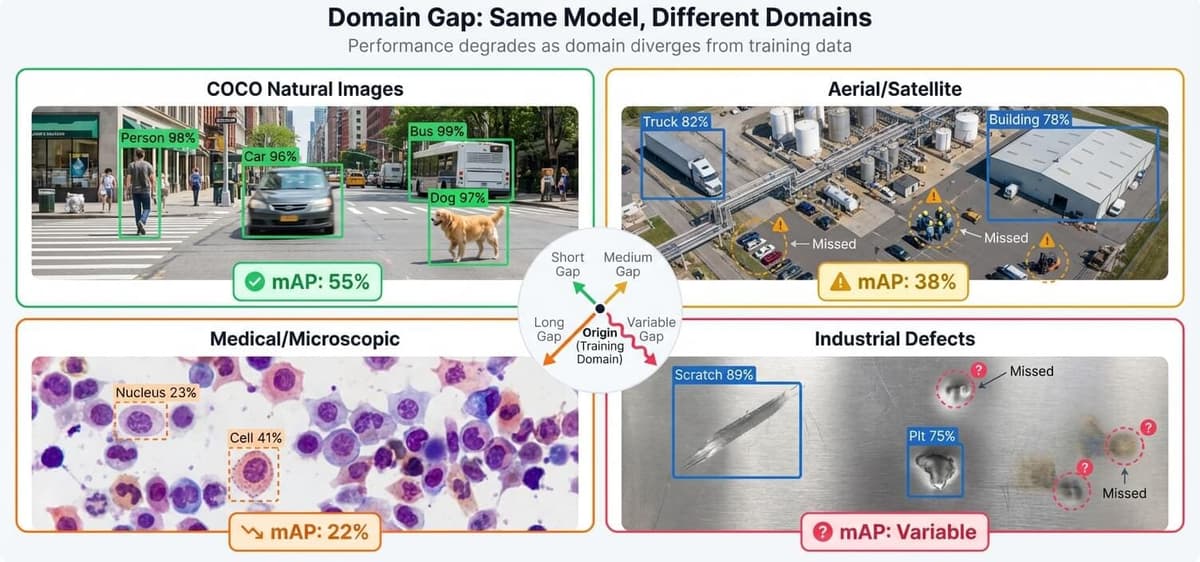
COCO performance is necessary but insufficient for industrial deployment. Models must generalize to domain-specific data that differs significantly from COCO's natural-image distribution.
Roboflow 100: The Generalization Test
Roboflow 100 (RF100), introduced in November 2022 and presented at CVPR 2023, provides a rigorous generalization benchmark:
- ●100 diverse datasets spanning 7 domains
- ●224,714 images with 805 class labels
- ●Domains: Aerial, Video Games, Microscopic, Underwater, Documents, Electromagnetic, Real World
Unlike COCO, which tests performance on common objects, RF100 reveals whether a model's representations transfer to specialized domains.
| Model | RF100 Overall | Aerial | Microscopic | Documents | Underwater |
|---|---|---|---|---|---|
| RF-DETR-B | 48.2%* | 52.1% | 45.3% | 61.2% | 42.8% |
| YOLO11x | 44.6% | 48.3% | 41.2% | 55.8% | 40.1% |
| YOLO-NAS-L | 46.1% | 49.7% | 43.8% | 58.4% | 41.5% |
*RF-DETR benefits from its DINOv2 backbone, which was pre-trained with self-supervised learning on diverse web-scale data.
Key Insight:
Why RF-DETR generalizes better: The DINOv2 backbone learns visual representations without task-specific supervision, capturing fundamental visual structure that transfers across domains. Models pre-trained solely on ImageNet classification tend to overfit to natural-image statistics.
LVIS: The Long-Tail Challenge
Real-world object detection rarely involves balanced class distributions. LVIS (Large Vocabulary Instance Segmentation) tests performance on 1,203 categories with realistic long-tail distribution—some classes have thousands of examples, others fewer than 10:
| Model | AP (all) | AP (rare) | AP (common) | AP (frequent) |
|---|---|---|---|---|
| Grounding DINO | 47.8% | 42.1% | 47.2% | 50.4% |
| RF-DETR-L | 48.6% | 38.2% | 47.8% | 52.1% |
| YOLO11x | 41.2% | 28.5% | 40.8% | 46.3% |
Critical insight: Grounding DINO's vision-language pretraining provides superior rare-class detection (42.1% vs. 38.2% for RF-DETR), while RF-DETR leads overall. For applications with imbalanced class distributions—which describes most real industrial scenarios—the choice between these models depends on whether rare-class performance or overall throughput matters more.
Domain-Specific Benchmarks
Aerial and Satellite Imagery (DOTA)
The DOTA benchmark tests oriented bounding box detection in aerial imagery—critical for agriculture, infrastructure monitoring, and defense applications:
| Model | mAP (OBB) | Latency | Notes |
|---|---|---|---|
| YOLO26x-obb | 56.7% | 30.5ms | Best speed-accuracy |
| YOLO26l-obb | 56.2% | 13.0ms | Fast variant |
| Oriented R-CNN | 57.8% | 95ms | Highest accuracy |
Recommendation: For aerial applications, YOLO26's OBB (Oriented Bounding Box) variants provide excellent accuracy with real-time capability. When latency permits, two-stage methods like Oriented R-CNN remain competitive for maximum accuracy.
Medical Imaging Considerations
Medical imaging presents challenges that no general-purpose benchmark adequately captures, and treating COCO or even LVIS performance as a proxy for clinical viability is a common and costly mistake.
Class imbalance is the defining characteristic of medical detection tasks. Pathological findings—tumors, lesions, fractures—are rare by definition, typically comprising less than 5% of cases in screening populations. A model that achieves 95% accuracy by simply classifying everything as "normal" would appear strong on aggregate metrics while being clinically useless. This makes precision-recall analysis, particularly at the operating points relevant to clinical workflow, far more informative than aggregate mAP. Sensitivity (recall) at a fixed specificity level is the standard evaluation paradigm in radiology AI, and detector benchmarks rarely report this.
Subtle visual features distinguish pathological from normal findings in many modalities. Unlike the clear object boundaries in natural images, a malignant nodule may differ from a benign one by texture gradients, density variations, or contextual anatomy. Models that learn to detect objects by sharp edges and distinct shapes (the strengths rewarded by COCO) may struggle with the diffuse, low-contrast patterns characteristic of early-stage disease. Foundation model backbones like DINOv2, which learn visual structure through self-supervised training on diverse data, often transfer better to these subtle discrimination tasks than ImageNet-pretrained backbones.
Regulatory and validation requirements add a layer of rigor absent from typical benchmarking. Clinical deployment requires validation on multi-site, demographically diverse datasets to demonstrate that performance generalizes across scanner types, patient populations, and institutional protocols. A model validated only on data from a single hospital may fail catastrophically at another site due to differences in imaging equipment, protocols, or patient demographics—a phenomenon well-documented in radiology AI literature.
For teams evaluating models for medical applications, we recommend:
- ●Validate on at least three independent clinical sites before drawing conclusions about generalization
- ●Report sensitivity at clinically relevant specificity thresholds (typically 90–95%)
- ●Implement human-in-the-loop verification for all clinical deployments
- ●Use foundation models (DINOv2, SAM) for feature extraction to maximize transfer across imaging domains
Part 4: Hardware-Specific Performance Analysis
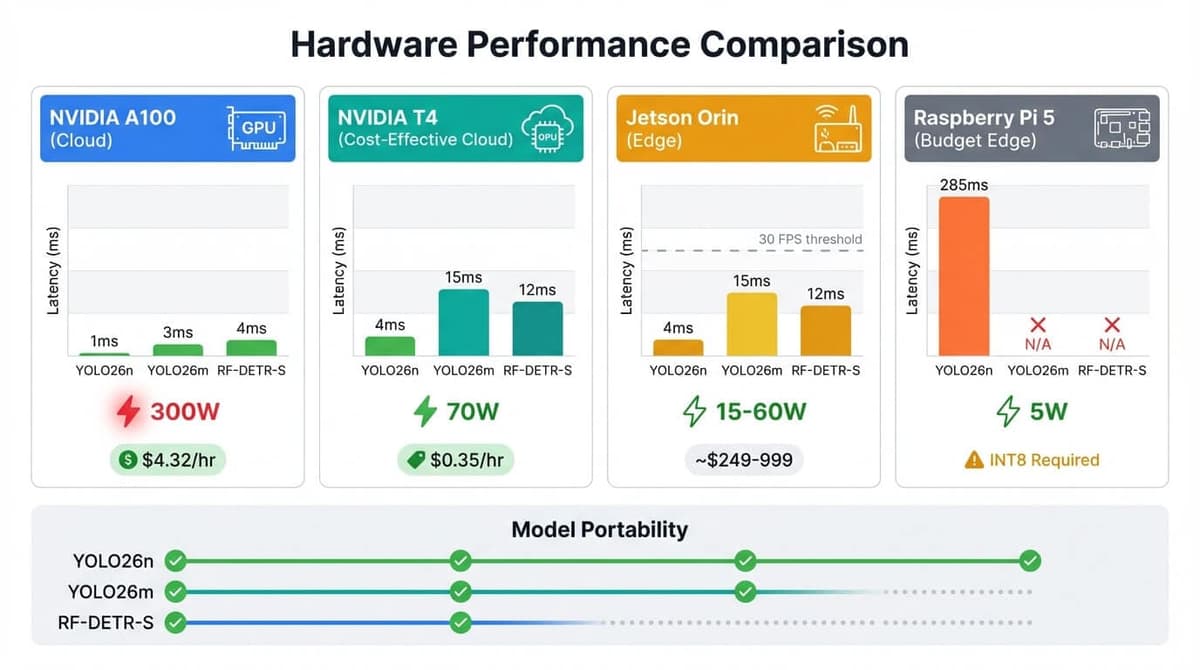
GPU Performance: Cloud Deployment
For cloud inference, the NVIDIA T4 remains the standard benchmark platform due to its widespread availability and cost-effectiveness:
| Model | PyTorch FP32 | TensorRT FP16 | Speedup |
|---|---|---|---|
| RF-DETR-M | 18.2ms | 4.4ms | 4.1× |
| YOLO26m | 12.4ms | 4.7ms | 2.6× |
| YOLO11m | 14.8ms | 5.2ms | 2.8× |
| RT-DETR-L | 24.6ms | 6.8ms | 3.6× |
| D-FINE-M | 22.4ms | 5.6ms | 4.0× |
Key Insight:
TensorRT optimization is non-negotiable for production. The 2–4× speedup from TensorRT conversion often determines whether real-time performance is achievable. Transformer-based models (RF-DETR, RT-DETR, D-FINE) benefit particularly well from TensorRT's attention operation fusion.
CPU Performance: Non-GPU Deployment
When GPU acceleration is unavailable:
| Model | Intel Xeon (ONNX) | Intel OpenVINO | Apple M2 (CoreML) |
|---|---|---|---|
| YOLO26n | 38.9ms | ~30ms | ~22ms |
| YOLO26s | 87.2ms | ~68ms | ~48ms |
| YOLO11n | 72ms | ~55ms | ~35ms |
| MobileNet-SSD | 16ms | ~12ms | ~8ms |
CPU deployment guidance:
- 1YOLO26 excels on CPU: The 43% latency reduction over previous YOLO versions stems from NMS removal and optimized architecture.
- 2OpenVINO provides significant gains: For Intel hardware, OpenVINO optimization delivers 20–25% speedup over generic ONNX Runtime.
- 3MobileNet-SSD remains fastest: For extreme latency constraints (sub-20ms CPU), MobileNet-SSD's depthwise separable convolutions remain unmatched, though at significant accuracy cost.
Edge Device Performance
NVIDIA Jetson Orin (Edge AI Platform)
| Model | Latency (TensorRT FP16) | Power Draw |
|---|---|---|
| YOLO26n | 4.2ms | 15W |
| YOLO26s | 8.5ms | 22W |
| RF-DETR-S | 12.1ms | 28W |
| YOLO11n | 5.1ms | 16W |
Raspberry Pi 5 (CPU-only Edge)
| Model | Latency (INT8 ONNX) | Notes |
|---|---|---|
| YOLO26n | ~285ms | Requires INT8 quantization |
| MobileNet-SSD | ~82ms | Purpose-built for efficiency |
| NanoDet | ~65ms | Sub-1MB model size |
Edge deployment recommendations:
- ●Jetson Orin: YOLO26 variants offer the best accuracy-power trade-off for robotics and embedded AI.
- ●CPU-only edge: MobileNet-SSD or NanoDet for sub-100ms inference; YOLO26n with INT8 quantization for better accuracy.
- ●Mobile devices: MobileNet-SSD via TFLite/CoreML remains the standard for iOS/Android deployment.
Part 5: Specialized Capability Analysis
Small Object Detection
Small object detection is critical for aerial imagery, manufacturing inspection, and medical imaging. Standard mAP can hide poor small-object performance, and many models that claim "state-of-the-art" results achieve their numbers primarily through strong large-object detection while struggling with objects below 32² pixels.
The following comparison reveals how dramatically performance varies by object scale:
| Model | AP_small | AP_medium | AP_large | Small/Large Ratio |
|---|---|---|---|---|
| RF-DETR-L | 46.2% | 67.4% | 78.1% | 0.59 |
| YOLO26x | 38.8% | 59.2% | 71.4% | 0.54 |
| YOLOv9-C | 42.1% | 58.6% | 68.3% | 0.62 |
| D-FINE-X | 40.5% | 62.1% | 75.8% | 0.53 |
Analysis:
- ●RF-DETR achieves best absolute small-object AP (46.2%) through its multi-scale DINOv2 features. The self-supervised pre-training produces feature representations that capture fine-grained visual structure at multiple resolutions—precisely the capability needed for small objects where each pixel carries significant information.
- ●YOLO26's STAL (Small-Target-Aware Label Assignment) specifically addresses small object challenges by adjusting how training labels are assigned to anchor positions, ensuring small objects receive proportionally more training signal. Combined with ProgLoss (Progressive Loss), this yields meaningful gains over prior YOLO versions on small object benchmarks.
- ●YOLOv9's PGI (Programmable Gradient Information) provides the best relative small/large ratio (0.62), indicating consistent performance across scales—valuable for applications where objects of varying sizes appear in the same frame.
Key Insight:
If your application is dominated by small objects (aerial imagery, microscopy, distant surveillance), prioritize RF-DETR despite its slightly higher latency. If you need balanced detection across all scales in real-time, YOLO26 with STAL provides the best trade-off.
Dense Object Detection
Applications like crowd counting, cell detection, or warehouse inventory require handling many overlapping objects. Traditional NMS-based detectors face a fundamental tension here: the IoU threshold that prevents duplicate detections also suppresses valid detections of closely-packed objects.
| Model | Dense Scene Performance | NMS Behavior |
|---|---|---|
| RF-DETR | Excellent | NMS-free, handles overlap natively |
| YOLO26 | Good | NMS-free (end-to-end predictor) |
| D-FINE | Excellent | NMS-free |
| YOLO11 | Moderate | NMS may suppress valid detections |
| YOLO-World | Moderate | NMS required |
Recommendation: For dense detection scenarios, prioritize NMS-free models (RF-DETR, YOLO26, D-FINE) to avoid suppression of valid overlapping detections. Traditional NMS can incorrectly remove true positives in crowded scenes—a problem that worsens as scene density increases. NMS-free architectures use learned suppression or set-based prediction (Hungarian matching), making them inherently better suited to dense object scenarios. In our experience, switching from NMS-based to NMS-free models typically recovers 3–8% of missed detections in crowded scenes.
Open-Vocabulary Detection Performance
For applications requiring flexible, text-prompted detection, the trade-off between accuracy and latency becomes even more pronounced. Open-vocabulary models carry the overhead of language processing alongside visual detection, and the gap between accuracy-optimized and speed-optimized models is wider than in closed-set detection:
| Model | Zero-Shot COCO AP | Zero-Shot LVIS AP | Latency | Best Use Case |
|---|---|---|---|---|
| Grounding DINO 1.5 Pro | 54.3% | 47.6% | ~300ms | Maximum accuracy, any prompt |
| Grounding DINO 1.6 Pro | 55.4% | 51.1% | ~300ms | Latest SOTA, improved rare classes |
| YOLO-World-L | 44.9% | 26.8% | 37.4ms | Real-time, fixed vocabulary |
| Florence-2-L | 41.4% | 28.5% | ~180ms | Multi-task (detection + captioning) |
Selection guidance:
- ●Grounding DINO for maximum accuracy with arbitrary natural language prompts—accepts complex referring expressions like "the person wearing a red hat." The recently released Grounding DINO 1.6 Pro further improves rare-class detection (51.1% LVIS-val AP), making it the strongest choice when your detection targets include unusual or infrequent objects.
- ●YOLO-World for real-time open-vocabulary with pre-computed class embeddings—approximately 8× faster than Grounding DINO. Its prompt-then-detect paradigm allows vocabulary changes without retraining, making it ideal for dynamic environments like retail where product catalogs update frequently.
- ●Florence-2 when multi-task capability (detection, captioning, OCR) is needed alongside detection. While its detection accuracy trails specialized models, the ability to perform multiple visual tasks in a single inference call significantly reduces deployment complexity.
Part 6: Quantization and Deployment Optimization
INT8 Quantization Impact
Quantization reduces model size and improves inference speed but may impact accuracy:
| Model | FP32 mAP | INT8 mAP | Accuracy Drop | T4 Speedup |
|---|---|---|---|---|
| YOLO26m | 53.1% | ~52.4% | ~-0.7% | ~1.8× |
| YOLO-NAS-M | 51.5% | ~51.2% | ~-0.3% | ~1.7× |
| RF-DETR-M | 54.7% | ~53.2% | ~-1.5% | ~1.5× |
| RT-DETR-L | 53.2% | ~51.5% | ~-1.7% | ~1.5× |
Quantization insights:
- 1CNN models quantize better: YOLO architectures typically show smaller accuracy drops (<1%) with INT8 compared to transformer models (1.5–2%).
- 2YOLO-NAS excels at quantization: Designed with Quantization-Aware Training (QAT) from inception, YOLO-NAS maintains performance with minimal precision loss.
- 3Transformer models need QAT: Post-training quantization (PTQ) hurts transformer models more significantly. For production deployment, use Quantization-Aware Training when available.
- 4Benchmark integrity warning: The RF-DETR paper notes that "prior work often reports latency using FP16 quantized models, but evaluates performance with FP32 models." Always verify that reported accuracy and speed use consistent precision.
Export Format Recommendations
| Target | Recommended Format | Optimization Level |
|---|---|---|
| NVIDIA GPU (cloud/edge) | TensorRT | Highest |
| Intel CPU/VPU | OpenVINO | High |
| Cross-platform | ONNX Runtime | Medium |
| Apple devices | CoreML | High |
| Android | TFLite | Medium |
| Web browser | ONNX.js / TensorFlow.js | Limited |
Part 7: Practical Model Selection Framework
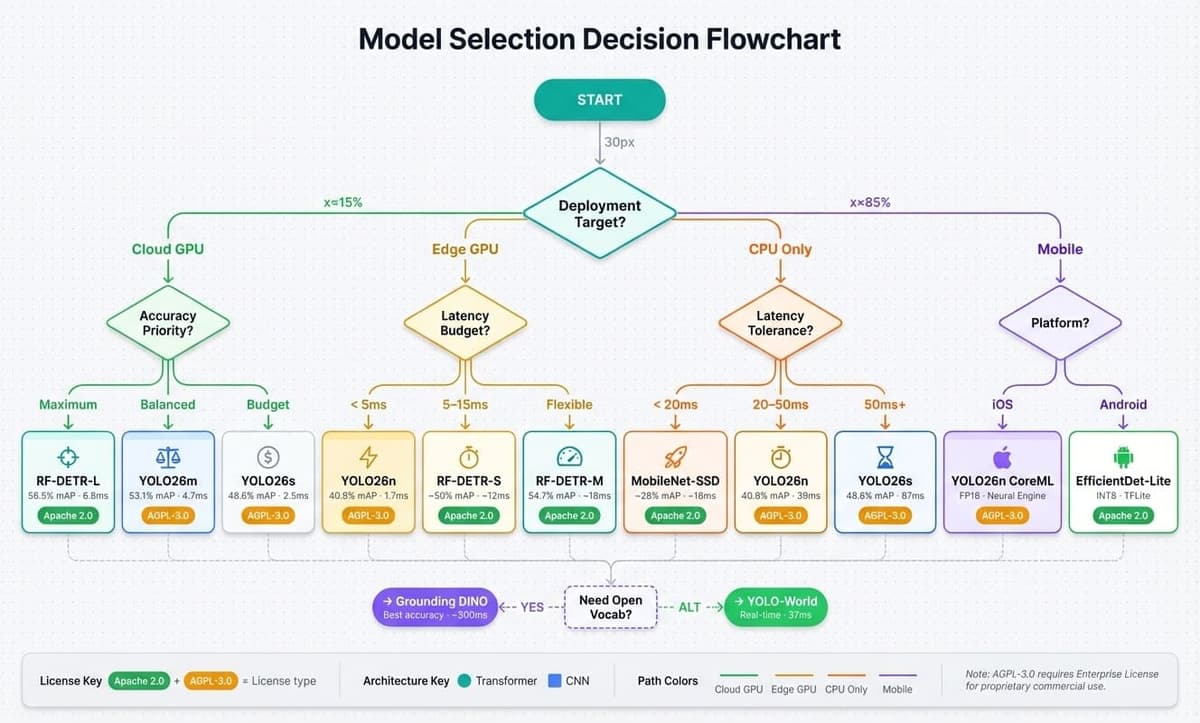
Decision Matrix by Use Case
Benchmark numbers narrow the field, but the final model choice depends on your deployment context. The following recommendations are based on verified benchmarks combined with practical deployment experience across these domains.
Real-Time Video Analytics (Security, Traffic)
Video analytics demands consistent, low-latency inference across continuous streams. NMS-free architectures are particularly important here because NMS adds variable post-processing latency that can cause frame drops under load. RF-DETR-M at 4.4ms provides the best accuracy within the real-time envelope, while YOLO26 variants offer the most mature tracking integration through Ultralytics' ByteTrack pipeline.
| Priority | Recommended Model | Why |
|---|---|---|
| Maximum accuracy | RF-DETR-M | 54.7% mAP at 4.4ms T4 |
| Balanced | YOLO26m | 53.1% mAP at 4.7ms, mature ecosystem |
| Edge deployment | YOLO26s | 48.6% mAP, excellent CPU performance |
Industrial Quality Inspection
Quality inspection differs fundamentally from general detection: defects are often subtle, training data is scarce (defective products are rare), and the cost asymmetry between false positives and false negatives drives model selection. RF-DETR-L's strong small-object AP (46.2%) makes it the leading choice for detecting fine scratches, pits, and surface anomalies. For operations that need to inspect for unanticipated defect types—novel failure modes in a new product line, for example—Grounding DINO's open-vocabulary capability provides immediate detection without retraining.
| Priority | Recommended Model | Why |
|---|---|---|
| Small defect detection | RF-DETR-L | Best AP_small (46.2%) |
| Open-vocabulary defects | Grounding DINO | Accepts 'scratch,' 'dent,' etc. |
| High-volume throughput | YOLO26l + batch processing | Optimized for throughput |
Autonomous Systems (Robotics, Vehicles)
Autonomous systems place the strictest latency constraints on detection: a robotic arm operating at cycle times under 500ms needs sub-10ms detection, and autonomous vehicles require deterministic inference timing to maintain control loop stability. YOLO26's NMS-free architecture eliminates the variable-latency post-processing step that can cause timing jitter in control systems, making it the safest choice for safety-critical real-time applications.
| Priority | Recommended Model | Why |
|---|---|---|
| Minimum latency | YOLO26n | 1.7ms T4, NMS-free deterministic |
| Dense scenes | RF-DETR-S | Handles overlapping objects |
| Multi-object tracking | YOLO26 + ByteTrack | Integrated tracking support |
Research and Exploration
Research workflows prioritize flexibility over efficiency. Grounded-SAM (Grounding DINO + SAM) is the most versatile tool for exploring new domains because it provides both localized detection and pixel-precise segmentation from arbitrary text prompts. Florence-2 adds captioning and OCR capabilities for multi-modal analysis. YOLO-World balances open-vocabulary flexibility with real-time speed for iterative experimentation.
| Priority | Recommended Model | Why |
|---|---|---|
| Flexible experimentation | Grounded-SAM | Detection + segmentation |
| Multi-task analysis | Florence-2 | Detection, captioning, OCR |
| Zero-shot capability | YOLO-World | Fast open-vocabulary |
Performance Tier Summary
Tier 1: Maximum Accuracy (GPU Required)
- ●RF-DETR-XL: 58.6% mAP @ 11.5ms (T4 TensorRT)
- ●D-FINE-X: 55.8% mAP @ 12.89ms (COCO-only; 59.3% with Objects365 pretraining)
- ●RF-DETR-L: 56.5% mAP @ 6.8ms
- ●Best for: Quality-critical applications with GPU infrastructure
Tier 2: Real-Time High Performance
- ●RF-DETR-M: 54.7% mAP @ 4.4ms
- ●YOLO26m: 53.1% mAP @ 4.7ms
- ●Best for: Production video analytics, balanced requirements
Tier 3: Edge Deployment
- ●YOLO26n: 40.9% mAP @ 38.9ms CPU / 1.7ms T4
- ●YOLO26s: 48.6% mAP @ 87.2ms CPU / 2.5ms T4
- ●Best for: Embedded systems, mobile, cost-sensitive deployment
Tier 4: Open-Vocabulary / Flexible
- ●Grounding DINO 1.5: 54.3% zero-shot COCO AP
- ●YOLO-World-L: 44.9% COCO AP @ 37.4ms
- ●Best for: Dynamic class requirements, exploration
Part 8: Benchmark Methodology and Caveats
Reproducibility Standards
All benchmarks cited in this document follow standardized protocols:
- ●Hardware: NVIDIA T4 GPU with TensorRT 8.6+ for GPU benchmarks; Intel Xeon for CPU benchmarks
- ●Framework: PyTorch 2.1+ for training, TensorRT for GPU inference, ONNX Runtime 1.16+ for CPU
- ●Dataset: COCO val2017 (5,000 images) unless otherwise noted
- ●Metrics: COCO-style evaluation with pycocotools, 10 IoU thresholds for mAP@50:95
- ●Batch size: 1 for latency measurements unless noted
Critical Caveats
1. Benchmark numbers vary by implementation
Different repositories may report different numbers for identical architectures due to:
- ●Training recipes and hyperparameters
- ●Data augmentation strategies
- ●Post-processing differences
- ●Framework versions
Always validate on your specific deployment stack.
2. Latency depends on batch size and input resolution
Reported latencies assume batch size 1 and 640×640 input unless noted. Higher resolutions improve small-object detection but increase latency quadratically.
3. Real-world performance may differ significantly
Benchmarks use clean, well-lit, static images. Production environments introduce:
- ●Motion blur
- ●Variable lighting
- ●Occlusions
- ●Domain shift from training data
Key Insight:
Plan for 10–30% accuracy degradation in real deployments compared to benchmark results. Always validate on your specific use case data before committing to a model architecture.
4. Model evolution is continuous
Performance numbers may be superseded by newer versions. YOLO26 replaced YOLO11 within months of its release; similar evolution continues across model families.
5. FP16 vs. FP32 mismatch
As noted in the RF-DETR paper, some prior work reports latency with FP16 models but accuracy with FP32. Ensure consistency when comparing models.
Conclusion: Benchmarks as Starting Points
Benchmarks provide essential starting points for model selection, but they are not destinations. COCO mAP indicates general capability; domain-specific validation reveals actual production performance. T4 latency suggests cloud feasibility; your target hardware determines real throughput.
The 2025–2026 landscape has fundamentally shifted the accuracy-speed tradeoff:
- ●Transformers now match CNN speed while offering superior accuracy
- ●NMS-free architectures eliminate post-processing variability
- ●Foundation model backbones (DINOv2) provide unprecedented generalization
- ●Edge-optimized designs (YOLO26) enable deployment on resource-constrained devices
For production deployments, we recommend:
- 1Start with benchmark leaders (RF-DETR, YOLO26) for initial evaluation
- 2Test on domain-specific data before committing to architecture
- 3Profile on target hardware with actual deployment optimizations
- 4Plan for iterative improvement as the field evolves rapidly
The next installment of this series will provide an industry-specific playbook, mapping common deployment scenarios to model recommendations with case studies from manufacturing, healthcare, retail, and autonomous systems.
Our Perspective
At Robolabs AI, we've learned—sometimes the hard way—that benchmark performance and production performance are correlated but not equivalent. We've deployed models that looked exceptional on COCO but struggled on industrial data, and vice versa.
Lessons from hundreds of real-world deployments:
- ●The single most predictive metric we track isn't mAP—it's domain-specific recall at a fixed precision threshold. A model achieving 55% COCO mAP that delivers 98% recall on your specific defect class outperforms one at 62% mAP with only 91% domain recall.
- ●Latency benchmarks without specifying batch size, precision, and warm-up protocol are meaningless. We've seen 3x latency variations for the same model depending on how the benchmark was configured.
- ●Roboflow 100 is the most production-relevant public benchmark we use. Its diversity across domains provides a much better signal for transfer learning potential than COCO alone.
- ●Hardware-specific optimization often matters more than model architecture. A well-optimized YOLOv8 on TensorRT can outperform a poorly exported RF-DETR on the same hardware.
Benchmarks are where the conversation starts, not where it ends. Every model we deploy goes through our own evaluation pipeline on client-specific data before we commit to production architecture decisions.
References & Further Reading
Lin, T.Y., et al. "Microsoft COCO: Common Objects in Context." ECCV 2014.
Gupta, A., et al. "LVIS: A Dataset for Large Vocabulary Instance Segmentation." CVPR 2019.
Ciaglia, F., et al. "Roboflow 100: A Rich, Multi-Domain Object Detection Benchmark." arXiv:2211.13523, CVPR 2023.
Xia, G.S., et al. "DOTA: A Large-scale Dataset for Object Detection in Aerial Images." CVPR 2018.
Roboflow. "RF-DETR: Neural Architecture Search for Real-Time Detection Transformers." ICLR 2026.
Ultralytics. "YOLO26: Edge-Optimized Real-Time Detection." January 2026.
Sun, J., et al. "YOLOv12: Attention-Centric Real-Time Object Detectors." NeurIPS 2025.
Peterande. "D-FINE: Redefine Regression Task of DETRs as Fine-grained Distribution Refinement." 2024.
Lv, W., et al. "DETRs Beat YOLOs on Real-time Object Detection." CVPR 2024.
Ultralytics. "YOLO11: Enhanced Real-Time Detection." 2024.
Deci AI. "YOLO-NAS: A Neural Architecture Search Based Object Detector." May 2023.
Ultralytics benchmark documentation and standardized comparison methodology.
Papers With Code object detection leaderboard and benchmark tracking.
Roboflow model comparison and evaluation guides.
NVIDIA TensorRT optimization guide for production inference.
IDEA Research. Grounding DINO 1.6 Pro: 55.4% COCO AP, 57.7% LVIS-minival AP zero-shot.
First real-time detector to surpass 60 AP on COCO (RF-DETR-2XL). NAS-derived architecture with DINOv2 backbone.
Intel OpenVINO toolkit. Hardware-specific optimization for Intel CPUs, GPUs, and VPUs.
Microsoft ONNX Runtime. Cross-platform inference optimization.
Multi-Object Tracking benchmark. Standardized tracking evaluation for ByteTrack, OC-SORT, and StrongSORT comparisons.
블로그 구독하기
로보틱스와 AI에 대한 최신 인사이트를 이메일로 받아보세요.
스팸 없음. 언제든지 구독 취소 가능.
You Might Also Like
View all posts
Computer Vision
The Industry Playbook: Choosing the Right Computer Vision Model for Your Business
A comprehensive industry guide mapping computer vision models to real-world deployment scenarios across manufacturing, healthcare, retail, automotive, agriculture, and security. Practical model selection frameworks with evidence-backed recommendations.
Feb 27, 202626 min read
Computer Vision
From Prototype to Production: The Complete Guide to Deploying Computer Vision Models at Scale
A comprehensive deployment guide covering model licensing, export optimization (TensorRT, OpenVINO, CoreML), video object tracking (ByteTrack, OC-SORT), cloud GPU cost analysis, edge deployment strategies, production architecture patterns, and monitoring best practices for computer vision systems.
Mar 1, 202633 min read
Computer Vision
YOLO in 2026: The Complete Evolution from Research Prototype to Industry Standard
A comprehensive technical deep-dive into YOLO's decade-long evolution. Understand what each version does, why it matters, and which models deserve your attention for production deployments.
Feb 17, 202618 min read