Voltar ao Blog
India Robotics Automation · Part 2 of 9Industry Analysis
Industrial Robotics Across Sectors in India: Deep Dive by Industry
This is the second in our comprehensive research series on robotics automation in India. While the first installment established the market overview and global positioning, this file goes sector-by-sector through India's industrial landscape — examining where robots are actually being deployed, how deeply, what's working, what's blocked, and where the next wave of adoption will come from.
1. Automotive: The Anchor Sector
1.1 Scale and Dominance
The automotive industry is, by a wide margin, the largest consumer of industrial robots in India. In 2025, it commands approximately 36% of the robotics market by value (IMARC Group) — and roughly 45% of unit installations per IFR data. In 2023, when India's robot installations surged by 59%, automotive alone accounted for a 139% jump (from ~1,486 units in 2022 to 3,551 units in 2023). In 2024, automotive installations surged a further 15% to reach 4,070 units.
This dominance mirrors the global pattern. Worldwide, automotive was the original adoption ground for industrial robotics, and it remains the primary driver in almost every market. In India, the automotive sector's gravity is even more pronounced because other sectors are still in early stages of robot adoption.
1.2 Where Robots Work in Indian Auto Plants
The applications within automotive manufacturing are well-established and follow a familiar hierarchy:
Body-in-White (BIW) Welding
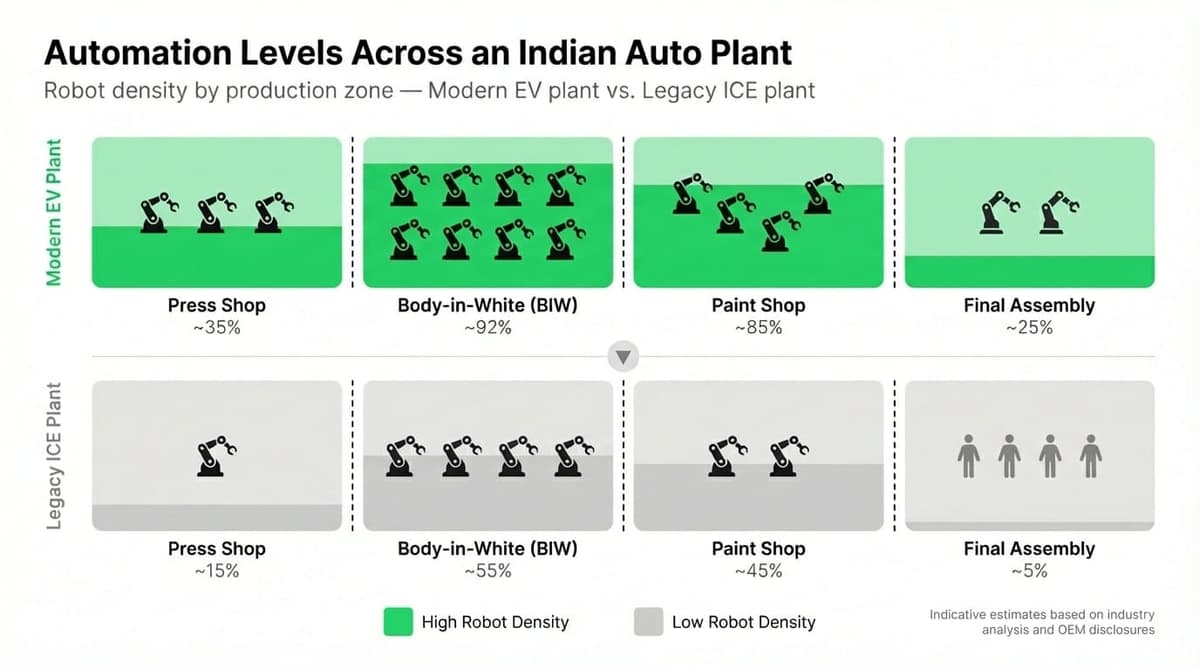
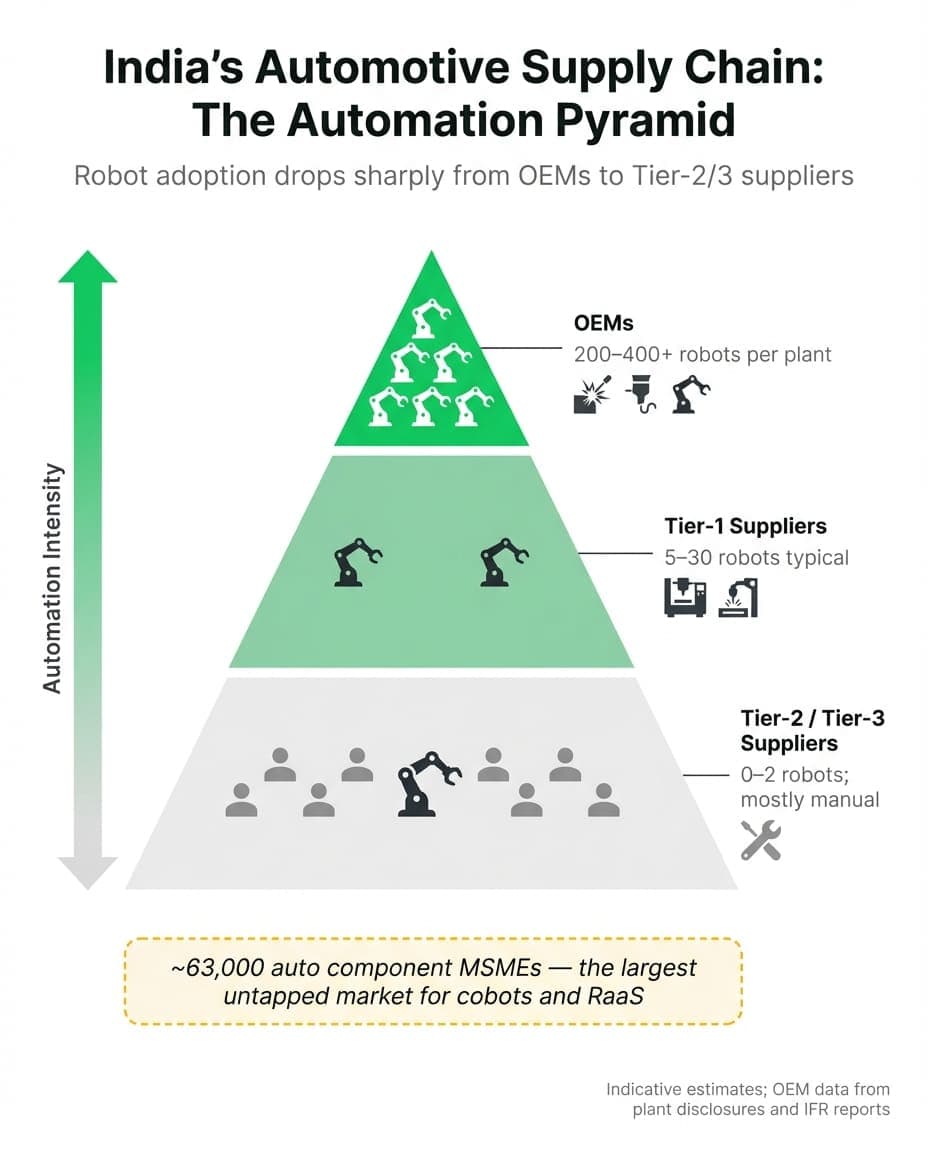
This is the single largest application for robots in Indian auto plants. The body-in-white process — where the car's structural frame is assembled from stamped sheet metal panels — requires hundreds of spot welds executed with sub-millimeter precision. A typical modern Indian auto plant (e.g., Maruti Suzuki's Manesar facility or Hyundai's Sriperumbudur plant near Chennai) uses 200–400+ robots in the BIW shop alone. These are predominantly large-payload articulated robots (150–250 kg payload) from ABB, Fanuc, or Yaskawa, many equipped with servo-driven spot welding guns.
The level of automation in BIW varies dramatically. Legacy plants built in the 1990s–2000s may have 40–60% automation in BIW. Newer plants — especially those designed for electric vehicles — are being built with 90%+ BIW automation, comparable to advanced plants in South Korea or Germany.
Paint Shop
Automotive paint shops require controlled environments (temperature, humidity, dust-free conditions) that make them natural candidates for automation. Paint robots handle primer, base coat, and clear coat applications with consistent film thickness and minimal overspray. In India, paint shop automation is relatively high even in older plants because the environmental and quality requirements make manual painting impractical for mass production.
Assembly
Final assembly remains the most labor-intensive stage in Indian automotive plants. Unlike BIW and paint (which are largely automated in modern plants), final assembly involves hundreds of different tasks — installing wiring harnesses, dashboards, seats, glass, and trim — in sequences that change with each model variant. This is where India's low labor costs historically reduce the ROI case for robots.
However, specific assembly tasks are being automated: windshield installation (often using robots with vision systems for precise sealant application and placement), wheel mounting, and door-line assembly. Collaborative robots (cobots) are increasingly appearing on Indian assembly lines for tasks like screw driving and inspection, where they work alongside human operators rather than replacing them.
Material Handling and Logistics
Automated Guided Vehicles (AGVs) and increasingly Autonomous Mobile Robots (AMRs) are being deployed for intra-plant material transport — moving parts from storage to line-side, transporting sub-assemblies between stations, and feeding components to workstations using kitting systems. Companies like Maruti Suzuki and Tata Motors have invested in AGV fleets for their newer plants.
1.3 The EV Effect: Building New Plants Robot-First
The most transformative trend in Indian automotive robotics is the electric vehicle (EV) revolution. Unlike incremental automation of existing ICE (Internal Combustion Engine) plant lines, EV manufacturing is creating greenfield plants designed with automation baked in from day one.
Key investments reshaping the landscape:
- ●Maruti Suzuki's new Gujarat plant (Khoraj, near Sanand): INR 35,000 crore (USD 4.2 Billion) investment for a new facility on 1,750 acres with 1 million annual vehicle capacity, expected to commence production by FY2029. This plant is being designed with significantly higher automation levels than Maruti's existing Manesar/Gurugram complex.
- ●Toyota Karnataka expansion: INR 3,300 crore (USD 396 Million) to add 100,000 units of annual capacity, with a focus on hybrid and electric vehicle lines that require new battery pack assembly automation.
- ●Tata Motors EV plants: Tata is building dedicated EV production lines at multiple locations, including its Sanand (Gujarat) facility, with battery module assembly and pack integration requiring new categories of robots — including cleanroom-capable units and precision torque-controlled assembly robots.
- ●Ola Electric's Futurefactory (Krishnagiri, Tamil Nadu): Designed as one of the most automated two-wheeler plants in the world, with extensive use of robots for motor assembly, battery pack production, and chassis welding.
- ●Hyundai Motor India: Expanding its Sriperumbudur facility and investing in EV-specific production capabilities.
EV manufacturing is driving demand for robot types that were uncommon in traditional Indian auto plants:
- ●Battery pack assembly robots: Precision assembly requiring controlled torque, cleanroom environments, and handling of high-voltage components
- ●High-precision dispensing robots: For thermal paste application, adhesive dispensing, and sealant application in battery enclosures
- ●Vision-guided inspection systems: For battery cell sorting, weld quality verification, and dimensional inspection
- ●Collaborative robots: For flexible sub-assembly tasks where full automation is not cost-effective
1.4 Tier-1 and Tier-2 Suppliers: The Underserved Middle
While OEMs (Maruti, Hyundai, Tata) operate highly automated plants, the picture changes dramatically as you move down the supply chain:
- ●Tier-1 suppliers (companies like Motherson Group, Minda Industries, Bharat Forge, Sundaram-Clayton) have varying levels of automation. Larger Tier-1s serving global OEMs generally have modern robotic welding, machining, and die-casting cells. However, many operate below the automation levels of their global counterparts.
- ●Tier-2 and Tier-3 suppliers — the backbone of India's automotive component industry — are overwhelmingly manual. These are typically small-to-medium enterprises with 50–500 employees, operating from industrial estates in Pune, Chennai, NCR, or Aurangabad. Their production runs are often low-volume/high-mix, making traditional robot ROI calculations unfavorable.
This is where cobots and Robotics-as-a-Service (RaaS) models have the greatest potential. A Tier-2 supplier doing CNC machine tending, small-volume welding, or quality inspection can use a cobot (INR 15–25 lakh investment) to automate a single station without redesigning their entire production flow.
2. Electronics and Semiconductor Manufacturing
2.1 The PLI-Driven Expansion
India's electronics manufacturing sector is undergoing a transformative expansion, primarily driven by Production-Linked Incentive (PLI) schemes. The Electronics Component PLI scheme was initially launched with an outlay of INR 22,919 crore — subsequently increased to INR 40,000 crore in the Union Budget 2026–27. Approved projects represent INR 41,863 crore (USD 4.60 Billion) in total investment, projected to generate INR 2.58 lakh crore (USD 28.60 Billion) in output and approximately 33,800 direct jobs across the approved tranches (the overall scheme targets 91,600+ direct jobs).
| Company | Investment Focus | Location | Robotics Implications |
|---|---|---|---|
| Foxconn | iPhone assembly + display modules | Tamil Nadu, Karnataka | High-precision SCARA robots, SMT line automation |
| Samsung | Electronics components manufacturing | Multiple facilities | Automated assembly, testing |
| Tata Electronics | Semiconductor fab + supply chain | Gujarat (Dholera) | Ultra-high automation: cleanroom robots, wafer handling |
| Dixon Technologies | JV in UP, optical transceiver in MP | Uttar Pradesh, Madhya Pradesh | PCB assembly, testing automation |
| Micron | ATMP (Assembly, Testing, Marking, Packaging) | Gujarat (Sanand) | Semiconductor backend automation |
| Zetwerk | Precision components for smartphones | Multiple | CNC automation, inspection robots |
2.2 Electronics Assembly: A Different Robot Profile
Electronics manufacturing uses a fundamentally different robot profile than automotive:
- ●SCARA robots dominate for pick-and-place operations on PCB assembly lines, inserting components, and testing
- ●Cartesian/gantry robots are used for SMT (Surface Mount Technology) processes — solder paste dispensing, component placement, and AOI (Automated Optical Inspection)
- ●Small articulated robots (3–6 kg payload) handle operations like connector insertion, cable management, and device testing
- ●Cobots are being deployed for tasks that require adaptability — inserting chips into testing machines, soldering, and repetitive but delicate assembly steps
- ●Cleanroom robots are essential for semiconductor operations — wafer handling in fabs requires ISO Class 1 or better environments
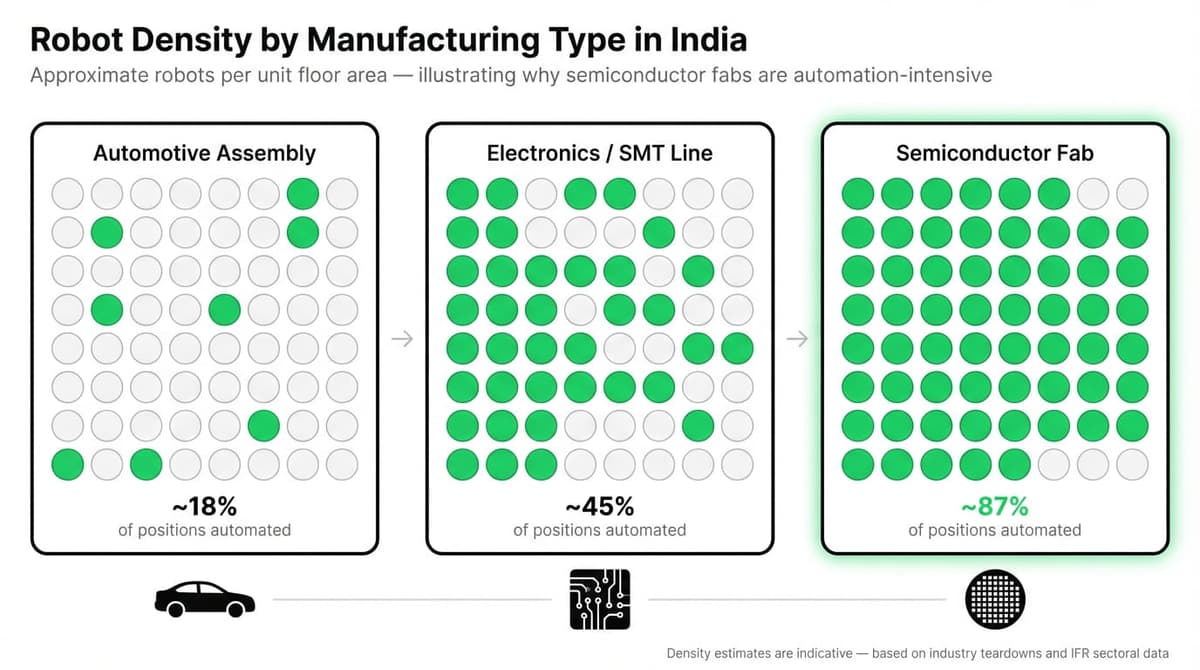
The robotics opportunity in Indian electronics manufacturing is enormous but qualitatively different from automotive. Electronics production is inherently more flexible (product lifecycles are shorter, model changes happen frequently), which requires robots that can be reprogrammed quickly and handle diverse products.
2.3 Semiconductor: The Ultra-High Automation Frontier
India's semiconductor ambitions represent the most automation-intensive manufacturing segment the country has ever undertaken. The India Semiconductor Mission, with USD 10 Billion+ allocation, is funding:
- ●Tata Electronics semiconductor fab in Dholera, Gujarat — India's first large-scale semiconductor fabrication facility, targeting 28nm to 110nm process nodes (with a separate partnership with PSMC exploring future 14nm capability). A modern semiconductor fab is essentially a fully automated factory — wafer transport, lithography, etching, deposition, and inspection are all robot-handled in cleanroom environments. A single fab can contain hundreds of specialized robots and automated material handling systems.
- ●Micron Technology ATMP facility in Sanand, Gujarat — semiconductor back-end operations (assembly, testing, marking, packaging) are also highly automated, using precision die bonding, wire bonding, and testing equipment.
When these facilities become operational (expected 2025–2027 for initial phases), they will represent an unprecedented injection of high-end automation into India's manufacturing landscape and create demand for skilled robot technicians and process engineers that India currently does not have in adequate numbers.
3. Metal and Machinery Industry
3.1 Growth Trajectory
The metal and machinery sector showed one of the strongest growth rates in robot adoption in 2024, with installations growing 30% year-over-year to reach 420 units. While small in absolute terms, this growth signals broadening automation beyond the traditional automotive-electronics axis.
3.2 Key Applications
Robotic Welding in Fabrication
Medium-to-large fabrication shops serving construction equipment (L&T, BEML, Caterpillar India), heavy machinery (Siemens, ABB, Thermax), and structural steel sectors are increasingly deploying robotic welding cells. These typically involve 6-axis articulated robots with MIG/MAG or TIG welding packages, paired with positioners and turn-table fixtures to achieve full-coverage welding on complex geometries.
The challenge in Indian metal fabrication is the diversity of product sizes and specifications. A typical heavy engineering shop may produce 50–100 different part types with batch sizes of 5–50 units. This high-mix/low-volume profile historically made robotic welding uneconomical. However, advances in offline programming (OLP) — where robot programs are created from CAD models rather than manually taught point-by-point — are reducing programming time from days to hours, making small-batch robotic welding increasingly viable.
CNC Machine Tending
India has a large installed base of CNC machines (estimated 200,000+ across all industries). CNC machine tending — loading raw material, unloading finished parts, and simple inspection — is one of the most straightforward robot applications and has clear ROI even for small shops operating 16–24 hour shifts. Cobots from Universal Robots, Techman, and Doosan are particularly popular for this application because they can be deployed alongside existing machines without safety fencing.
Casting and Forging
India's casting industry (the world's 2nd largest) and forging industry (2nd largest, per the Association of Indian Forging Industry at IFC 2025) are massive but poorly automated. Operations like die-casting extraction, deburring, fettling, and post-cast inspection are physically demanding, hazardous, and repetitive — ideal for robotic automation. Companies like Bharat Forge have invested in robotic forging lines, but the broader industry (particularly small foundries) remains largely manual.
3.3 SME Challenge
The metal and machinery sector epitomizes India's SME automation challenge. The sector is fragmented across thousands of small workshops in industrial clusters like Ludhiana (Punjab), Rajkot (Gujarat), Coimbatore (Tamil Nadu), and Howrah (West Bengal). These shops typically have:
- ●Annual revenue under INR 5–10 crore
- ●20–100 workers
- ●Older machinery (non-CNC or basic CNC)
- ●Limited technical capability for robot integration
- ●No access to the kind of system integrators who design and deploy robotic cells
For this segment, the path to automation is not through traditional industrial robots but through:
- 1Cobots with simplified programming interfaces
- 2RaaS (Robotics-as-a-Service) models that eliminate upfront capital requirements
- 3Cluster-level shared automation centers where multiple workshops share access to robotic welding, inspection, or finishing equipment
- 4Government-subsidized demonstration centers where SME owners can see robots operating on their own part types before committing to investment
4. Plastics and Chemical Products
4.1 Fastest-Growing Segment
The plastics and chemical products sector recorded the highest growth rate in robot installations in 2024, with 600 units installed — a 33% increase year-over-year. This sector includes injection molding, blow molding, extrusion, and chemical process packaging.
4.2 Why Plastics is Adopting Fast
Injection Molding Automation
India has an enormous injection molding industry, producing everything from automotive components (bumpers, dashboards, interior trim) to consumer goods (containers, packaging) and electrical components (switchgear, connectors). Injection molding is inherently suited to robotic automation because:
- ●The cycle is highly repetitive (mold closes → inject → cool → eject → repeat)
- ●Part extraction from the mold can be done by a simple 3-axis Cartesian robot or a 6-axis robot, depending on part complexity
- ●Downstream operations (trimming, inspection, packaging) are also automatable
In India, injection molding robots are often the "first robot" a company buys — because the ROI is clear, the integration is straightforward, and the payback period is typically 12–18 months even for medium-volume production.
Chemical and Pharma Packaging
The chemical and pharmaceutical sectors require automation for safety and compliance reasons — handling hazardous chemicals, maintaining sterile packaging environments, and ensuring traceability. Robotic palletizing systems are increasingly common in Indian chemical packaging operations.
4.3 Domestic Robot Makers and Low-Cost Solutions
The plastics sector is notable because it has spurred the growth of domestic robot manufacturers who build simplified, cost-effective injection molding robots. Companies like Alfa Robotic Systems, Robolink, and several Pune and Ahmedabad-based manufacturers produce Cartesian and SCARA-type injection molding robots at 30–50% of the cost of imported equivalents. These may lack the precision and reliability of ABB or Fanuc units, but they serve the needs of small and medium plastics molders effectively.
5. Pharmaceuticals and Healthcare Manufacturing
5.1 Compliance-Driven Automation
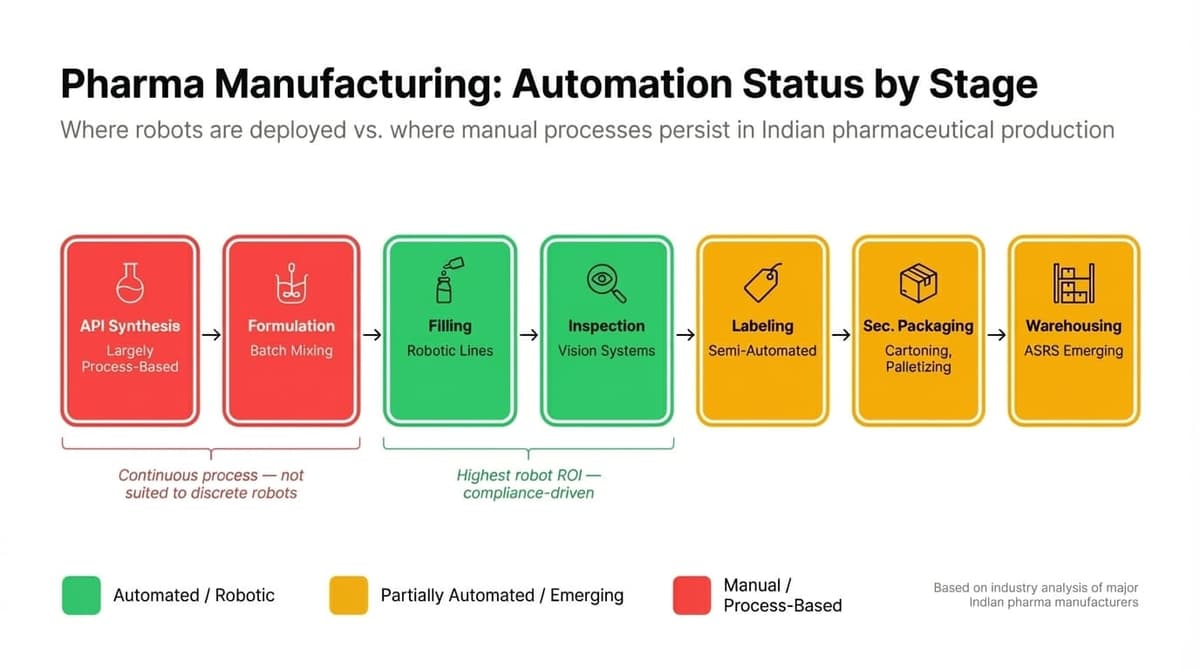
India is the "pharmacy of the world," supplying 60%+ of the global vaccine supply and 20% of global generic medicines. This massive manufacturing base is under constant pressure to meet FDA, EMA, and WHO quality standards — which increasingly require automated processes for:
- ●Filling and capping: Robotic vial/bottle filling lines ensure consistent fill volumes and sterile handling
- ●Inspection: Vision-based robotic inspection of vials for particulate contamination, fill level, and cap integrity
- ●Packaging and serialization: Automated packaging lines with unique serial numbers for track-and-trace compliance (as mandated by regulations like the EU's Falsified Medicines Directive)
- ●Cleanroom operations: Isolator-based robotic arms for handling sterile products without human contact
5.2 Current State
The adoption of industrial robots in Indian pharma manufacturing is moderate but growing. Large Contract Manufacturing Organizations (CMOs) and major companies like Sun Pharma, Dr. Reddy's, Cipla, and Biocon have invested in robotic filling lines and automated inspection systems. However, the broader pharma industry — particularly API (Active Pharmaceutical Ingredient) manufacturing — remains more process-oriented than robotics-oriented, relying on continuous chemical processing equipment rather than discrete robotic operations.
The biggest robotics opportunity in Indian pharma is in secondary packaging (boxing, cartoning, palletizing) and warehouse automation (automated storage and retrieval for temperature-controlled warehousing).
6. Food and Beverage Processing
6.1 The Untapped Giant
India's food processing industry is valued at over USD 500 Billion and is one of the largest employers in the country. Yet it remains one of the least automated manufacturing sectors. The reasons are structural:
- ●Highly fragmented: The sector includes everything from village-level grain mills to large FMCG factories (Nestle, Britannia, ITC, Amul). The vast majority of food processing units are micro-enterprises.
- ●Product variability: Indian food products have enormous variety in shapes, sizes, textures, and packaging requirements — making standardized robotic handling difficult.
- ●Hygiene requirements without compliance enforcement: While food safety regulations exist (FSSAI), enforcement in smaller operations is inconsistent, reducing the compliance-driven automation pressure that drives robotics adoption in Western food processing.
6.2 Where Automation is Happening
Large FMCG operations in India are deploying robots primarily in:
- ●Palletizing: End-of-line palletizing is often the first robot application in food processing, handling cases/cartons onto pallets at speeds that exceed manual capability
- ●Pick and place for packaging: High-speed delta/parallel robots for picking products (biscuits, snack packets, confectionery) from conveyor lines and placing them into trays or cartons
- ●Sorting and grading: Vision-based systems for sorting fruits, vegetables, nuts, and spices by size, color, and quality — this is growing in export-oriented operations
Companies like Nestle India, Britannia, Parle, and ITC have modernized their packaging lines with robotic systems. Dairy giants like Amul and Mother Dairy use automated processing and packaging equipment, though not always articulated robots — often purpose-built packaging machines with integrated automation.
6.3 Cold Chain and Food Safety
The expansion of India's cold chain infrastructure (National Cold Chain Development Plan) creates opportunities for robotic automation in temperature-controlled environments where human labor is uncomfortable and less productive. Robotic palletizers, AGVs, and automated storage systems that operate at -20°C to +4°C are increasingly relevant.
7. Textiles and Apparel
7.1 India's Automation Resistance Poster Child
The textile and apparel sector is India's second-largest employer (after agriculture), with over 45 million direct workers. It is also one of the most resistant sectors to robotics automation globally — and India is no exception.
The fundamental challenge is that textile production, particularly garment sewing, involves handling soft, deformable materials (fabric) that are extremely difficult for robots to manipulate. While cutting, dyeing, and spinning have been mechanized (though not fully roboticized), sewing remains a manual, skill-intensive operation. Even in China and Bangladesh — far more automated textile economies — garment sewing is largely done by human operators on industrial sewing machines.
7.2 Where Automation is Possible
Despite the sewing challenge, several areas of textile manufacturing are amenable to automation:
- ●Fabric cutting: Automated CNC fabric cutting tables (from companies like Lectra, Gerber) are used in larger garment factories, replacing manual pattern cutting
- ●Quality inspection: AI-powered vision systems for fabric defect detection (broken threads, color inconsistencies, weave defects) are being piloted in larger mills
- ●Warehousing and material handling: AGVs and AMRs for moving fabric rolls and finished goods within large manufacturing complexes
- ●Spinning and weaving: These are already heavily mechanized; the opportunity is in predictive maintenance using IoT sensors rather than new robot deployment
7.3 The Social Dimension
Any discussion of robotics in Indian textiles must acknowledge the social dimension. Textiles employs millions of workers, disproportionately women, in clusters like Tirupur (Tamil Nadu), Surat (Gujarat), Ludhiana (Punjab), and the NCR belt. Aggressive automation would have significant employment implications. The practical path forward is not replacing seamstresses with robots but augmenting productivity through better material handling, cutting, quality control, and warehouse logistics — allowing the human-intensive sewing operations to focus on value-addition rather than material movement.
8. Heavy Engineering, Construction Equipment, and Infrastructure
8.1 A Sector Primed for Robots but Slow to Adopt
India's heavy engineering sector — spanning construction equipment (L&T, BEML, Caterpillar India, JCB India), power generation equipment (BHEL, Siemens, GE), and infrastructure fabrication (bridge components, pressure vessels, boilers) — involves exactly the kind of tasks that robots handle well: heavy welding, machining, surface treatment, and assembly of large steel structures.
Yet adoption is slower than in automotive because:
- ●Product variety: A construction equipment manufacturer may produce 50+ models with extensive customization, making fixed automation uneconomical
- ●Part sizes: Many heavy engineering components are physically large (3m+ dimensions), requiring robots with extended reach and high payload capacity — expensive and requiring significant floor space and safety infrastructure
- ●Low production volumes: Annual volumes of 500–5,000 units for a given product type are common, making the per-unit robot amortization high
8.2 Success Stories
Despite these limitations, several Indian heavy engineering companies have made significant investments in robotic automation:
- ●Bharat Forge: India's largest forging company has invested in robotic forging and machining cells in Pune, achieving levels of automation comparable to European forging operations
- ●L&T Heavy Engineering: Uses robotic welding for pressure vessel and nuclear component manufacturing in its Hazira and Powai facilities
- ●JCB India: Has deployed robotic welding cells in its Jaipur plant for excavator boom and arm welding
The trend in heavy engineering is toward flexible robotic cells with offline programming — cells that can be reprogrammed for different products within hours rather than the days or weeks required for traditional teach-pendant programming. This flexibility is essential for India's high-mix production environment.
9. Cross-Sector Patterns and Observations
9.1 The "First Robot" Problem
Across all sectors, the biggest barrier is not the technology or even the cost — it is the lack of first-hand experience with robotic automation. For many Indian manufacturing managers and factory owners, they have never seen a robot operating on their own product type. The mental model of automation is either "massive automotive welding lines" (which feels unattainable) or "expensive experiments that didn't work" (based on hearsay from peers).
Key Insight:
The "first robot" problem is why demonstration centers, trial programs, and RaaS (Robotics-as-a-Service) models are so critical for India's next wave of adoption. Once a factory owner sees a robot successfully loading their CNC machine, welding their bracket, or palletizing their product cartons — with their own eyes, on their own parts — the psychological barrier collapses.
9.2 System Integration: The Missing Value Chain Layer
A robot is useless without system integration — the engineering to design the cell layout, fixtures, end-effectors, safety systems, programming, and commissioning. India has a severe shortage of qualified system integrators. The market is served by:
- ●OEM-affiliated integrators: ABB, Fanuc, and Yaskawa have partner integrator networks, but these are concentrated in major cities and focus on larger projects
- ●Independent integrators: A small but growing number of Indian companies specialize in robotic cell design and deployment, but their capacity is limited
- ●Machine builders: Companies that build special-purpose machines are increasingly incorporating robots, but their robotic programming skills may be limited
Expanding the system integrator base is arguably more important for India's robotics growth than reducing robot hardware costs.
9.3 The Sector-Readiness Spectrum
| Readiness Level | Sector | Robot Density Relative to Global Peers |
|---|---|---|
| High | Automotive OEMs | 50–70% of global best (for new plants) |
| Medium-High | Electronics (large EMS operations) | 40–60% |
| Medium | Pharma (large formulation) | 30–50% |
| Medium | Plastics (injection molding) | 25–40% |
| Low-Medium | Metal & Machinery (large enterprises) | 15–25% |
| Low | Food & Beverage (organized sector) | 10–20% |
| Very Low | Textiles, Leather, Small Foundries | <5% |
Note: These are informed estimates based on installation data, industry reports, and sector-level analysis, not precise measurements.
10. Key Takeaways
- 1Automotive drives the market but is not the whole story. At ~45% of unit installations (IFR, 2024) and 36% by market value (IMARC), automotive dominance is actually declining as other sectors grow faster in percentage terms (plastics +33%, metals +30% in 2024).
- 2The EV transition is automotive's second automation wave. Greenfield EV plants are being designed with 90%+ BIW automation — a leap from legacy plants. Battery pack assembly brings entirely new robot categories into Indian manufacturing.
- 3Electronics/semiconductor is the next mega-driver. PLI-driven investments of INR 41,863 crore in electronics components, plus semiconductor fabs, will create demand for thousands of robots in high-precision, cleanroom-capable configurations.
- 4The SME gap is the defining challenge. India's manufacturing is overwhelmingly SME-based. These companies lack capital, technical knowledge, and access to system integrators. Cobots, RaaS, and demonstration programs are the bridge, but they need massive scale-up.
- 5Food processing and textiles are the biggest unrealized opportunities. Together they employ 100+ million Indians and have near-zero robot density. Automating even packaging and material handling in these sectors would dramatically expand the total addressable market.
- 6System integrators — not robots — are the bottleneck. India needs 5–10x more qualified system integrators to turn robot purchases into working production cells.
Closing Thoughts
The sector-by-sector view makes one thing clear: India's robotics story is not a single narrative. It is multiple parallel stories — automotive racing ahead on the EV wave, electronics being pulled forward by PLI-scale investments, pharma pushed by global compliance, and a vast SME landscape watching from the sidelines, waiting for the right entry point.
The sectors that will define the next phase of growth are not the ones already buying robots. They are the ones with the largest gaps — food processing, textiles, small metal fabrication shops — where even modest automation of packaging, material handling, or inspection would represent a step change. The infrastructure to serve these sectors — affordable cobots, accessible system integrators, RaaS financing, hands-on demonstration programs — is still being built.
In the next installment of this series, we go deeper into the specific challenges and structural blockers that slow India's robotics adoption — from the system integrator shortage to the skill gap, financing hurdles, and the policy environment.
References & Further Reading
5
Ministry of Electronics and IT. "PLI Scheme for Electronics Components." Government of India. — INR 41,863 crore total approved investment across tranches.
7
IMARC Group. "India Robotics Market by End Use Industry." — Source for sectoral market share breakdowns.
Assine nosso Blog
Receba as últimas novidades sobre robótica e IA no seu email.
Sem spam. Cancele quando quiser.
You Might Also Like
View all posts
Industry Analysis
The State of Robotics Automation in India: Market Overview and Global Position
A comprehensive data-driven analysis of India's robotics market — market size, growth trajectory, global positioning, robot density gap, sectoral composition, key players, government policy, and structural challenges as of early 2026.
Mar 8, 202626 min read
Industry Analysis
Agriculture, Warehouse, and Logistics Robotics in India
A data-driven analysis of India's most distinctive robotics opportunities — agricultural drones (Kisan Drone, Namo Drone Didi, 38,500+ registered drones), warehouse automation (USD 560M market, Addverb, GreyOrange, Unbox Robotics, quick-commerce fulfillment), cold chain robotics, drone delivery, and the farm-to-consumer automation chain.
Apr 9, 202623 min read
Industry Analysis
Defence and Space Robotics in India
A strategic analysis of India's defence and space robotics ecosystem — military UAVs (IdeaForge, Adani-Elbit Hermes 900, DRDO TAPAS-BH, HAL CATS), unmanned ground vehicles (AeroArc Robotic MULE, Bhairav Robotics Shvana), underwater robotics (DRDO MP-AUVs, EyeROV TUNA), swarm drones, the Atmanirbhar Bharat defence push (1,000+ startups, USD 247M investments in 2025), ISRO's Pragyan lunar rover, SpaDeX robotic arm in space, Vyommitra humanoid for Gaganyaan, and India's 2035 space station roadmap.
Apr 19, 202623 min read
Pronto para Construir Algo com Impacto?
Vamos discutir como nossa equipe pode ajudar a dar vida à sua visão de IA e robótica.