Zurück zum Blog
Computer Vision Models for Industry · Part 1 of 6Computer Vision
YOLO in 2026: The Complete Evolution from Research Prototype to Industry Standard
In the decade since its introduction, YOLO (You Only Look Once) has transformed from an academic curiosity into the backbone of computer vision systems powering everything from autonomous vehicles to quality control on factory floors. If you're evaluating object detection solutions for your organization—whether you're a technical lead architecting a new system or a business stakeholder assessing AI capabilities—understanding the YOLO ecosystem is no longer optional.
This isn't another surface-level overview. We've written this guide to give you the depth required to make informed decisions: understanding not just what each YOLO version does, but why it matters for your specific deployment context. By the end of this article, you'll understand the technical trajectory that brought us to 2026's state-of-the-art, and more importantly, which models deserve your attention today.
The Paradigm Shift: Understanding What Made YOLO Revolutionary
Before we explore the modern YOLO landscape, it's essential to understand the problem YOLO originally solved—because that context illuminates why certain architectural decisions were made and why some approaches succeeded where others failed.
The World Before YOLO: A Computational Bottleneck
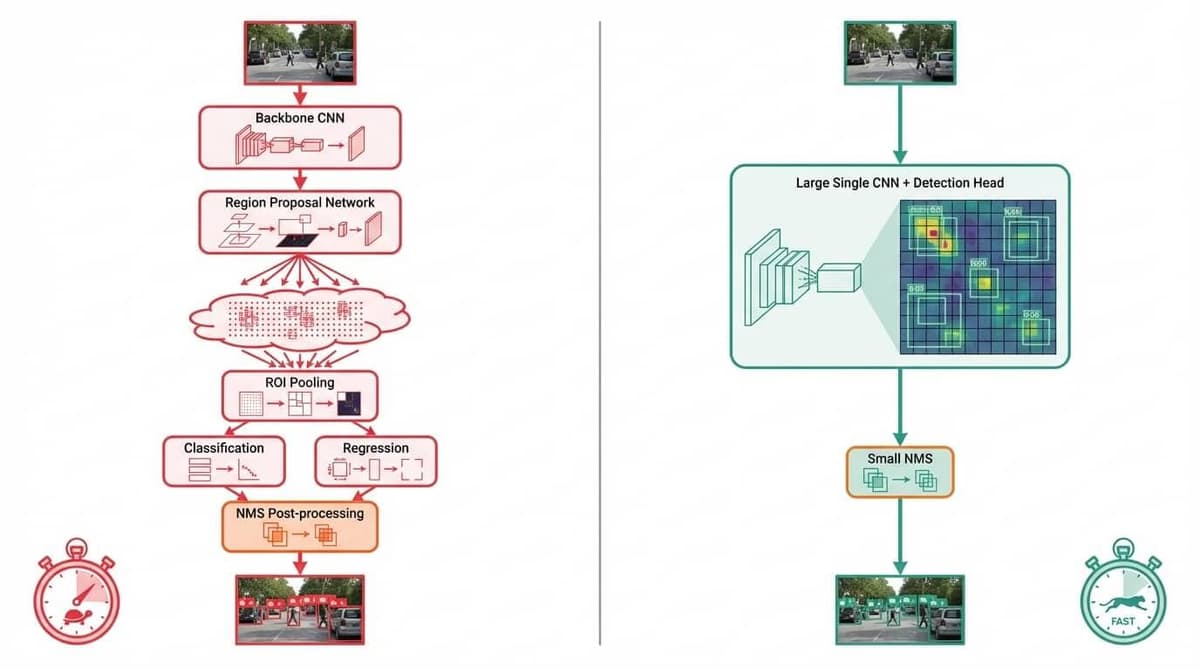
Prior to 2016, the dominant approach to object detection was fundamentally two-phase. Systems like R-CNN, Fast R-CNN, and Faster R-CNN worked through a pipeline that first generated thousands of "region proposals"—areas of an image that might contain objects—and then classified each proposal separately.
This approach had an intuitive appeal: focus computational resources only on regions likely to contain objects rather than processing the entire image. In practice, however, this created significant challenges:
- ●Latency Issues: Even Faster R-CNN, the most optimized variant, processed images at roughly 7 frames per second on the hardware of its era. For applications requiring real-time processing—security systems, autonomous navigation, industrial inspection at production speeds—this was simply insufficient.
- ●Pipeline Complexity: The two-stage nature meant optimization was difficult. Improving region proposal generation didn't necessarily improve final detection quality, and the components had to be carefully balanced.
- ●Contextual Blindness: Because each region was classified independently, these systems struggled with objects whose identity depended on context. A region containing part of a bicycle wheel, viewed in isolation, might be misclassified; a system that sees the entire bicycle has more information to work with.
YOLO's Insight: Detection as Regression
Joseph Redmon's fundamental insight was elegant in its simplicity: what if we treated object detection not as a classification problem requiring region-by-region analysis, but as a single regression problem that could be solved in one forward pass through a neural network?
The original YOLO divided an image into a grid (typically or cells) and had each cell predict:
- 1Whether an object's center fell within that cell
- 2The bounding box coordinates for that object
- 3The probability distribution over possible classes
This reformulation meant that detecting objects in an image required exactly one pass through the network—hence "You Only Look Once." The computational implications were dramatic: while region-based methods measured performance in seconds per image, YOLO measured performance in images per second.
Key Insight:
By processing the entire image at once, YOLO models developed "contextual intelligence"—the ability to use global information when making local predictions. A person standing next to a car, a fork on a plate, a ball in someone's hands: these contextual relationships help resolve ambiguities that isolated region analysis would miss.
The Evolution: A Decade of Continuous Innovation
Understanding YOLO's development requires recognizing that multiple research groups have contributed to its evolution, sometimes building on each other's work, sometimes pursuing parallel paths. What follows is a comprehensive chronological analysis of each major version, focusing on the innovations that matter for practical deployment.
The Foundational Era: YOLOv1 through YOLOv3 (2016-2018)
YOLOv1: Proof of Concept
The original YOLO, presented at CVPR 2016, demonstrated that single-shot detection was viable. It achieved 45 frames per second on contemporary hardware while maintaining competitive (though not state-of-the-art) accuracy.
However, the original design had notable limitations that subsequent versions would address:
- ●Small object detection was poor: Each grid cell could only predict a limited number of objects, and small objects often fell through the cracks
- ●Localization accuracy lagged: Bounding box predictions, while fast, weren't as precise as region-based methods
- ●Generalization challenges: The model struggled with unusual aspect ratios and object configurations
These limitations weren't failures—they were the natural starting point for a research program that would spend the next decade addressing them.
YOLOv2: Engineering Excellence
Released in 2017, YOLOv2 (also known as YOLO9000) introduced several techniques that would become standard practice:
- ●Batch Normalization: Added after every convolutional layer, stabilizing training dynamics and allowing dropout removal. The result was both faster convergence and better final accuracy—a 2% mAP improvement from this single change.
- ●Anchor Boxes: Rather than predicting bounding box dimensions from scratch, YOLOv2 predicted adjustments to predefined "anchor" boxes determined by k-means clustering on training data. This significantly improved recall.
- ●Multi-Scale Training: Training on images at varying resolutions ( to ) taught the model to detect objects at different scales and gave practitioners flexibility to trade speed for accuracy.
The "9000" designation reflected an ambitious experiment: by combining detection training with classification training using a hierarchical label structure, YOLO9000 could detect over 9,000 categories—demonstrating the potential for expanding YOLO's vocabulary beyond fixed training sets.
YOLOv3: The Multi-Scale Breakthrough
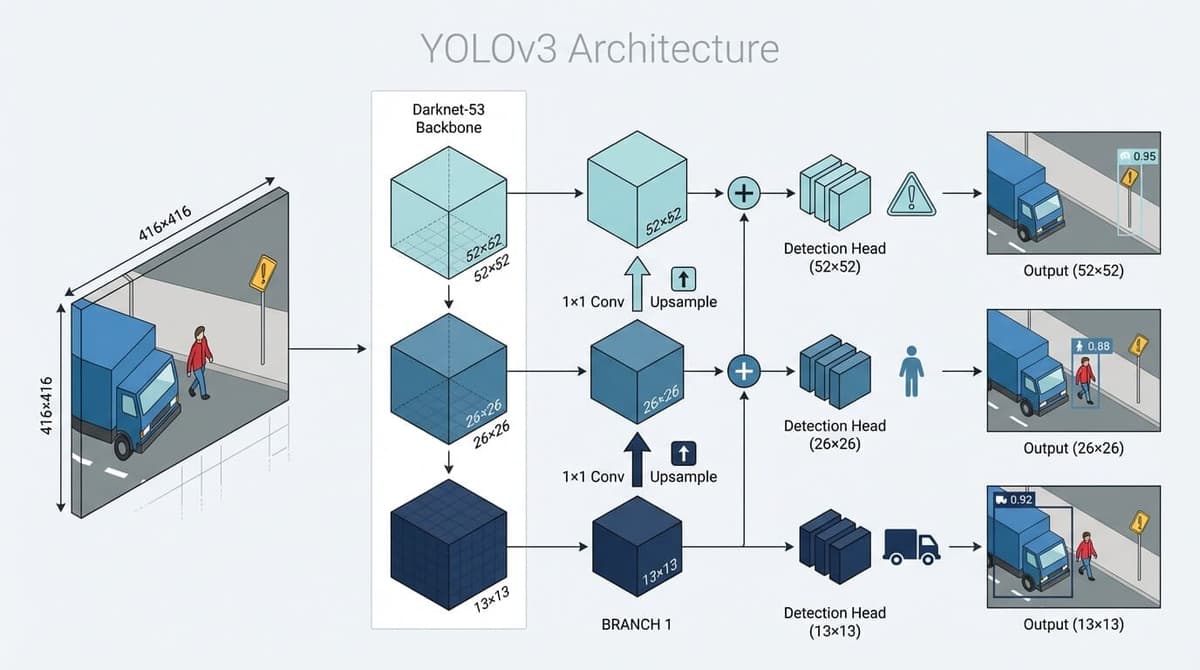
YOLOv3, released in 2018, addressed perhaps the most significant weakness of earlier versions: detecting objects at different scales within the same image.
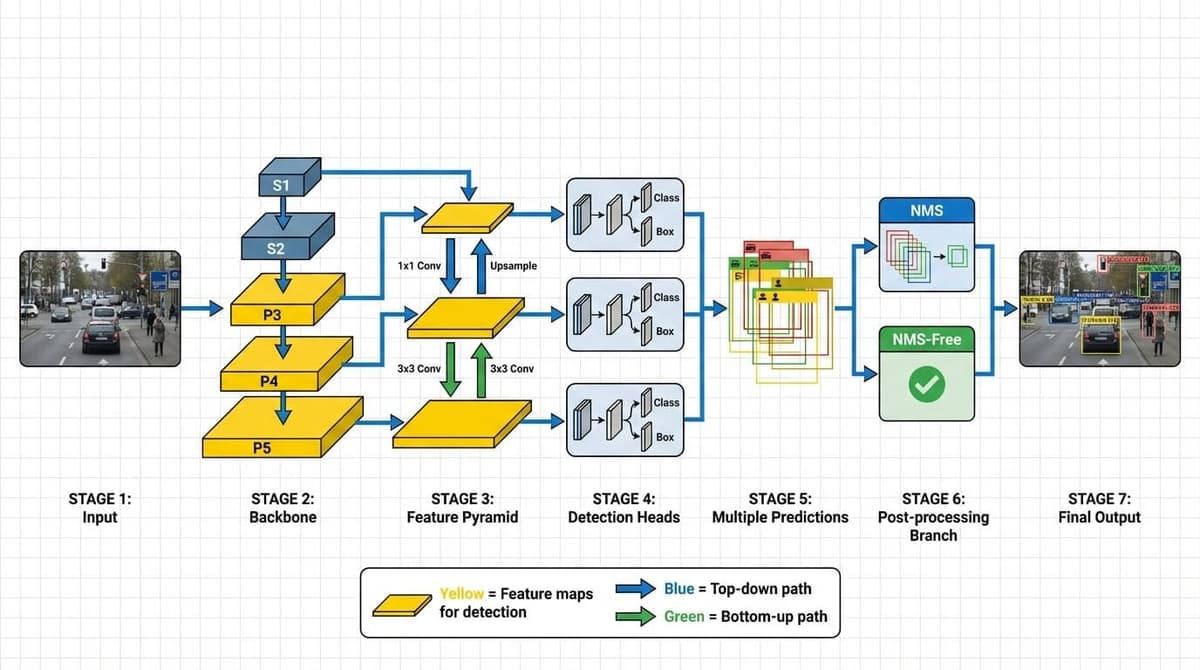
The key innovation was integrating a Feature Pyramid Network (FPN) architecture that made predictions at three different scales. Feature maps from early in the network (which preserve spatial detail) were combined with feature maps from later layers (which capture semantic information) to create representations suitable for detecting both small and large objects.
Consider a surveillance camera monitoring a parking lot: it needs to detect both distant vehicles (appearing small in the frame) and nearby pedestrians. YOLOv3's multi-scale approach meant a single model could handle both scenarios without requiring multiple passes or model ensembles.
The backbone network also evolved significantly. Darknet-53, with its 53 convolutional layers and residual connections, achieved accuracy comparable to much larger networks like ResNet-152 while running nearly twice as fast.
The Divergence Era: YOLOv4 through YOLOv8 (2020-2023)
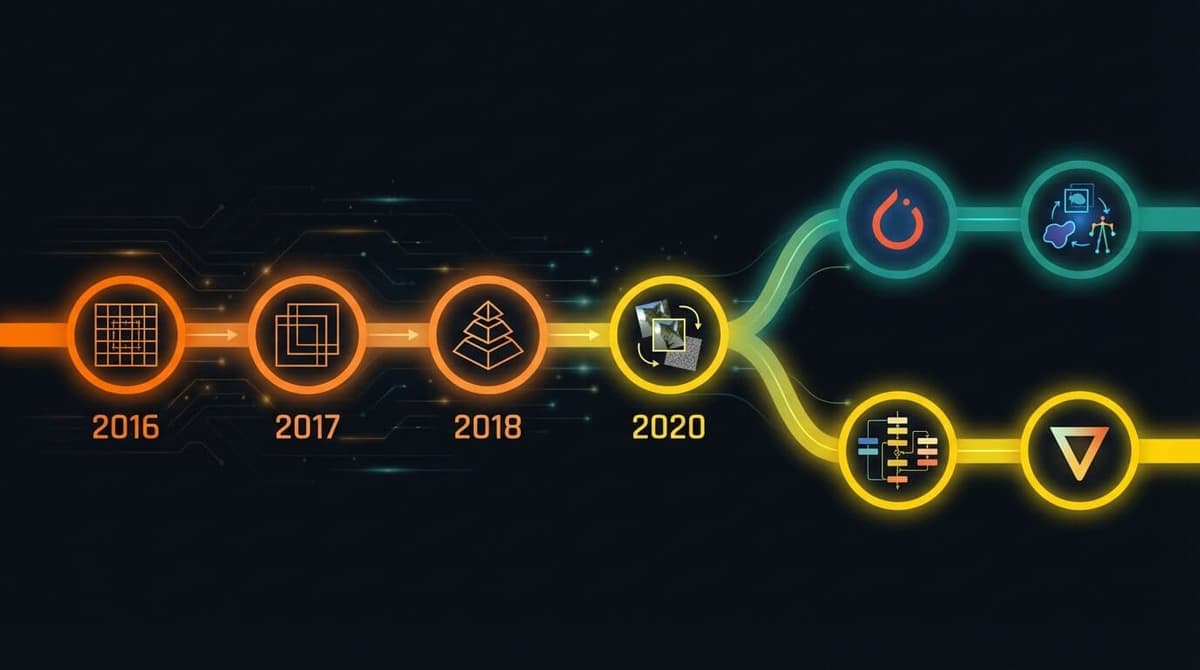
The period from 2020 onward saw YOLO development split into multiple parallel tracks, each pushing the state of the art in different directions.
YOLOv4: The Comprehensive Survey
Released in April 2020 by Alexey Bochkovskiy (Joseph Redmon had stepped away from computer vision research citing ethical concerns), YOLOv4 represented a systematic integration of best practices from across the object detection literature.
Rather than introducing fundamentally new concepts, YOLOv4's contribution was comprehensive evaluation and thoughtful combination of existing techniques. The authors categorized innovations into two groups:
| Category | Technique | Impact |
|---|---|---|
| Bag of Freebies | Mosaic augmentation | Combines 4 images, forcing varied context learning |
| Bag of Freebies | CutMix | Cuts and pastes regions with proportional labels |
| Bag of Freebies | Label smoothing | Prevents overconfident predictions |
| Bag of Specials | CSPDarknet53 backbone | Reduced computation, maintained accuracy |
| Bag of Specials | SPP (Spatial Pyramid Pooling) | Increased receptive field efficiently |
| Bag of Specials | PANet neck | Improved multi-scale feature aggregation |
For practitioners, YOLOv4 provided a well-validated recipe: these techniques work, they work together, and here's how to implement them.
YOLOv5: The Developer Experience Revolution
Just months after YOLOv4, Ultralytics released YOLOv5. The version number sparked controversy—Ultralytics wasn't part of the original YOLO lineage—but the impact was undeniable.
YOLOv5's primary contribution wasn't architectural; it was engineering excellence and accessibility:
- ●PyTorch Implementation: Previous versions used the custom Darknet framework. YOLOv5 was pure PyTorch, immediately accessible to anyone familiar with Python's dominant deep learning ecosystem.
- ●Production-Ready Tooling: Automatic anchor optimization, extensive data augmentation, built-in experiment tracking, and comprehensive export functionality (TensorRT, ONNX, CoreML, TFLite).
- ●Model Zoo: A family of models from nano (1.9M parameters) to extra-large (86.7M parameters), allowing practitioners to choose their own speed-accuracy tradeoff.
- ●Documentation and Community: Comprehensive docs, active maintenance, and responsive support—the "soft" factors that determine real-world adoption.
Key Insight:
YOLOv5 became the most widely deployed YOLO version in history, running in production systems across industries worldwide. Sometimes the best technical choice isn't the most innovative architecture—it's the one that gets out of your way.
YOLOv6 and YOLOv7: Parallel Innovation
While Ultralytics developed YOLOv5, other organizations continued pushing the architecture:
- ●YOLOv6 (Meituan, 2022) focused on industrial deployment efficiency. Its EfficientRep backbone used re-parameterization—training with complex multi-branch architectures that collapse into simpler, faster structures for inference.
- ●YOLOv7 (original YOLO lineage, 2022) introduced Extended Efficient Layer Aggregation (E-ELAN) for better gradient flow, and pioneered auxiliary head training—additional supervision during training that's removed for inference.
YOLOv8: Multi-Task Unification
Ultralytics' YOLOv8 (January 2023) unified multiple computer vision tasks—detection, segmentation, classification, and pose estimation—into a single framework sharing common backbones and infrastructure.
| Innovation | Description | Benefit |
|---|---|---|
| Anchor-Free Detection | Predicts object centers directly | Simpler training, no anchor tuning |
| C2f Module | New building block for gradient flow | Better training of deeper networks |
| Decoupled Head | Separate classification/localization branches | Task-specific optimization |
| Polished API | Intuitive Python interface and CLI | Rapid development and deployment |
The Modern Era: 2024-2026
The past two years have seen the most rapid innovation in YOLO's history, with fundamental architectural changes and new capabilities that substantially expand what's possible.
YOLOv9: Preserving Information (February 2024)
Chien-Yao Wang and colleagues introduced Programmable Gradient Information (PGI) in YOLOv9, addressing a subtle but fundamental problem in deep networks.
The Information Bottleneck Problem: As images pass through successive network layers, information is inevitably lost. This isn't a bug—it's a feature for learning high-level abstractions. But the gradients that flow backward during training also degrade, making it difficult for early layers to learn effectively.
PGI addresses this through auxiliary reversible branches that maintain information pathways and generate reliable gradients. Unlike traditional auxiliary supervision (which simply adds loss terms), PGI fundamentally changes how information flows during training.
The accompanying GELAN (Generalized Efficient Layer Aggregation Network) architecture provides a modular framework that can incorporate various computational blocks while maintaining gradient path efficiency.
Key Insight:
YOLOv9 achieved measurably higher accuracy than YOLOv8 on standard benchmarks, particularly for challenging cases involving small objects or complex scenes. For applications where every percentage point matters—medical imaging, security, autonomous vehicles—this improvement translates directly to reduced error rates.
YOLOv10: Eliminating Post-Processing (May 2024)
Researchers at Tsinghua University tackled one of YOLO's persistent inefficiencies: Non-Maximum Suppression (NMS).
Why NMS Matters: Every previous YOLO version required a post-processing step to remove duplicate detections. This NMS step creates several problems:
- ●Adds latency independent of GPU acceleration
- ●Requires careful threshold tuning
- ●Is inherently sequential, limiting parallelization
- ●Makes end-to-end model optimization impossible
YOLOv10's Solution—Consistent Dual Assignments: During training, YOLOv10 uses two assignment strategies simultaneously:
- ●One-to-many: Multiple predictions per object, providing rich supervision signals
- ●One-to-one: Exactly one prediction per object, learning direct prediction
At inference, only the one-to-one head is used, producing exactly one prediction per object without any NMS. The model learns to suppress duplicates internally.
| Model | mAP (%) | Latency (ms) | Parameters |
|---|---|---|---|
| YOLOv10-N | 38.5 | 1.84 | 2.3M |
| YOLOv10-S | 46.3 | 2.49 | 7.2M |
| YOLOv10-M | 51.1 | 4.74 | 15.4M |
| YOLOv10-L | 53.2 | 7.28 | 24.4M |
| YOLOv10-X | 54.4 | 10.70 | 29.5M |
YOLOv11: Expanding Capabilities (Late 2024)
Ultralytics' YOLOv11 continued the multi-task unification philosophy while pushing accuracy boundaries further:
- ●Oriented Bounding Boxes (OBB): Essential for aerial imagery, document analysis, and any domain where objects appear at arbitrary rotations
- ●Enhanced Pose Estimation: More accurate keypoint detection for human pose and other articulated objects
- ●Improved Small Object Detection: Architectural refinements specifically targeting the persistent challenge of detecting small objects
YOLOv12: The Attention Revolution (February 2025)
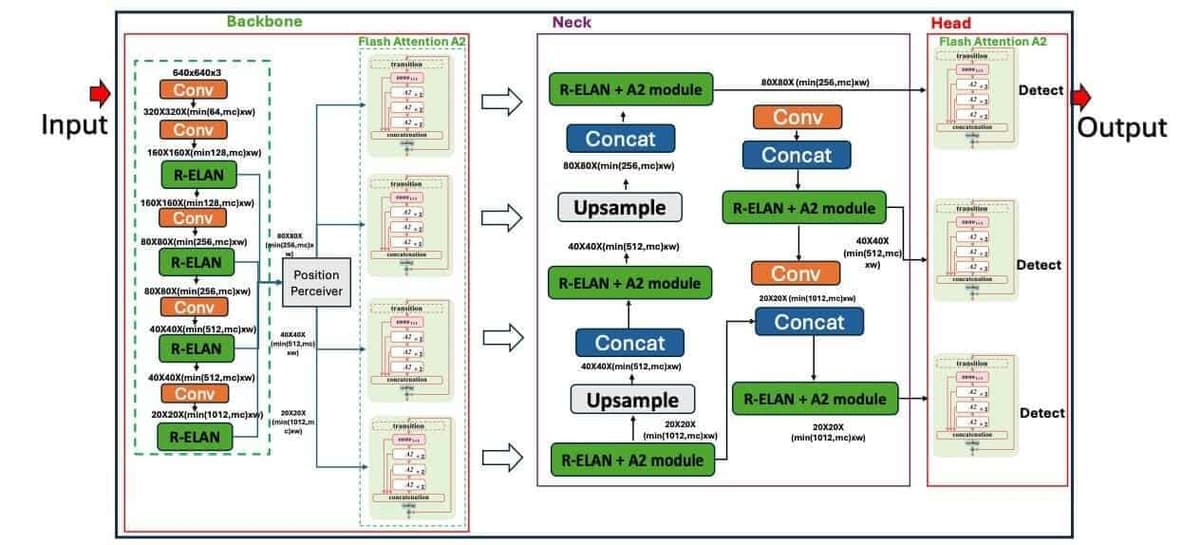
YOLOv12, developed by researchers Yunjie Tian, Qixiang Ye, and David Doermann, marked a fundamental architectural shift.
From CNN-Centric to Attention-Centric: For years, YOLO models relied primarily on convolutional architectures, using attention mechanisms sparingly if at all. The assumption was that attention's computational cost would compromise YOLO's speed advantage.
YOLOv12 challenged this assumption directly. Through careful engineering of efficient attention implementations, the authors demonstrated that attention-centric designs could match CNN speeds while achieving superior accuracy.
Why This Matters: Attention mechanisms excel at capturing long-range dependencies—relationships between distant image regions. For object detection, this translates to better handling of context, occlusion, and objects spanning multiple grid cells. A person partially hidden behind a car, a traffic sign obscured by foliage: attention helps resolve these challenging cases.
Key Insight:
YOLOv12-X outperformed RT-DETR variants (transformer-based detectors) while running faster with fewer parameters. This achievement demonstrated that the YOLO paradigm remained competitive even as transformer architectures attracted increasing research attention.
YOLO26: Edge-Optimized State of the Art (January 2026)
YOLO26 (also referred to as YOLOv26), released on January 14, 2026, represents Ultralytics' current flagship, with a specific focus on edge deployment scenarios.
Key Architectural Innovations:
- ●End-to-End NMS-Free Inference: Building on YOLOv10's dual assignment approach, YOLO26 achieves fully end-to-end inference for deployment scenarios where custom post-processing isn't possible.
- ●Progressive Loss (ProgLoss): A curriculum-learning approach that gradually increases training difficulty, leading to more robust final models.
- ●Small-Target-Aware Label Assignment (STAL): Specific improvements targeting small object detection by adjusting how ground truth is assigned based on object scale.
- ●MuSGD Optimizer: A hybrid optimizer combining SGD's stability with better convergence benefits.
| Model | mAP (e2e) | CPU ONNX (ms) | T4 TensorRT (ms) | Parameters |
|---|---|---|---|---|
| YOLO26n | 41.2% | 58.3 | 1.6 | 2.4M |
| YOLO26s | 47.8% | 112.4 | 2.9 | 9.2M |
| YOLO26m | 52.1% | 267.1 | 6.1 | 20.8M |
| YOLO26l | 54.3% | 398.2 | 9.4 | 25.3M |
| YOLO26x | 55.8% | 712.6 | 17.2 | 56.2M |
Key Insight:
YOLO26 achieves up to 43% faster inference on CPU platforms compared to previous versions. This improvement is transformative for edge deployment—industrial cameras, mobile applications, and IoT devices without GPU acceleration.
Beyond the Main Lineage: Specialized YOLO Variants
YOLO-World: Zero-Shot Detection
Developed by Tencent AI Lab, YOLO-World extends YOLO's capabilities to open-vocabulary detection—the ability to detect objects specified by natural language prompts without task-specific training.
How It Works: YOLO-World combines YOLO's detection architecture with vision-language pretraining. A Re-parameterizable Vision-Language PAN (RepVL-PAN) fuses visual features with text embeddings, enabling the model to search for objects described in words.
- ●Prototype development: Test detection concepts without training custom models
- ●Evolving requirements: When the objects of interest may change over time
- ●Long-tail categories: Objects for which training data is scarce
- ●Rapid deployment: When speed-to-production outweighs maximum accuracy
YOLO-NAS: Neural Architecture Search
Deci AI's YOLO-NAS takes a fundamentally different approach: rather than human-designed architectures, YOLO-NAS was discovered through automated Neural Architecture Search.
- ●Quantization-Aware Design: Architectures designed from the ground up with INT8 quantization in mind, maintaining accuracy through the quantization process.
- ●Transfer Learning Excellence: On the Roboflow 100 benchmark, YOLO-NAS achieves best-in-class results for fine-tuning on custom datasets.
- ●Hardware Optimization: Different variants optimized for specific deployment targets—GPUs, mobile processors, or TPUs.

Technical Foundations: Understanding How YOLO Actually Works
The Detection Head: From Features to Predictions
Every YOLO model transforms input images into predictions through a common conceptual pipeline:
Grid-Based Prediction: The input image is conceptually divided into an grid (typically , , or ). Each cell predicts objects whose centers fall within its boundaries.
- 1Bounding box coordinates : Center position and dimensions of the predicted box
- 2Objectness confidence: Probability that this prediction corresponds to a real object
- 3Class probabilities: Conditional probability for each possible class
Backbone Networks: Feature Extraction Evolution
| Era | Backbone | Key Innovation |
|---|---|---|
| 2016-2017 | Darknet-19 | VGG-inspired with reduction |
| 2018 | Darknet-53 | Residual connections |
| 2020-2022 | CSPDarknet | Cross-stage partial connections |
| 2022+ | EfficientRep | Re-parameterization |
| 2025+ | Attention-Centric | Self-attention throughout |
Neck Architectures: Multi-Scale Feature Fusion
The "neck" combines features from different backbone stages to enable detection at multiple scales:
- ●Feature Pyramid Network (FPN): Top-down pathway combining semantically rich deep features with spatially precise shallow features.
- ●Path Aggregation Network (PANet): Adds a bottom-up pathway to FPN, improving localization information flow.
- ●BiFPN: Bidirectional weighted connections that learn feature importance from different levels.
Choosing the Right YOLO for Your Application
With over a dozen YOLO variants available, selecting the right one requires understanding your specific constraints:
| Priority | Recommended | Rationale |
|---|---|---|
| Maximum accuracy | YOLO26x, YOLOv12-X | Latest architectures with highest benchmark scores |
| Production stability | YOLOv8, YOLOv5 | Mature ecosystems, extensive documentation, proven deployments |
| Edge deployment | YOLO26n/s | 43% faster CPU inference, optimized for constrained hardware |
| Multi-task needs | YOLO26, YOLOv11 | Unified frameworks supporting detection, segmentation, pose, OBB |
| Rapid prototyping | YOLO-World | Zero-shot detection with natural language prompts |
| Custom hardware | YOLO-NAS | Quantization-friendly, hardware-optimized variants |
What's Next in This Series
This article covered YOLO's evolution, but YOLO is just one approach to object detection. In the upcoming articles of this series, we'll explore:
- 1The DETR Revolution: How transformers redefined object detection with end-to-end learning
- 2Beyond Detection: Open-vocabulary and foundation models that generalize beyond training categories
- 3The Benchmarking Reality Check: Why benchmark numbers don't tell the whole story
- 4The Industry Playbook: A framework for choosing the right model for your specific business context
- 5From Prototype to Production: Deployment strategies, optimization techniques, and operational considerations
Each article will provide the same depth of technical analysis combined with practical guidance for real-world deployment decisions.
Our Perspective
At Robolabs AI, we've deployed YOLO models across dozens of production environments—from factory floor inspection systems to real-time robotics perception stacks. We've watched the YOLO family evolve from a research curiosity into the backbone of industrial computer vision.
Here's what a decade of hands-on deployment has taught us:
- ●The newest version isn't always the right version. We still run YOLOv8 in production environments where stability and ecosystem maturity matter more than marginal mAP gains.
- ●Edge deployment is where model selection really matters. The gap between YOLO26n and YOLO26x isn't just a benchmark number—it's the difference between running on a $200 Jetson and requiring a $10,000 GPU server.
- ●Transfer learning performance varies dramatically across YOLO variants. For custom industrial datasets, we've found that backbone pretraining quality often matters more than architecture novelty.
- ●The YOLO ecosystem—not just the model—drives production value. Ultralytics' tooling, export pipelines, and community support are as important as the architecture itself.
YOLO's evolution mirrors the maturation of computer vision itself: from research breakthrough to reliable engineering tool. The teams that succeed are the ones who choose based on deployment reality, not leaderboard rankings.
References & Further Reading
Computer Vision Models for IndustryPart 1 of 6
Blog abonnieren
Erhalten Sie die neuesten Einblicke zu Robotik und KI direkt in Ihren Posteingang.
Kein Spam. Jederzeit abmelden.
You Might Also Like
View all posts
Computer Vision
The Industry Playbook: Choosing the Right Computer Vision Model for Your Business
A comprehensive industry guide mapping computer vision models to real-world deployment scenarios across manufacturing, healthcare, retail, automotive, agriculture, and security. Practical model selection frameworks with evidence-backed recommendations.
Feb 27, 202626 min read
Computer Vision
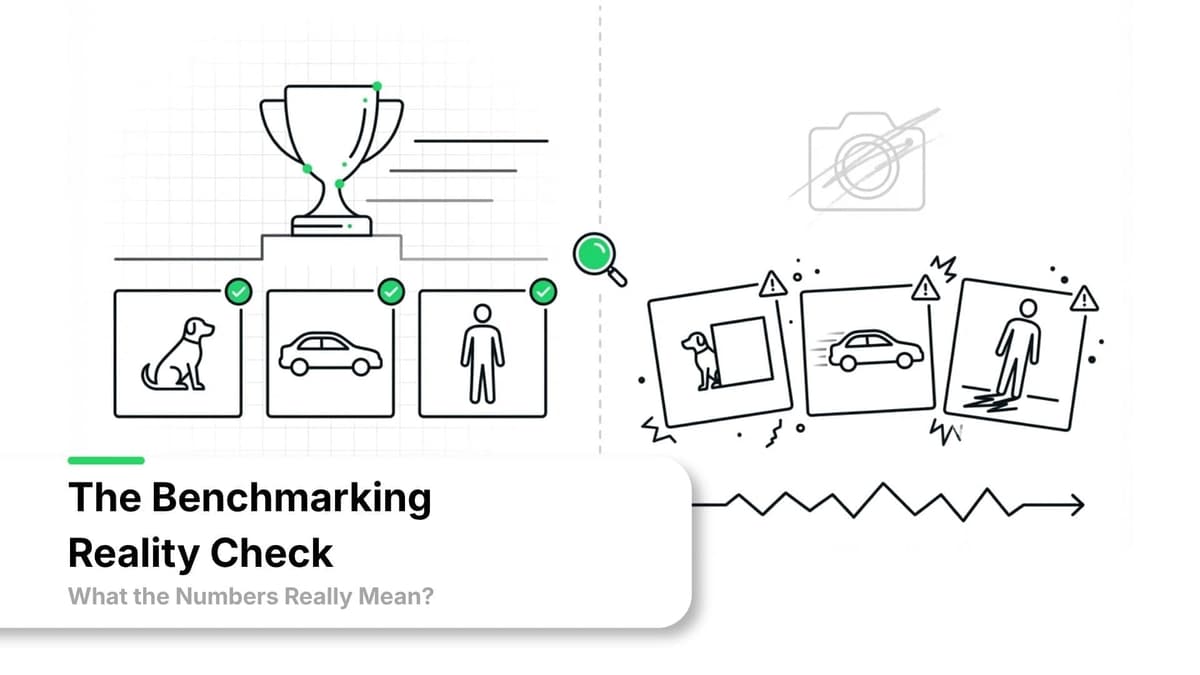
The Benchmarking Reality Check: What the Numbers Really Mean for Your Computer Vision Deployment
A comprehensive technical deep-dive into object detection benchmarks, metrics, and real-world performance. Understand mAP, latency, hardware-specific results, and how to build a practical model selection framework for production deployments.
Feb 25, 202625 min read
Computer Vision
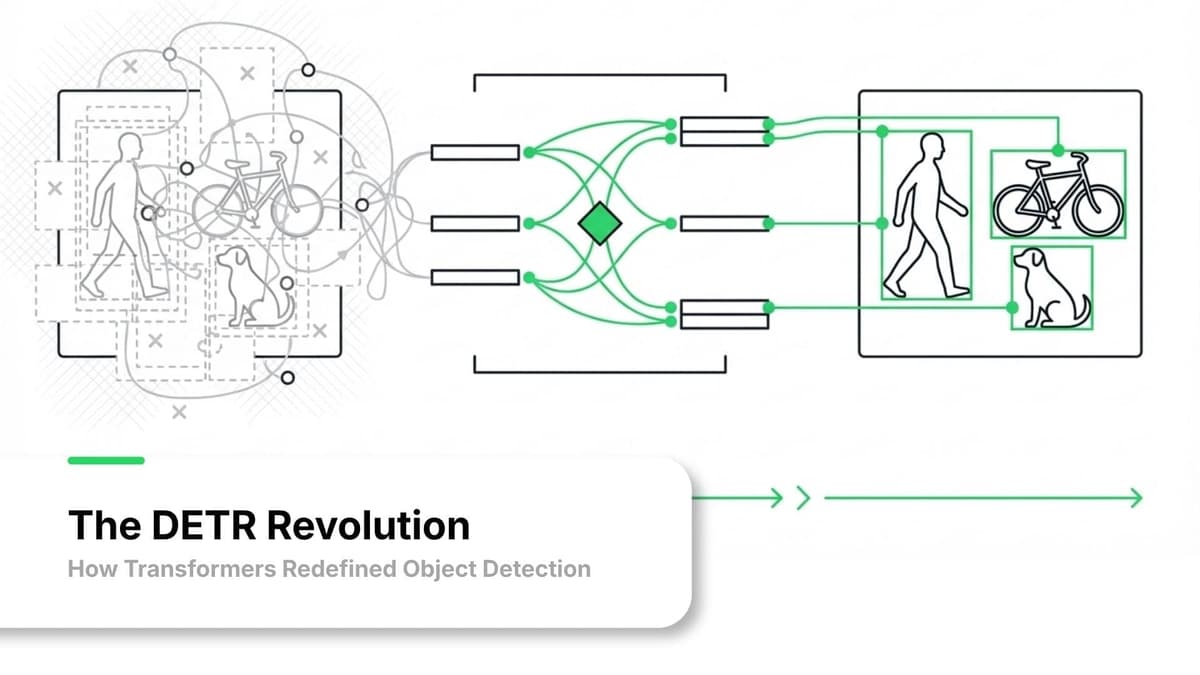
The DETR Revolution: How Transformers Redefined Object Detection
A comprehensive technical deep-dive into DETR's evolution from 2020 to 2026. Understand how transformer-based detectors work, why RF-DETR broke the 60% mAP barrier, and when to choose DETR over YOLO for your production deployments.
Feb 21, 202626 min read
Bereit, etwas Wirkungsvolles zu entwickeln?
Lassen Sie uns besprechen, wie unser Team Ihre KI- und Robotik-Vision zum Leben erwecken kann.