The $10 Billion Question
Between 2015 and 2025, the robotics industry experienced what historians may one day call its "Cambrian Explosion"—a period of unprecedented experimentation, billions in venture capital, and a staggering extinction rate. Unicorns valued in the billions vanished overnight. Market leaders that had shaped consumer expectations for decades filed for bankruptcy.
At Robolabs AI, we believe in learning from reality, not hype. This analysis isn't about celebrating failure—it's about understanding why technically brilliant companies with massive funding still didn't survive.
The pattern is clear: running out of cash is a symptom. The disease lies deeper.
When a Pioneer Becomes a Commodity: The iRobot Story
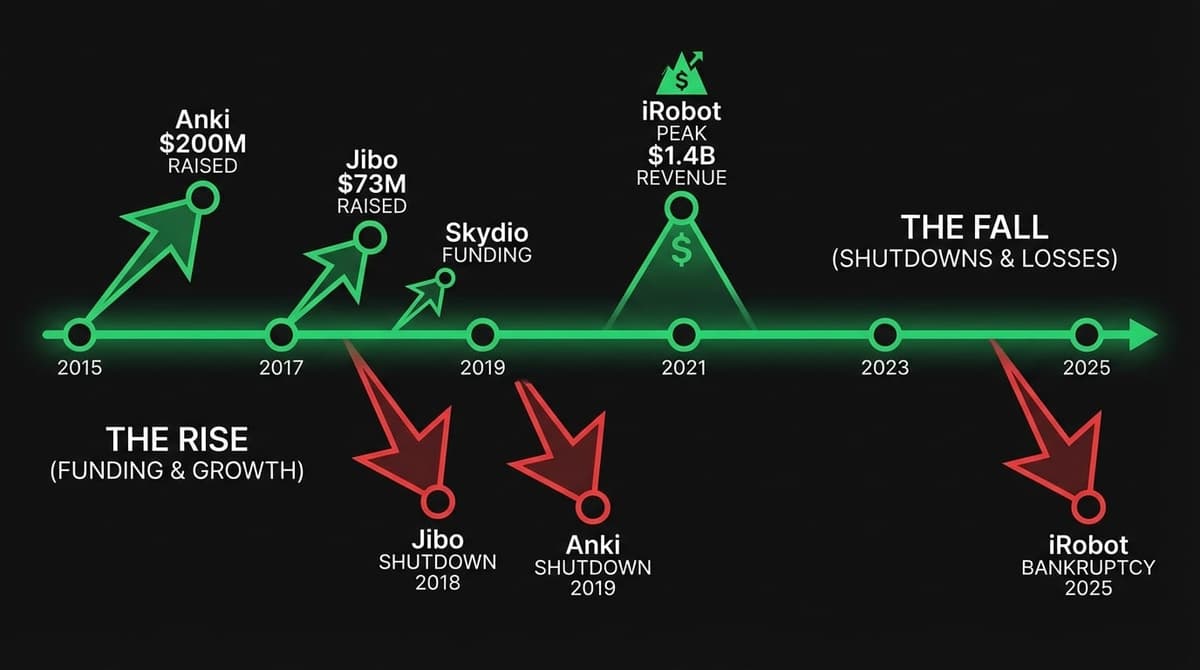
On December 14, 2025, iRobot filed for Chapter 11 bankruptcy—a symbolic end to the first generation of consumer robotics. Founded in 1990 by MIT roboticists—including the legendary Rodney Brooks—iRobot essentially created the domestic cleaning robot category with the Roomba in 2002.
For nearly two decades, iRobot dominated through aggressive patent protection, strong brand equity, and slow-moving competition. Then came the collapse.
The proximate cause was Amazon's abandoned $1.7 billion acquisition in January 2024, blocked by EU and FTC regulators on antitrust grounds. But the deeper story reveals a company already in terminal decline:
| Year | Revenue | Market Signal |
|---|---|---|
| 2020 | $1.43B | Peak performance |
| 2024 | $682M | 52% decline |
What happened? The commoditization of the very technologies that made iRobot special.
In the early 2010s, iRobot's proprietary vSLAM (visual simultaneous localization and mapping) was cutting-edge. By 2023, Chinese competitors—Roborock, Ecovacs, Dreame—were integrating superior LiDAR navigation systems derived from automotive suppliers at significantly lower price points.
These robots mapped faster, navigated in darkness (where vSLAM struggled), and included features like self-emptying docks that iRobot was slow to adopt. The result was brutal: U.S. market share dropped from 75% to 42%. European share collapsed from 35% to 12%.
Then came the geopolitical twist. When iRobot attempted to diversify manufacturing to Vietnam, new 2025 trade policies levied 46% tariffs—adding $23 million in unrecoverable costs in a single year.
Key Insight:
Hardware moats erode faster than anyone expects when underlying technologies become commoditized. Brand premium evaporates when "knockoffs" offer superior performance metrics.
The Toy Trap: When Brilliant Engineering Meets Broken Economics
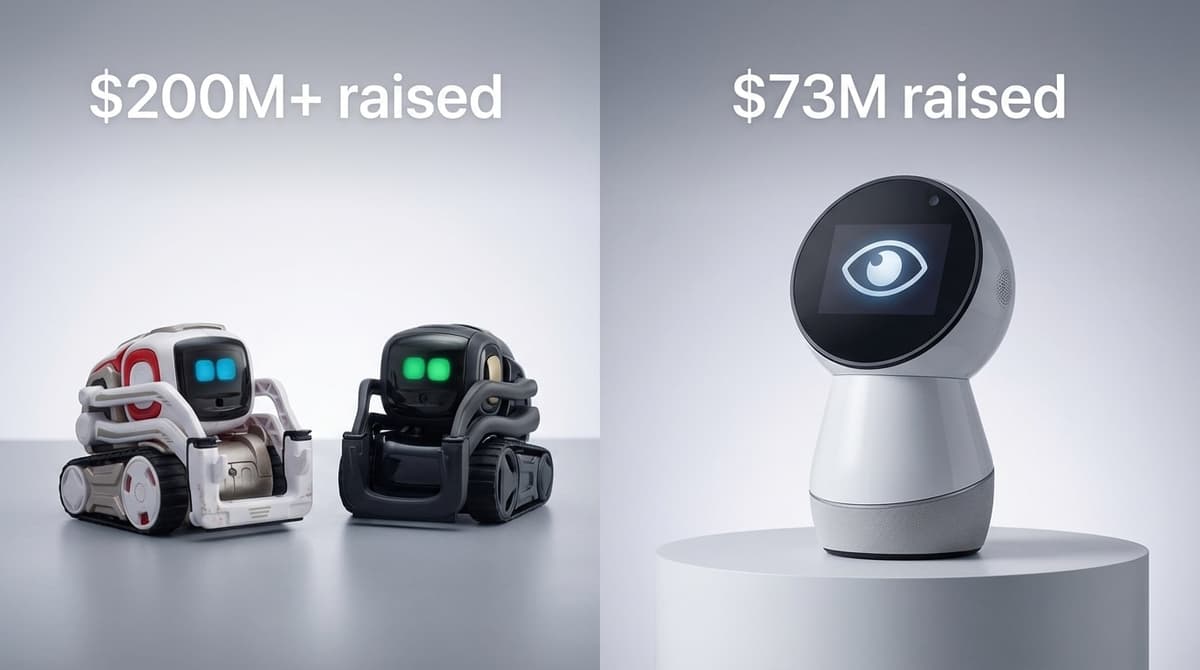
Anki and Jibo represent the two most prominent casualties of the "social robot" dream. Together, they burned through approximately $300 million trying to bring emotional AI companions into homes.
Anki: The Revenue-Burn Mismatch
Founded by Carnegie Mellon robotics PhDs, Anki raised over $200 million from investors including Andreessen Horowitz. Their robots—Cozmo and Vector—exhibited Pixar-level personality and animation. The engineering was genuinely impressive. At peak, the company generated nearly $100 million in annual revenue.
So why did they fail overnight in 2019?
The answer lies in what we call the Hardware-Software Valuation Gap:
- ●Hardware reality: Complex devices requiring high-end processors, cameras, and precision motors forced \$150-\$250 retail pricing
- ●Software expectations: Investors expected platform-scale growth and SaaS-like metrics
- ●Fatal flaw: Zero recurring revenue. Once a customer bought the robot, the revenue stream ended—but Anki continued paying for cloud infrastructure and 200+ engineers
Anki achieved the revenue of a hardware hit but carried the burn rate of a platform play. When the next funding round didn't materialize, 200 people lost their jobs within days.
Jibo: The Platform Delusion
Jibo, founded by social robotics pioneer Cynthia Breazeal, raised over $70 million promising to be the "world's first family robot." The development timeline stretched to three years.
In 2014, when Jibo was announced, voice assistants were a novelty. By the 2017 ship date, Amazon had released Echo, Google had released Home. These smart speakers—priced at $50-100—offered superior voice recognition, vast third-party integrations, and music streaming.
Jibo shipped at $899. The "social" features—the robot turning to look at you, giggling—couldn't justify an $800 premium over an Echo that solved the same user needs.
Key Insight:
In consumer hardware, timing is existential. Over-engineering creates vulnerability to simpler, cheaper alternatives from platform players who can subsidize hardware to capture data.
The Survival Playbook: Skydio's Strategic Pivot
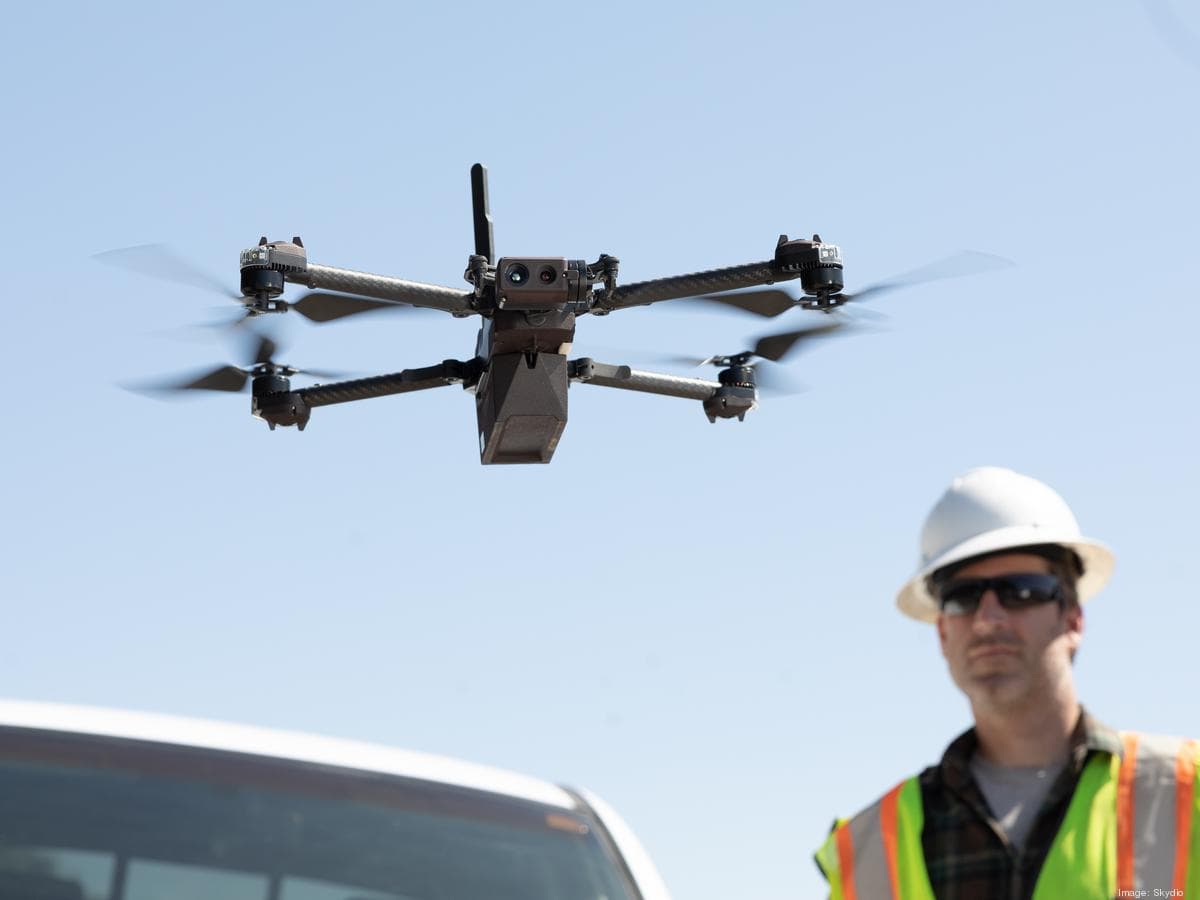
Not everyone died. Skydio offers a masterclass in recognizing when to abandon a market.
Originally competing against DJI in consumer drones, Skydio's autonomous navigation was technically superior. But DJI's Shenzhen manufacturing scale created price points Skydio could never match. The consumer market was price-elastic—users would sacrifice obstacle avoidance for 50% savings.
In August 2023, Skydio made a ruthless decision: exit consumer entirely and focus exclusively on Enterprise and Defense.
Why this worked:
- 1Different value hierarchy: Enterprise customers prioritize data security, reliability, and autonomy over price. A crash during bridge inspection is a liability event; a crash in a park is an annoyance.
- 2Geopolitical leverage: By achieving "Blue sUAS" certification (DoD approval), Skydio became the only option for government agencies prohibited from using Chinese technology.
- 3Margin protection: B2B/B2G sales command premium pricing for software-differentiated autonomy.
Key Insight:
Knowing when to abandon a market is as important as knowing how to enter one. The same technology can fail in one context and thrive in another.
Key Takeaways for Consumer Robotics
- 1Hardware moats erode faster than expected. When core technology commoditizes, brand premium disappears.
- 2Timing is existential. Over-engineering creates vulnerability to simpler alternatives from well-funded platform players.
- 3Know when to pivot. The same technology can fail in consumer and thrive in enterprise.
- 4Recurring revenue is essential. Hardware companies with software burn rates and no subscription model are structurally fragile.
Want to learn about industrial robotics failures? Read our analysis: Why Industrial Robotics Giants Failed—And What's Actually Working.
Our Perspective
At Robolabs AI, we've watched these consumer robotics stories unfold while working alongside teams building the next generation of robotic systems. These failures aren't distant history—they're warnings we reference in every product strategy discussion.
What these cases reinforce for us:
- ●AI capability alone doesn't create sustainable business models. Anki's Vector was technically impressive—but impressive demos don't pay recurring server costs. We help teams design systems where the AI creates measurable, ongoing value.
- ●Hardware margins require software revenue. Every robotics project we take on includes a long-term software and services strategy from the outset, not as an afterthought.
- ●Market timing is a design constraint, not just a business consideration. We build in phases—deployable MVPs that generate revenue while the full vision matures—rather than betting everything on a multi-year development cycle.
The next wave of successful robotics companies won't just build better robots. They'll build better businesses around them.
References & Further Reading
Robotics Industry ReckoningPart 1 of 2
订阅我们的博客
获取机器人和AI领域的最新洞察,直接发送到您的邮箱。
无垃圾邮件。随时可取消订阅。
You Might Also Like
View all posts
Industry Analysis
Why Industrial Robotics Giants Failed—And What's Actually Working
Deep analysis of industrial robotics failures: Rethink Robotics, Zume Pizza, and Argo AI. How Robots-as-a-Service (RaaS) is reshaping the $80B industrial automation market and what startups must learn.
Dec 22, 20258 min read
Industry Analysis
Service Robotics and Healthcare Robotics in India
An in-depth analysis of India's service robotics landscape — surgical robots (da Vinci, SSi Mantra, Meril MIZZO), rehabilitation and assistive robotics, hospitality robots, consumer cleaning robots, delivery bots, and security robots. Where service robotics is growing, what's blocked, and why it will outpace industrial robotics.
Apr 6, 202621 min read
Industry Analysis
Defence and Space Robotics in India
A strategic analysis of India's defence and space robotics ecosystem — military UAVs (IdeaForge, Adani-Elbit Hermes 900, DRDO TAPAS-BH, HAL CATS), unmanned ground vehicles (AeroArc Robotic MULE, Bhairav Robotics Shvana), underwater robotics (DRDO MP-AUVs, EyeROV TUNA), swarm drones, the Atmanirbhar Bharat defence push (1,000+ startups, USD 247M investments in 2025), ISRO's Pragyan lunar rover, SpaDeX robotic arm in space, Vyommitra humanoid for Gaganyaan, and India's 2035 space station roadmap.
Apr 19, 202623 min read