Back to Blog
Robotics Industry Reckoning · Part 2 of 2Industry Analysis
Why Industrial Robotics Giants Failed—And What's Actually Working
Beyond Consumer: Where Industrial Innovation Met Reality
In our analysis of consumer robotics failures, we examined how iRobot was commoditized, Anki and Jibo burned through $300M on social robots, and Skydio survived by pivoting to enterprise.
But the consumer market wasn't the only graveyard. Industrial robotics startups—armed with billions from SoftBank and automotive giants—faced an equally brutal reckoning. Their failures reveal deeper truths about the physics of hardware businesses.
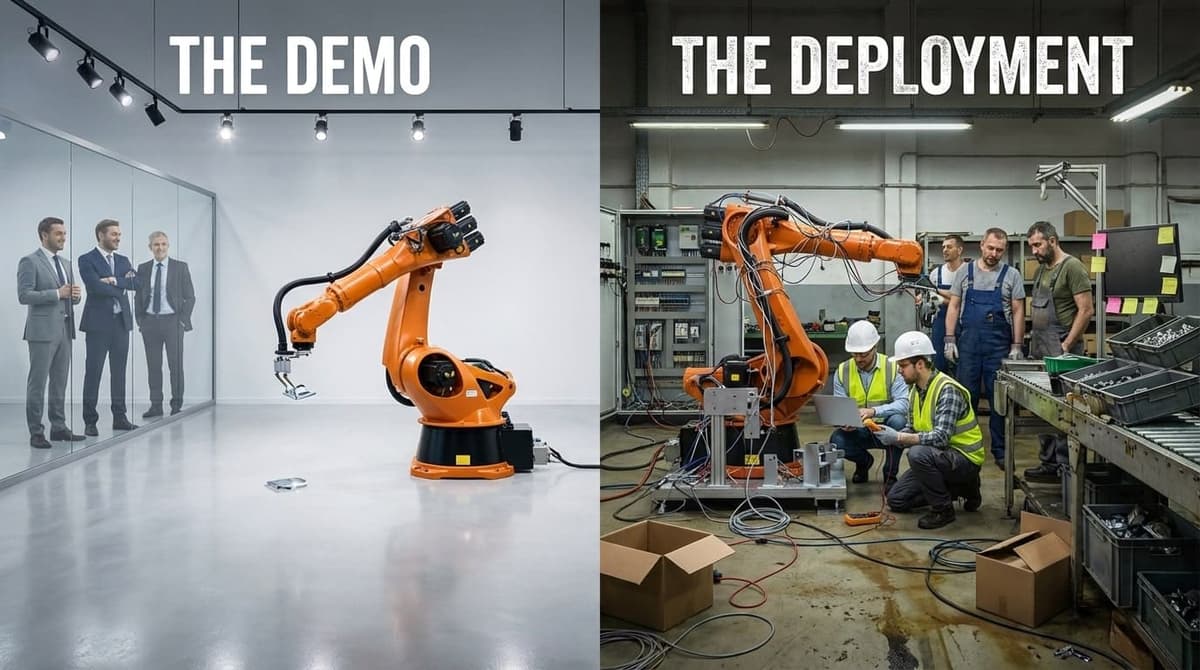
The Safety vs. Performance Trap: Rethink Robotics
Rethink Robotics, another Rodney Brooks venture, attempted to democratize automation with collaborative robots (cobots) named Baxter and Sawyer. The mission was noble: robots safe to work alongside humans, easy enough for non-engineers to program.
To achieve inherent safety, Rethink engineered a radical innovation: the Series Elastic Actuator (SEA). Unlike rigid industrial gears, the SEA incorporated springs between motors and joints, allowing robots to "absorb" collisions. Brilliant safety engineering.
But factories measure success in cycle time and repeatability.
The elasticity that made Baxter safe made it "spongy." Arms vibrated at high speeds, lacked sub-millimeter precision, and would "wobble" at movement endpoints—destroying cycle time metrics.
Meanwhile, Universal Robots used rigid harmonic drives with software-based collision detection. "Good enough" safety with retained precision and speed. UR captured the cobot market.
Key Insight:
In industrial B2B, novel architecture cannot compromise core performance metrics. Manufacturers liked the idea of safety but demanded the reality of efficient production.
When Silicon Valley Logic Meets Physical World Limits: Zume Pizza
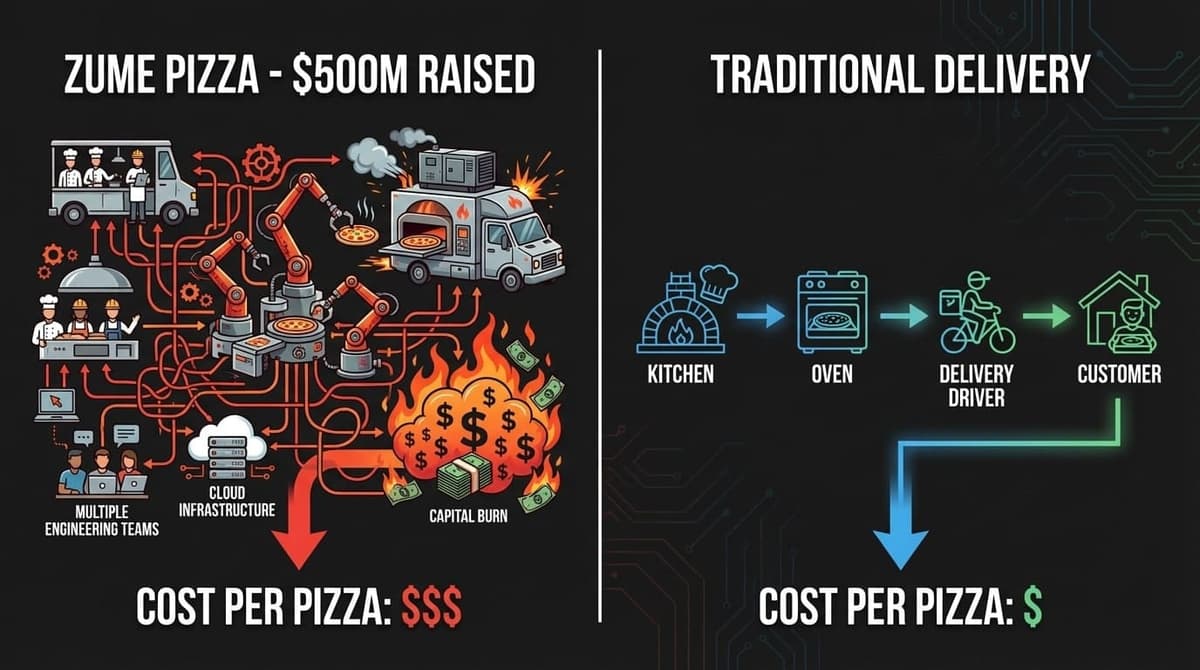
Perhaps no failure better exemplifies the "automation for automation's sake" fallacy than Zume Pizza. The company raised nearly $500 million—largely from SoftBank's Vision Fund—on the premise of baking pizza in trucks using robotic arms.
The problems were fundamental:
- ●Robotic arms spread tomato sauce slower than minimum-wage workers
- ●Cheese slid off pizzas when trucks turned corners
- ●Ovens required massive generators prone to failure
- ●Custom truck fleet + robotic kitchen + Silicon Valley engineering salaries = catastrophic unit economics
Zume's cost per delivered pizza exceeded Domino's, with inconsistent quality. The company eventually pivoted to sustainable packaging before dissolving.
Key Insight:
Scale fixes margins in software. In physical world logistics, scale often multiplies operational inefficiencies. Not every problem benefits from automation.
The Autonomous Vehicle Reality Check: Argo AI
The 2022 shutdown of Argo AI sent shockwaves through autonomy. Backed by Ford and Volkswagen with over $2.6 billion, Argo's vehicles were successfully navigating Miami and Austin streets.
The failure wasn't technical—it was economic.
By 2022, automakers recalculated Level 4 (fully driverless) commercialization timelines: profitable, large-scale deployment was likely post-2030. The "burn to earn" ratio was unsustainable.
Ford CEO Jim Farley pivoted to Level 2+ driver assistance systems (BlueCruise)—features that could be sold today as premium options on passenger vehicles.
Key Insight:
Technical capability (the car can drive itself) is distinct from product viability (the car can drive itself profitably). Even billions in funding cannot outlast misaligned commercialization timelines.
The Structural Physics of Robotics Failure
Why "Running Out of Cash" Is a Symptom, Not a Cause
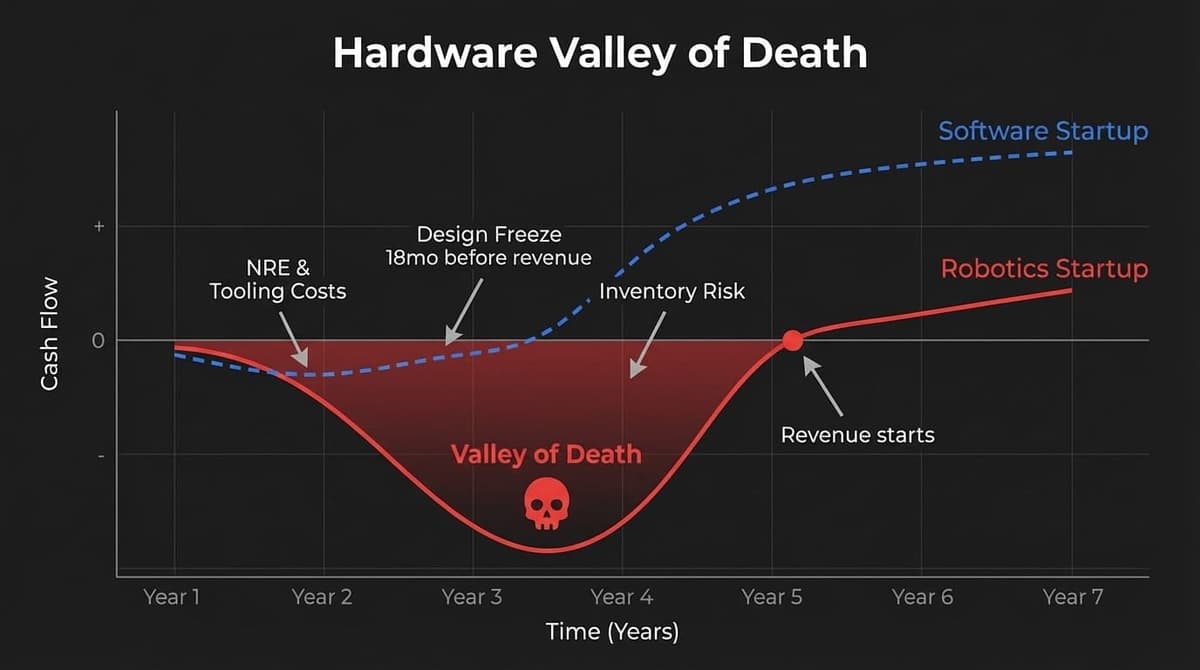
Across every dataset of robotics failures, "running out of cash" tops the list. But in robotics, this is the symptom of a deeper structural challenge: the Hardware Valley of Death.
Unlike software startups where iteration is cheap and distribution instant, robotics companies face a uniquely punishing J-curve:
| Phase | Software Startup | Robotics Startup |
|---|---|---|
| Iteration cost | Negligible | Expensive |
| Time to revenue | Weeks-months | 12-18+ months |
| Inventory risk | None | Significant |
| Working capital | Low | High |
A robotics company must spend heavily on non-recurring engineering (NRE), tooling, and supply chain setup long before shipping a single unit. The design must freeze 12-18 months before revenue. If the market shifts during that window—as happened to Jibo when Alexa launched—inventory becomes liability.
The VC Mismatch Problem
Venture capital typically seeks 10x returns within 5-7 year fund cycles. Robotics companies often require 5-8 years just to reach technical maturity. This creates "financial indigestion":
- ●Companies raise massive early rounds to fund hardware development
- ●They can't hit explosive growth metrics required for later rounds
- ●Result: down-rounds, recapitalization, or liquidation
The Integration Tax
Robots don't exist in vacuums—they must integrate into complex existing workflows.
When sold as CapEx purchases, customers bear integration risk. If a warehouse robot requires changing shelving, upgrading Wi-Fi, or altering lighting, sales cycles extend to 18-24 months. Many startups die during these cycles, burning cash while waiting for corporate procurement.
The Survivors' Playbook: Robots-as-a-Service
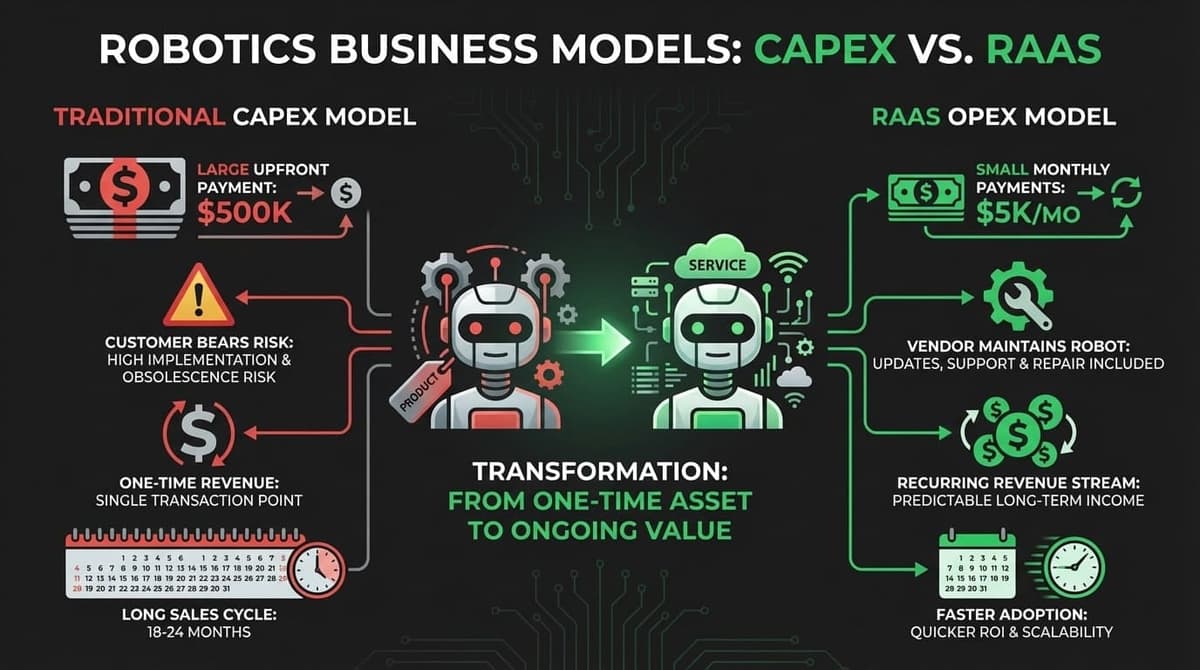
The companies navigating the "Valley of Death" successfully share a common strategy: fundamentally altering the economic relationship between machine and operator.
Robots-as-a-Service (RaaS) shifts from capital-expenditure sales to operating-expense service models:
| Traditional Model | RaaS Model |
|---|---|
| High upfront CapEx | Predictable monthly OpEx |
| Customer bears integration risk | Vendor maintains and updates |
| One-time revenue | Recurring revenue stream |
| Long sales cycles | Faster adoption |
Companies like Locus Robotics (warehouse automation) have demonstrated this model's power—deploying robots without requiring customers to redesign their entire operations.
The Integration Advantage
Successful robotics companies share another trait: they solve the integration problem, not just the robot problem.
This means:
- ●Deploying with existing infrastructure constraints
- ●Providing ongoing maintenance and updates
- ●Sharing deployment risk with customers
- ●Building for real-world variability from day one
Looking Forward: Are We Repeating History?
As we enter 2026, the robotics industry is riding another capital frenzy—this time around humanoid robots. Figure AI raised over $1 billion in its Series C at a $39 billion valuation. Apptronik closed $403 million in an oversubscribed Series A from Google, Mercedes-Benz, Japan Post Capital, and ARK Invest. 1X continues expanding its workforce robots in commercial settings.
The question we must ask: Does this wave repeat the structural errors of the past, or does Generative AI represent a genuine paradigm shift?
The honest answer: it's too early to tell. But the lessons from the last decade suggest caution around:
- ●Consumer-facing humanoids with unclear value propositions
- ●CapEx-heavy deployment models
- ●Timelines that exceed investor patience
- ●Integration complexity in unstructured environments
What gives us optimism:
- ●AI capabilities have genuinely advanced
- ●RaaS models are now proven
- ●Industrial customers are more sophisticated buyers
- ●The talent pool has learned from previous failures
Key Takeaways for Builders and Investors
- 1Performance trumps novelty in industrial settings. Novel architecture cannot compromise core metrics.
- 2Not every problem benefits from automation. Physical world complexity doesn't always yield to Silicon Valley logic.
- 3Technical capability commercial viability. The timeline to profitable deployment matters as much as the technology.
- 4RaaS changes everything. Shifting from CapEx to OpEx aligns incentives and accelerates adoption.
- 5Solve the integration problem. The robot is only part of the solution.
Our Perspective
At Robolabs AI, we've spent years deploying robotics and AI systems in production environments. We've seen what works and what doesn't—often learned the hard way.
The failures documented in this series aren't evidence that robotics doesn't work. They're evidence that how you build and deploy matters as much as what you build. The companies that survived this decade did so by:
- ●Being honest about technical limitations
- ●Designing for real constraints from day one
- ●Building business models that matched their technology timelines
- ●Solving customer problems, not showcasing technical prowess
The next decade of robotics will be built by teams that learned these lessons.
References & Further Reading
Robotics Industry ReckoningPart 2 of 2
PreviousWhat iRobot, Anki & Jibo Taught Us
End of series
Subscribe to Our Blog
Get the latest insights on robotics and AI delivered to your inbox.
No spam. Unsubscribe anytime.
You Might Also Like
View all posts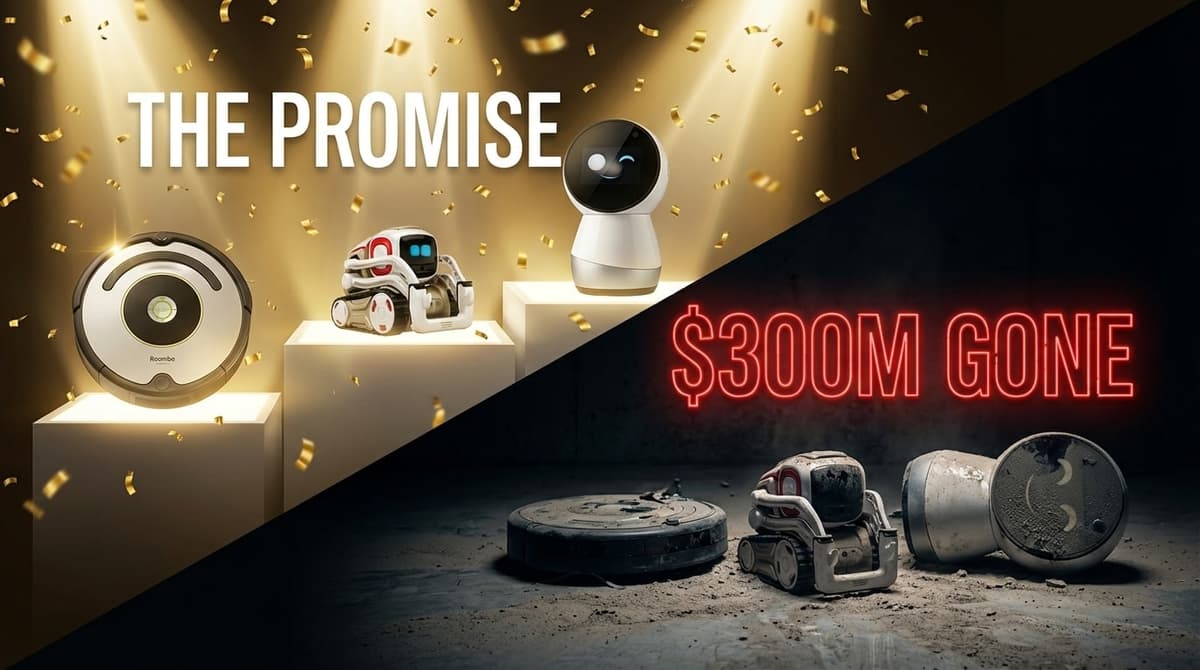
Industry Analysis
What iRobot, Anki & Jibo Taught Us
Why did iRobot file for bankruptcy? How did Anki and Jibo burn through $300M? Deep analysis of consumer robotics failures from 2015-2025 and the lessons every hardware startup must learn.
Dec 22, 20257 min read
Industry Analysis
The State of Robotics Automation in India: Market Overview and Global Position
A comprehensive data-driven analysis of India's robotics market — market size, growth trajectory, global positioning, robot density gap, sectoral composition, key players, government policy, and structural challenges as of early 2026.
Mar 8, 202626 min read
Industry Analysis
Industrial Robotics Across Sectors in India: Deep Dive by Industry
A sector-by-sector analysis of industrial robotics adoption in India — automotive, electronics, semiconductor, metals, plastics, pharma, food processing, textiles, and heavy engineering. Where robots are deployed, what's working, and where the next wave comes from.
Mar 30, 202625 min read
Ready to Build Something Impactful?
Let's discuss how our team can help bring your AI and robotics vision to life.