Back to Blog
India Robotics Automation · Part 5 of 9Industry Analysis
Defence and Space Robotics in India
This is the fifth installment in our comprehensive research series on robotics automation in India. Defence and space represent two of India's most strategically consequential domains for autonomous systems — and they are fundamentally different from the commercial robotics covered in Parts 1–4. Where warehouse or surgical robotics are driven by ROI and cost-per-unit, defence and space robotics are driven by sovereignty, geopolitical pressure, and national prestige. The 2020 Galwan Valley clash, China's advancing unmanned systems along the LAC, and ISRO's accelerating launch cadence have all compressed timelines dramatically. India is no longer catching up — in several areas, it is setting the pace.
1. Defence Robotics Market Overview
1.1 Market Size and Projections
India's military robotics market is growing rapidly, fueled by defence modernization, geopolitical tensions, and the Atmanirbhar Bharat (self-reliant India) defence manufacturing push:
- ●India's defence budget: INR 6.81 lakh crore (~USD 78.7 billion) in FY2025-26, increased to INR 7.85 lakh crore (~USD 85.7 billion) in FY2026-27 — a 15% jump, with an increasing share allocated to indigenous technology.
- ●India's overall defence market (2025): USD 30.52 billion (Mordor Intelligence, January 2026), projected to reach USD 38.73 billion by 2031 at 4.05% CAGR.
- ●India drone (UAV) market (2025): USD 0.47 billion, projected to reach USD 1.39 billion by 2030 at 24.4% CAGR (MarketsandMarkets).
- ●India UGV market (2023): USD 111.2 million, projected to reach USD 234.5 million by 2030 (NextMSC).
- ●Military robotics subset (drones + UGVs + UUVs + autonomous systems): Estimated at USD 0.8–1.5 billion in 2025, growing rapidly — unmanned systems are the fastest-growing defence category at 7.02% CAGR (Mordor Intelligence).
- ●Defence tech investment in 2025: Approximately USD 247 million in corporate-backed investments — roughly double the USD 125 million in 2024 (Tracxn).
- ●1,000+ defence startups now operate across India, many focused on drones, robotics, and autonomous systems.
Key Breakdown by Armed Forces (2025):
| Service Branch | Market Share (2025) | Growth Notes |
|---|---|---|
| Army | 46.12% | Dominant — driven by 6,811 km of disputed border, high-altitude operations |
| Navy | Growing fastest (5.07% CAGR) | Indo-Pacific assertion, submarine programs, maritime ISR |
| Air Force | Slower budget growth | 31 vs. 42 authorized squadrons; AMCA development underway |
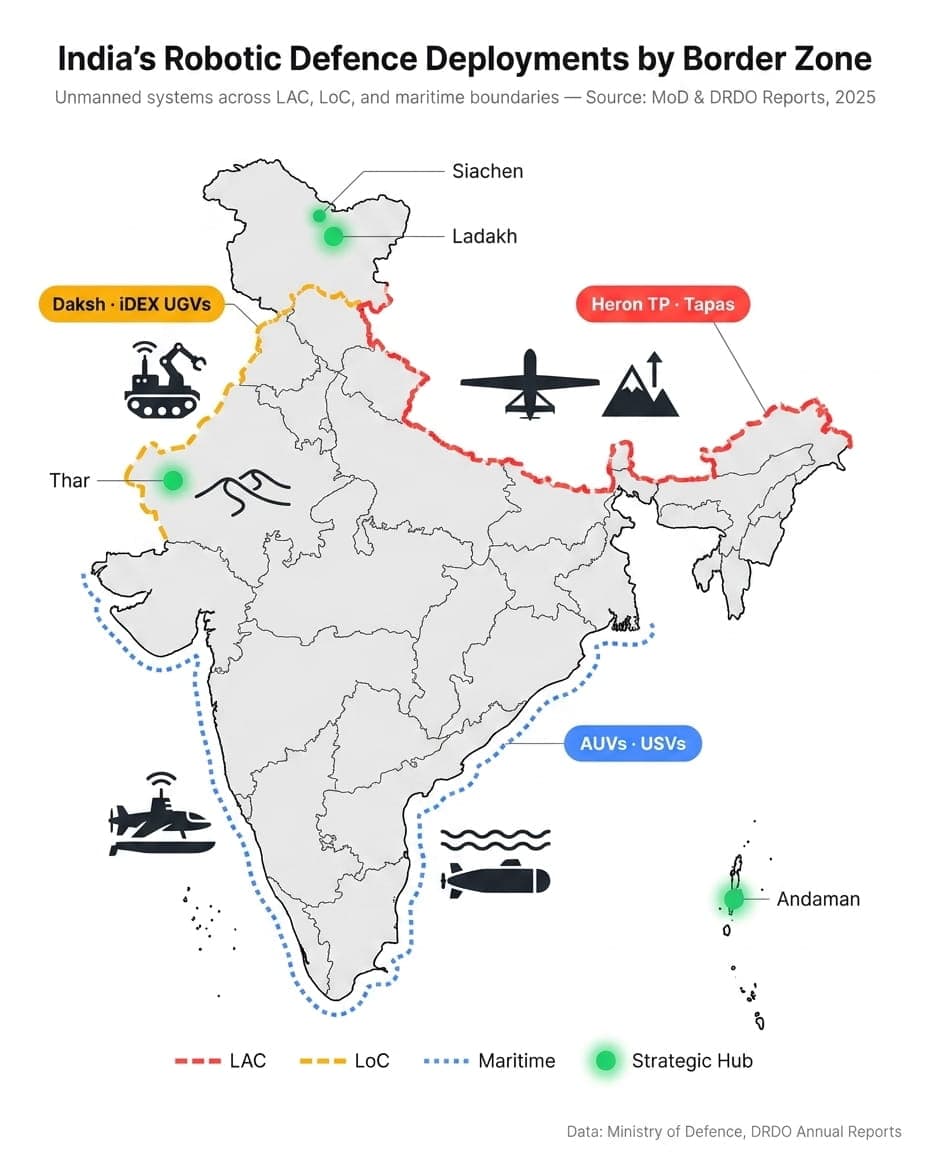
The Army's dominance is directly linked to India's border realities — the Line of Actual Control (LAC) with China and the Line of Control (LoC) with Pakistan require persistent surveillance, which unmanned systems provide at dramatically lower risk than manned patrols.
1.2 The Galwan Valley Effect
The 2020 Galwan Valley clash between Indian and Chinese troops was a watershed moment for Indian defence robotics. Occurring at over 14,000 feet elevation in one of the most remote regions on Earth, it demonstrated four stark realities:
- 1Border areas are too dangerous and remote for sustained manned presence at the required density.
- 2China's deployment of unmanned surveillance and autonomous logistics systems along the LAC was ahead of India's.
- 3Procurement budgets for autonomous platforms were dramatically increased as a direct result.
- 4India's defence establishment recognized unmanned systems as non-negotiable force multipliers.
Post-Galwan, the Indian Army accelerated procurement across three fronts:
- ●Surveillance drones for high-altitude border monitoring
- ●Unmanned ground vehicles for logistics and patrol in extreme terrain
- ●AI-based sensor fusion for border intrusion detection
2. Unmanned Aerial Vehicles (UAVs) / Military Drones
2.1 India's Drone Ecosystem for Defence
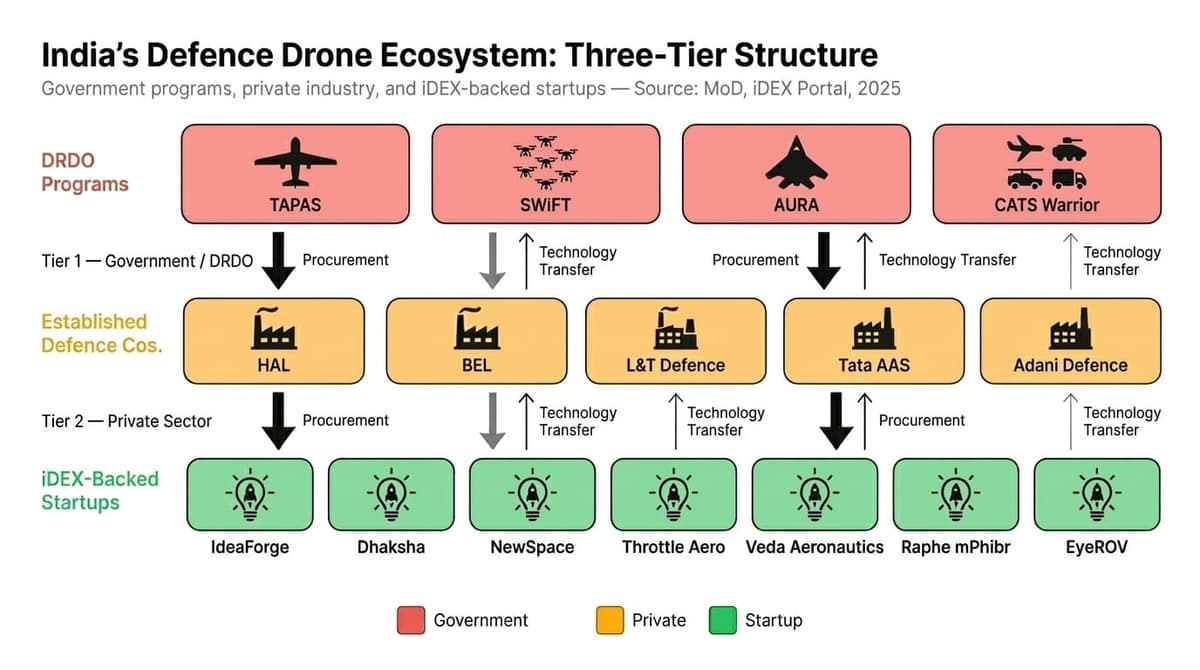
Military drones are the most mature segment of India's defence robotics ecosystem, spanning tactical, MALE (Medium Altitude Long Endurance), and HALE (High Altitude Long Endurance) categories. DRDO leads the government programs while a vibrant private sector has emerged rapidly.
Major Government / DRDO Programs:
| Program | Type | Status | Key Specs |
|---|---|---|---|
| TAPAS-BH (Rustom-II) | MALE UAV | Flight testing; inducted for limited ops | 28,000 ft altitude, 18+ hr endurance, ISR payloads |
| SWiFT | Stealth UCAV | Technology demonstrator | Stealth features, weapons-capable platform |
| AURA (Autonomous Unmanned Research Aircraft) | UCAV | Development | Ghatak-class autonomous combat drone |
| Netra | Mini UAV | Operational | 2.5 hr endurance, 15 km range, day/night ISR |
| Lakshya | Pilotless Target Aircraft | Operational | Weapons testing and aircrew training |
Key Private Sector Companies:
| Company | Product Focus | Notable Achievement |
|---|---|---|
| IdeaForge Technology | Tactical UAVs (SWITCH, NINJA) | India's largest UAV manufacturer by volume for defence; IPO-listed; drones deployed at both LAC and LoC |
| Adani Defence / Adani-Elbit | Hermes 900 MALE UAV | India's first private UAV manufacturing facility; manufactures Elbit's Hermes 900 — the first facility outside Israel to do so |
| Garuda Aerospace | Multi-purpose drones | Dual-use defence and agriculture; export licenses secured for US, Australia, and Middle East |
| NewSpace Research & Technologies | Solar-powered drones | Extended endurance through solar power; innovation leader in persistent surveillance |
| Dhaksha Unmanned Systems | Defence drones | Multi-purpose, combat-capable platforms for Indian armed forces |
2.2 HAL's Combat Air Teaming System (CATS)
Hindustan Aeronautics Limited (HAL) is developing the Combat Air Teaming System (CATS) — a suite of autonomous and semi-autonomous platforms designed to work alongside manned fighter aircraft. CATS represents India's entry into the Collaborative Combat Aircraft (CCA) paradigm, one of the most significant shifts in air warfare globally.
- ●CATS Warrior: Unmanned wingman / loyal wingman concept — an autonomous combat aircraft that flies alongside manned fighters for strike, ISR, or decoy missions.
- ●CATS Hunter: Air-launched autonomous drone that deploys from a manned aircraft for deep-penetration missions behind enemy lines.
- ●CATS ALFA (Air Launched Flexible Asset): Swarming munition / loitering drone for area suppression.
- ●CATS Integration: AI-based orchestration system coordinating multiple CATS assets with the manned fighter in real time.
Key Insight:
CATS places India in a select group — the US (CCA / Next Generation Air Dominance), China, the UK (Project Mosquito), and Australia (MQ-28 Ghost Bat) are pursuing the same concept. This is not incremental modernization; it is a doctrinal shift in air warfare.
2.3 The iDEX Ecosystem for Defence Drones
iDEX (Innovations for Defence Excellence) is the Ministry of Defence's innovation program that funds startups and entrepreneurs to develop defence technologies, serving as the critical bridge between civilian drone innovation and military procurement:
- ●iDEX has funded dozens of drone and robotics projects through its Defence India Startup Challenge (DISC) rounds.
- ●The Manthan event at Aero India 2025 showcased India's vibrant defence innovation ecosystem to global audiences.
- ●iDEX serves as the bridge between civilian drone startups — which often begin with agriculture or survey applications — and defence procurement contracts.
- ●The pipeline from iDEX-funded prototype to military procurement runs 18–36 months — fast by defence procurement standards.
3. Unmanned Ground Vehicles (UGVs)
3.1 Market Size
- ●India UGV Market Size (2023): USD 111.2 million
- ●2030 Projection: USD 234.5 million
- ●CAGR: 10.0% — making UGVs the second-fastest-growing defence robotics category after UAVs
3.2 DRDO Programmes
Daksh
- ●India's first remotely operated vehicle (ROV) for bomb disposal and counter-IED operations.
- ●Developed by DRDO's R&DE (Engineers) lab in Pune; used by the National Security Guard (NSG) and Indian Army.
- ●Capable of detecting and disposing of bombs, opening vehicle doors and trunks, climbing stairs, and towing suspect vehicles.
- ●While not fully autonomous, Daksh represents India's foundational capability in ground robotics for defence.
First Indigenous Multi-Utility UGV (2025)
- ●India debuted its first fully indigenous multi-utility UGV for frontline operations in late 2025.
- ●Designed for reconnaissance, surveillance, logistics support, and combat applications.
- ●Represents a significant step beyond early bomb-disposal-focused platforms — broader mission profile, higher autonomy.
3.3 Private Sector UGV Development
Torus Robotics
- ●Specialist in unmanned ground vehicles for defence — tactical UGVs for reconnaissance, border patrol, and logistics.
- ●Ranked among the top 10 Indian defence robotics companies (Inkwood Research 2026).
AeroArc — Robotic MULE
- ●Developed the Robotic MULE (Multi-Utility Legged Equipment) — a load-carrying autonomous ground robot for extreme high-altitude terrain.
- ●The Indian Army has inducted 100 Robotic MULEs from AeroArc for forward combat areas.
- ●Addresses a specific and urgent Indian Army need: logistics support at 15,000–20,000 ft altitude where wheeled vehicles cannot operate.
Bhairav Robotics — Shvana and Vrishabh
- ●Defence startup specializing in armed quadrupedal UGVs (robotic dogs).
- ●Unveiled Shvana, India's first armed quadrupedal unmanned ground vehicle, in January 2024.
- ●Also developing the Vrishabh Combat ATV — an unmanned ground platform for combat, ISR, and casualty evacuation.
- ●Showcased at the India AI Impact Summit 2026.
Key UGV Application Areas:
- 1High-altitude logistics: Autonomous load carriers supplying forward positions in Ladakh, Siachen, and Arunachal Pradesh — terrain where wheeled vehicles fail and manned logistics is a casualty risk.
- 2Border surveillance: Persistent ground-based surveillance at remote border posts, reducing the need for exposed manned positions.
- 3Explosive ordnance disposal (EOD): Bomb disposal robots for urban counter-terrorism operations where casualty risk to personnel is unacceptable.
- 4Tunnel detection: UGVs equipped with ground-penetrating radar for detecting cross-border tunnels — a specific and growing threat on the LoC.
4. Underwater Robotics (UUVs / AUVs / ROVs)
4.1 DRDO Naval Programmes
India's naval capabilities increasingly incorporate autonomous underwater systems. DRDO's Naval Science and Technological Laboratory (NSTL) in Visakhapatnam has developed next-generation man-portable autonomous underwater vehicles (MP-AUVs):
- ●AI-driven mine detection: The MP-AUVs use sonar imaging and inter-AUV communication to detect and classify naval mines autonomously.
- ●Sensor suite: Fitted with side-scan sonar and underwater cameras for real-time imaging and classification.
- ●Mine countermeasure operations: Designed to detect, classify, and localize naval mines — reducing risk to divers and manned vessels in the Indian Ocean.
- ●Man-portable designation: Can be deployed by small teams without heavy handling equipment — critical for forward naval operations.
Key Insight:
Naval mine warfare is a critical concern for the Indian Navy, which operates in the Indian Ocean — one of the world's busiest shipping lanes. Autonomous mine detection removes human divers from the most dangerous phase of mine countermeasure operations.
4.2 Private Sector: EyeROV
EyeROV is India's most prominent underwater robotics company, based in Kochi, Kerala — strategically located near India's western coastline:
| Product | Type | Application |
|---|---|---|
| TUNA | High-performance observation-class ROV | Deep-sea operations, advanced payload support, autonomous navigation |
| Other ROV systems | Tethered underwater robots | Oil & gas inspection, marine research, underwater infrastructure maintenance, port security |
- ●Develops ROVs tailored for real-world operations in Indian waters — the TUNA is EyeROV's flagship high-performance platform.
- ●Serves both civilian (oil & gas, marine research) and defence (port security, hull inspection) markets — a true dual-use company.
- ●Ranked among the top 10 Indian defence robotics companies (Inkwood Research 2026).
4.3 Sagar Defence Engineering
- ●Develops maritime autonomous systems — including autonomous surface vessels and unmanned boats for naval and coast guard applications.
- ●Focuses on coastal surveillance, harbor security, and naval ISR.
- ●Ranked among the top 10 Indian defence robotics companies (Inkwood Research 2026).
5. AI, Swarm Robotics, and Emerging Defence Technologies
5.1 Swarm Drone Technology
AI-enabled swarm drone technology is one of the most significant emerging capabilities in India's defence robotics, and one where India is developing genuine offensive and defensive capability:
- ●Recent military demonstrations have shown swarm drones performing coordinated ISR, area suppression, and simulated combat operations.
- ●Cost-effective force multiplication: A swarm of 50–100 small drones can saturate air defences designed to counter a smaller number of larger, more expensive platforms — fundamentally changing the cost calculus of air defence.
- ●The domestic drone market for defence could reach USD 11 billion by 2030, with swarm capabilities being a key growth driver.
- ●DRDO and private companies — including Big Bang Boom Solutions — are developing AI combat systems that coordinate swarm operations.
5.2 AI-Powered Surveillance and Targeting
Tonbo Imaging
- ●Develops electro-optical systems for defence: night vision, thermal imaging, and AI-powered target detection.
- ●Critical enablers for unmanned platforms — a drone without capable sensors is blind. Tonbo provides the situational awareness layer.
Optimized Electrotech
- ●AI-powered surveillance systems for border security.
- ●Computer vision and sensor fusion for autonomous threat detection along India's extended land borders.
AjnaLens
- ●Mixed reality (MR) training solutions for defence personnel.
- ●While not a robot, MR training systems train soldiers to work with and alongside robotic platforms — an essential enabler for human-machine teaming at scale.
5.3 Manufacturing Cost Advantage
A key strategic insight: India's manufacturing cost advantages create compelling conditions for both domestic deployment and export of defence robotics:
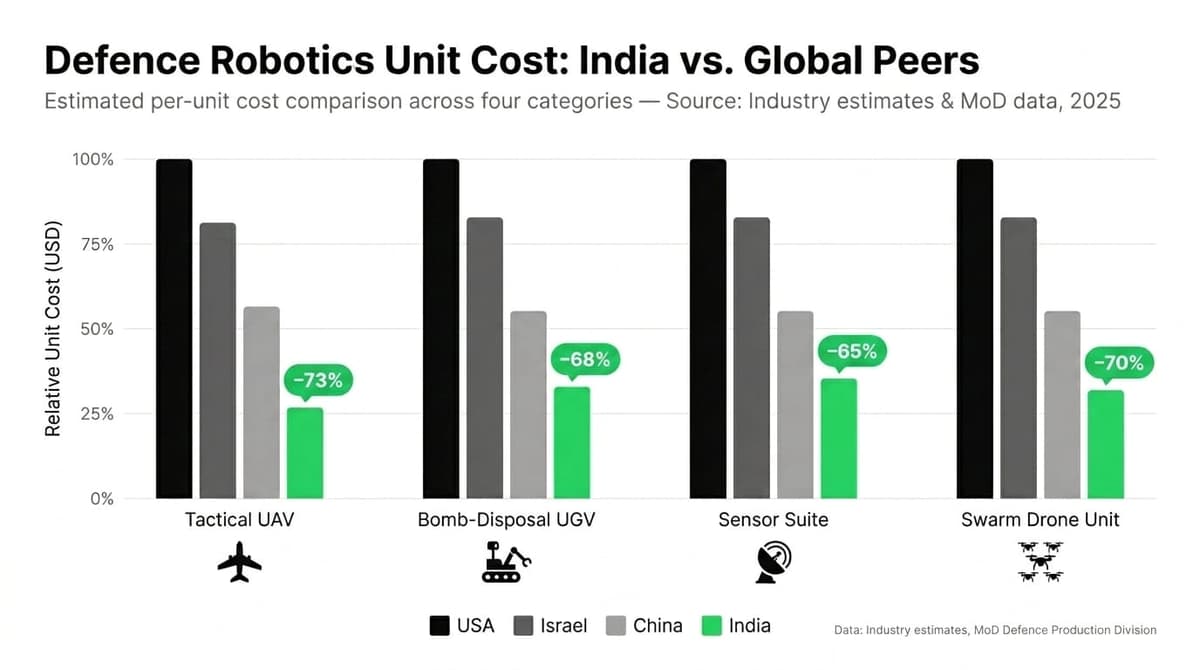
- ●Humanoid robot production costs are estimated at 73% lower than US equivalents — similar cost advantages apply to drones, UGVs, and sensor systems.
- ●Diverse testing geography: Deserts (Rajasthan), high-altitude ice (Ladakh/Siachen), tropical coast (Kerala), dense jungle (Northeast) — India's natural environments provide test conditions that most countries must simulate artificially.
- ●This cost + testing advantage creates a compelling pitch to Southeast Asian, African, and Middle Eastern buyers who need capable-but-affordable unmanned systems.
6. Space Robotics: ISRO and Beyond
6.1 ISRO's Robotic Milestones
Chandrayaan-3 / Pragyan Rover (August 2023)
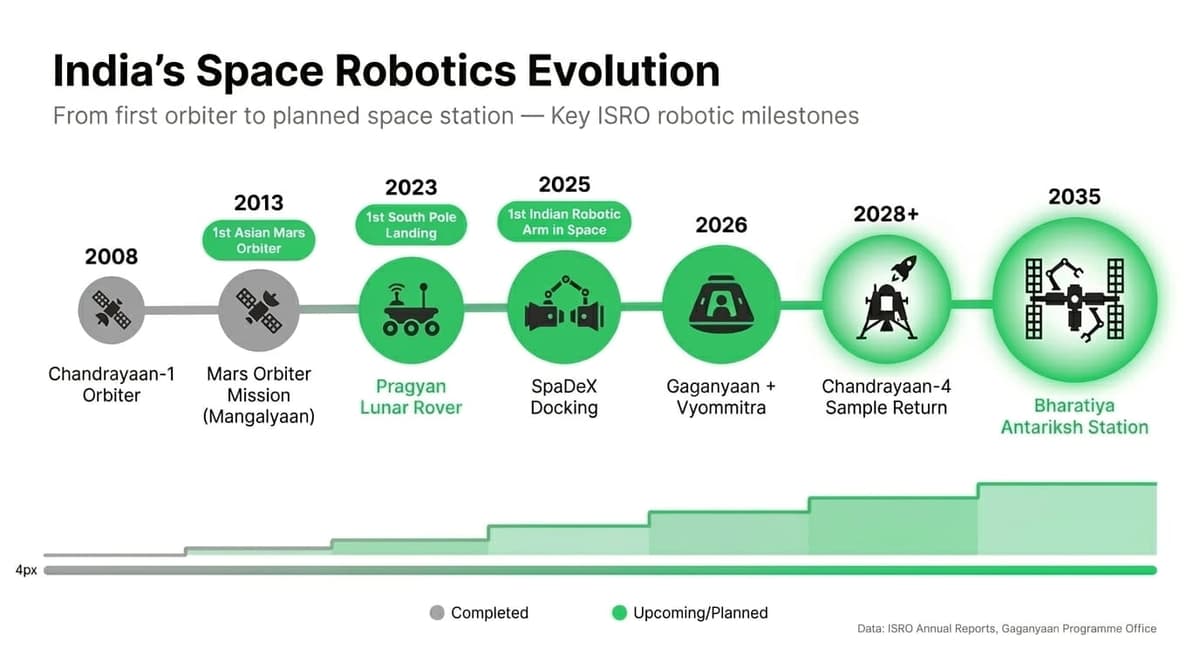
- ●India became the 4th country to successfully land on the Moon — and the first to land near the lunar south pole.
- ●The Pragyan rover — a 26 kg, 6-wheeled solar-powered robot — traversed the lunar surface for 14 days.
- ●Pragyan carried two scientific instruments: APXS (Alpha Particle X-ray Spectrometer) and LIBS (Laser Induced Breakdown Spectroscope) for analyzing lunar soil composition.
- ●The mission confirmed the presence of sulphur, iron, oxygen, and other elements near the lunar south pole.
- ●While Pragyan was teleoperated rather than fully autonomous, it demonstrated India's ability to design, build, and operate a robotic platform in an extraterrestrial environment.
SpaDeX (Space Docking Experiment) — January 2025
- ●On January 16, 2025, ISRO successfully accomplished the SpaDeX mission — demonstrating in-space docking using two small spacecraft ("Chaser" and "Target").
- ●The mission included testing of robotic arms in space — a first for India.
- ●SpaDeX validated autonomous rendezvous and docking technology, which is essential for: future space station operations, satellite servicing and refueling, in-orbit assembly of large structures, and sample return missions.
Gaganyaan Programme
- ●India's human spaceflight programme, with the first uncrewed mission a key milestone in ISRO's 2026 launch schedule.
- ●Prior to sending astronauts, ISRO plans uncrewed missions with a humanoid robot called Vyommitra (Sanskrit for "space friend").
- ●Vyommitra is designed to simulate human presence, test life support systems, and perform basic tasks in the crew module — India's first operational space humanoid.
6.2 ISRO's 2026 Launch Roadmap
ISRO has announced seven major missions by March 2026, demonstrating a significantly increased launch cadence:
- ●First uncrewed Gaganyaan mission — life support and crew module testing with Vyommitra aboard.
- ●Multiple satellite launches via PSLV, GSLV, LVM3, and SSLV across commercial and government payloads.
- ●Technology validation flights including quantum key distribution and electric propulsion demonstrators.
- ●These missions collectively build India's capability for more complex autonomous and robotic space operations.
6.3 India's Space Robotics Trajectory
India's space robotics roadmap extends well beyond 2026:
- 1Chandrayaan-4 (Sample Return): A future lunar mission to collect and return soil samples from the Moon — requiring autonomous sample collection mechanisms and fully automated sample handling systems.
- 2Bharatiya Antariksh Station (BAS): India's planned space station (targeted for 2035) will require robotic arms for assembly, maintenance, and cargo handling — analogous to the Canadarm on the ISS.
- 3Satellite Servicing: SpaDeX's docking technology is a direct precursor to in-orbit servicing — robotic refueling, repair, and de-orbiting of aging satellites — a multi-billion-dollar global opportunity.
- 4Deep Space Missions: India's planned Mars orbiter follow-up and potential Venus mission will incorporate increasingly autonomous decision-making in spacecraft systems, where Earth-to-spacecraft communication delays make full teleoperation impossible.
6.4 Private Space Sector and Robotics
India's liberalized space policy (IN-SPACe framework) has enabled private companies to participate in space missions, building the infrastructure ecosystem that will eventually support space robotic missions:
- ●Agnikul Cosmos: Developing 3D-printed rocket engines — the manufacturing process involves robotic 3D printing of complex metal components in a single piece.
- ●Skyroot Aerospace: India's first private orbital launch company (Vikram-S, 2022); developing orbital vehicles for satellite deployment.
- ●Pixxel: Space-based hyperspectral imaging — satellite systems use autonomous on-board data processing for near-real-time Earth observation.
- ●Dhruva Space: Satellite platforms and ground systems for the growing commercial satellite market.
While these companies are not primarily "space robotics" firms, they represent the infrastructure ecosystem that will eventually support space robotic missions.
7. Defence Procurement and the Atmanirbhar Bharat Push
7.1 Policy Framework
The Atmanirbhar Bharat (Self-Reliant India) initiative has fundamentally changed defence robotics procurement. The policy levers are structural and durable:
- ●Positive Indigenisation Lists: The Ministry of Defence has published multiple lists of items that can no longer be imported — forcing the armed forces to buy Indian-made systems. Drones and certain UGV categories are included.
- ●Defence Acquisition Procedure (DAP) 2020: Prioritizes "Buy (Indian)" and "Buy and Make (Indian)" categories over direct imports — reshaping procurement incentives at every level.
- ●75% Indigenous Content Target: INS Nilgiri, INS Surat, and INS Vaghsheer were commissioned together in January 2025 with 75% indigenous content — demonstrating that India can build complex defence platforms domestically at scale.
- ●Defence Production Target: India aims for USD 25 billion in annual defence production, including significant export revenue from drones, missiles, and autonomous systems.
7.2 Defence Exports
- ●Defence exports crossed INR 21,083 crore (approximately USD 2.5 billion) in FY 2023–24, reaching a new record of INR 23,622 crore (approximately USD 2.76 billion) in FY 2024–25.
- ●Drone systems and components are among the fastest-growing export categories.
- ●Countries in Africa, Southeast Asia, and the Middle East are active potential markets for Indian defence robotics.
- ●India's cost advantage — 73% lower than US equivalents for some robotic platforms — makes it directly competitive against Israeli and Western systems on price.
7.3 The Defence-Civilian Technology Transfer
Defence robotics R&D creates significant spillover benefits for civilian applications — the iDEX programme specifically encourages dual-use technologies:
- ●Autonomous navigation technology developed for military UGVs adapts directly to warehouse AMRs, agricultural robots, and autonomous vehicles.
- ●Computer vision and AI developed for military surveillance finds applications in industrial quality inspection, autonomous driving, and security systems.
- ●Sensor technologies (LiDAR, thermal, radar) developed for defence are increasingly available for civilian use at lower cost.
- ●Startups developing dual-use systems serve both military and commercial markets — accelerating adoption curves on both sides.
8. Key Challenges
8.1 Defence Challenges
- 1Procurement delays: Indian defence procurement cycles average 3–7 years from requirement identification to deployment — too slow for fast-evolving robotic technologies where the competitive landscape shifts every 12–18 months.
- 2Testing and certification infrastructure: India lacks standardized testing infrastructure for autonomous military systems (unlike the US, which has dedicated test ranges like Dugway Proving Ground) — slowing the path from prototype to induction.
- 3Skilled workforce shortage: Radar engineering, RF systems, avionics, and AI/ML specialists are in critically short supply — the same talent gap that constrains civilian robotics is more acute in defence.
- 4Integration complexity: Integrating autonomous systems into existing command-and-control structures requires doctrinal changes, not just technology upgrades.
- 5Cybersecurity: Autonomous military systems are high-value targets for cyberattacks — India's cybersecurity infrastructure for military robotics is still maturing.
8.2 Space Challenges
- 1Budget constraints: ISRO's budget (~USD 1.5–2 billion annually) is a fraction of NASA's (~USD 19 billion in FY2026, down from ~USD 25 billion in FY2024) or China's CNSA budget — limiting the pace and scope of robotic missions.
- 2Payload constraints: India's launch vehicles have lower payload capacities than SpaceX or Chinese systems, constraining the size and complexity of space robotic systems that can be deployed.
- 3Deep space communication: Operating autonomous robots beyond lunar distance requires communication infrastructure — ground stations, relay satellites, deep-space antennas — that India is still building.
- 4International competition: The Artemis Accords (led by the US) and China's ILRS (International Lunar Research Station) are creating competing space blocs — India navigates between them, requiring diplomatic as much as technological capability.
9. Key Takeaways
- 1India's defence market is large and its unmanned systems segment is the fastest-growing component. The overall defence market stands at USD 30.5 billion in 2025, with the military robotics subset (drones, UGVs, UUVs, autonomous systems) estimated at USD 0.8–1.5 billion and growing rapidly. The drone market alone is projected to reach USD 1.39 billion by 2030 at 24.4% CAGR, driven by border security imperatives, the Galwan wake-up call, and the Atmanirbhar Bharat push.
- 2UAVs are the most mature defence robotics category. IdeaForge is India's largest tactical drone manufacturer, Adani-Elbit manufactures the Hermes 900 MALE UAV in India (the only facility outside Israel), and DRDO's TAPAS-BH is India's indigenous MALE program. HAL's CATS represents India's entry into the autonomous collaborative combat aircraft paradigm.
- 3The private sector is now a significant defence robotics player. 1,000+ defence startups, USD 247 million in investments in 2025 (double the 2024 figure), and iDEX serving as the structured bridge between civilian innovation and military procurement — the ecosystem is maturing fast.
- 4UGVs and underwater robotics are emerging with real inductions. India's first indigenous multi-utility UGV debuted in 2025; the Indian Army has inducted 100 AeroArc Robotic MULEs for high-altitude operations; DRDO's MP-AUVs feature AI-driven mine detection; EyeROV and Sagar Defence represent private-sector maritime robotics capability.
- 5ISRO's robotics capabilities are advancing on a compressed timeline. From the Pragyan lunar rover (2023) to SpaDeX robotic arm testing in space (January 2025) to Vyommitra humanoid for Gaganyaan (2026). The trajectory points toward Bharatiya Antariksh Station robotic assembly by 2035.
- 6India's cost advantage is a strategic export asset. Estimated 65–73% lower manufacturing costs for robotic platforms, combined with India's diverse extreme-environment testing geography — deserts, high-altitude ice, tropical coast, dense jungle — create conditions for both domestic deployment at scale and export.
- 7The defence-civilian spillover accelerates India's broader robotics ecosystem. Technologies developed under defence (autonomous navigation, computer vision, sensors, AI) transfer to warehouse, manufacturing, and agriculture robotics — creating a shared innovation infrastructure that compounds both sectors.
Closing Thoughts
If the previous installments covered India's robotics story through a commercial lens — ROI, cost-per-unit, market size — this article covers the domain where the calculus is fundamentally different. Sovereignty, deterrence, and national prestige drive decision-making, and the timelines compress dramatically when geopolitical pressure is applied. The 2020 Galwan clash did more for Indian defence robotics procurement in one year than a decade of reports and white papers had achieved before it.
The picture that emerges is one of genuine capability building on multiple fronts: IdeaForge drones deployed on the LAC and LoC, AeroArc Robotic MULEs inducted for high-altitude logistics, Adani-Elbit manufacturing the Hermes 900 on Indian soil, and HAL developing a loyal wingman concept that puts India in the same technological league as the US, UK, and Australia. In space, the trajectory from Pragyan (2023) to SpaDeX (2025) to Vyommitra on Gaganyaan (2026) to the Bharatiya Antariksh Station (2035) is one of the most ambitious robotic capability-building roadmaps in the world — executed on a fraction of NASA's budget.
The next installment in this series will examine the structural challenges facing India's broader robotics ecosystem — the talent gap, infrastructure constraints, capital availability, and policy bottlenecks that determine whether India's robotics ambitions translate into sustained industrial capability.
References & Further Reading
India Robotics AutomationPart 5 of 9
Subscribe to Our Blog
Get the latest insights on robotics and AI delivered to your inbox.
No spam. Unsubscribe anytime.
You Might Also Like
View all posts
Industry Analysis
Agriculture, Warehouse, and Logistics Robotics in India
A data-driven analysis of India's most distinctive robotics opportunities — agricultural drones (Kisan Drone, Namo Drone Didi, 38,500+ registered drones), warehouse automation (USD 560M market, Addverb, GreyOrange, Unbox Robotics, quick-commerce fulfillment), cold chain robotics, drone delivery, and the farm-to-consumer automation chain.
Apr 9, 202623 min read
Industry Analysis
Service Robotics and Healthcare Robotics in India
An in-depth analysis of India's service robotics landscape — surgical robots (da Vinci, SSi Mantra, Meril MIZZO), rehabilitation and assistive robotics, hospitality robots, consumer cleaning robots, delivery bots, and security robots. Where service robotics is growing, what's blocked, and why it will outpace industrial robotics.
Apr 6, 202621 min read
Industry Analysis
Industrial Robotics Across Sectors in India: Deep Dive by Industry
A sector-by-sector analysis of industrial robotics adoption in India — automotive, electronics, semiconductor, metals, plastics, pharma, food processing, textiles, and heavy engineering. Where robots are deployed, what's working, and where the next wave comes from.
Mar 30, 202625 min read
Ready to Build Something Impactful?
Let's discuss how our team can help bring your AI and robotics vision to life.