Back to Blog
Computer Vision Models for Industry · Part 2 of 6Computer Vision
The DETR Revolution: How Transformers Redefined Object Detection
In May 2020, a team at Facebook AI Research (now Meta AI) published a paper that would fundamentally reshape how the computer vision community approached object detection. DETR (DEtection TRansformer), led by Nicolas Carion and Francisco Massa, wasn't merely an incremental improvement—it was a complete reimagining of what object detection could be.
If you read our first article in this series, you understand that YOLO revolutionized detection by making it fast. DETR's contribution was equally profound but different: it made detection elegant. Where YOLO simplified the speed problem, DETR simplified the architecture problem.
For industry practitioners evaluating detection solutions in 2026, understanding the DETR family isn't optional. These models now represent the accuracy frontier for real-time detection, with RF-DETR becoming the first real-time model to exceed 60% mAP on COCO. More importantly, their architectural advantages—no anchor tuning, no NMS, superior transfer learning—translate directly into reduced development time and more robust deployments.
This article provides the depth you need: from foundational concepts that explain why DETR works, through the technical evolution that solved its early limitations, to practical guidance for choosing between DETR variants for your specific use case.
The Problem DETR Solved: A Complexity Crisis
The Pre-DETR Detection Landscape
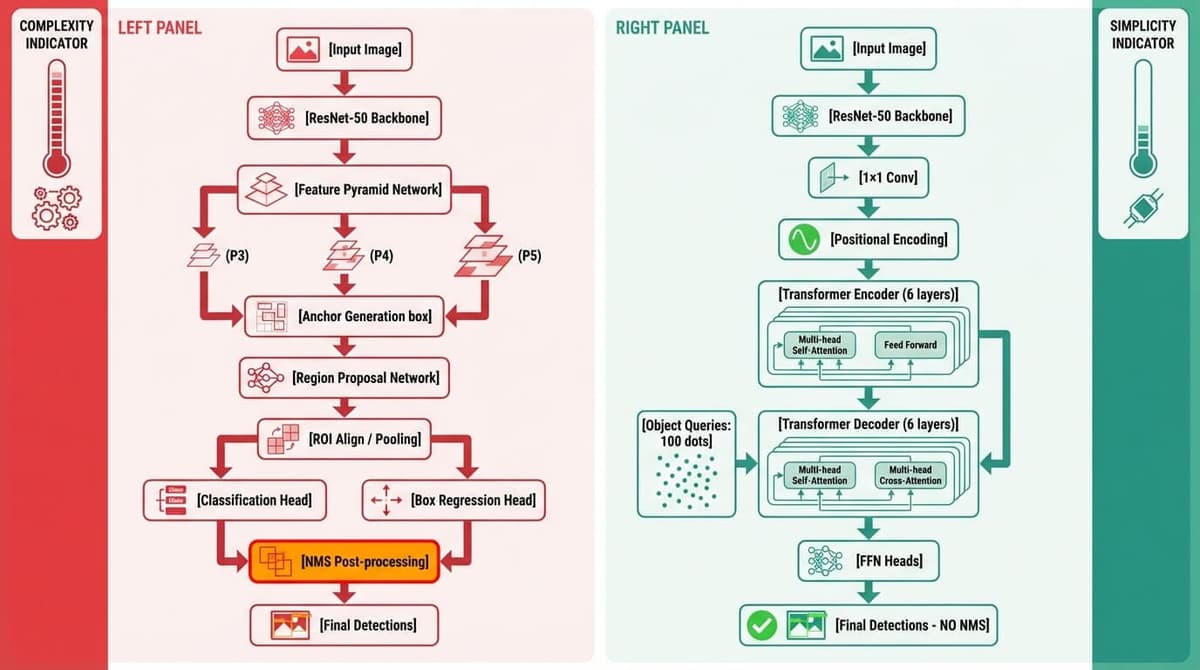
Before 2020, building an object detection system required mastering a constellation of interconnected components, each with its own hyperparameters and failure modes:
Anchor Boxes: Fixed-size reference boxes scattered across the image at various scales and aspect ratios. A typical detector might use thousands of anchors, each requiring classification. Choosing the wrong anchor configurations—too few scales, wrong aspect ratios for your objects—could silently degrade performance.
Region Proposal Networks (RPNs): In two-stage detectors like Faster R-CNN, a separate network generated "proposals" for regions likely containing objects. This added architectural complexity and another component to tune.
Non-Maximum Suppression (NMS): Since multiple predictions often fired for the same object, a post-processing step removed duplicates based on overlap thresholds. But NMS is fundamentally heuristic—its thresholds affect recall (miss objects) and precision (duplicate detections) in ways that vary by scene density.
Loss Function Engineering: Training involved carefully balancing multiple loss terms (classification, localization, objectness) with weighting factors that interacted in non-obvious ways.
Positive/Negative Sampling: With thousands of anchors, most are background. Training required sophisticated sampling strategies to prevent the model from simply predicting "no object" everywhere.
For practitioners, this complexity manifested as:
- ●Extended development cycles: Each component required domain expertise to configure correctly
- ●Brittle deployments: Systems that worked in development could fail in production when scene characteristics changed
- ●Difficulty in debugging: When detection failed, identifying the cause among multiple interacting components was challenging
DETR's Radical Simplification
DETR asked a fundamental question: What if we eliminated most of these components entirely?
The answer was to reformulate object detection as a direct set prediction problem. Rather than generating thousands of proposals, classifying and refining each, then removing duplicates with NMS, DETR simply:
- 1Process the image through a transformer
- 2Directly predict a fixed set of detections
- 3Done
This wasn't just architectural tidying—it was a paradigm shift. The transformer's global attention mechanism, combined with a clever training procedure called bipartite matching, allowed the model to learn to produce exactly one prediction per object without explicit duplicate suppression.
Key Insight:
DETR's elegance comes from treating detection as set prediction. By using the Hungarian algorithm to optimally match predictions to ground truth during training, each object is assigned to exactly one query—eliminating the need for NMS entirely. What the network outputs is the final detection.
How DETR Actually Works: A Technical Deep-Dive
Understanding DETR's architecture is essential for making informed decisions about deployment and customization. Let's examine each component in detail.
The Backbone: Feature Extraction
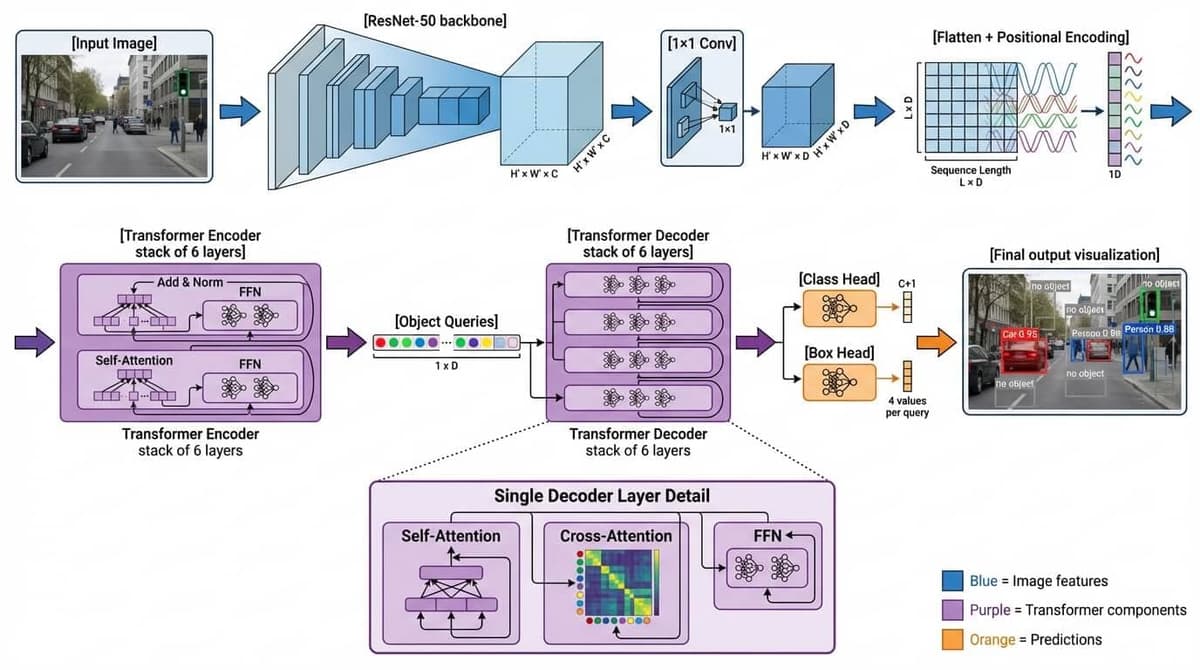
DETR begins with a conventional CNN backbone—typically ResNet-50—that transforms an input image into a rich feature representation. For an image of size :
- ●The backbone produces a feature map of size with channels
- ●A convolution reduces this to channels (the transformer's model dimension )
- ●The 2D feature map is flattened into a sequence of feature tokens
This hybrid approach is deliberate: CNNs excel at extracting local visual features efficiently, while transformers excel at modeling global relationships. DETR leverages the strengths of both.
Positional Encodings: Preserving Spatial Information
Transformers are inherently permutation-invariant—they process token sequences without any notion of order or position. For object detection, where spatial location is critical, this presents a challenge.
DETR addresses this through fixed sinusoidal positional encodings added to the feature sequence. These encodings use sine and cosine functions of different frequencies for the x and y coordinates:
The positional encoding formulas use sine and cosine functions at different frequencies:
where is the model dimension.
This encoding scheme provides several benefits:
- ●Each spatial position receives a unique encoding
- ●The model can easily learn relative positions through attention
- ●The sinusoidal basis allows generalization to sequence lengths not seen during training
The Transformer Encoder: Building Global Context
The encoder consists of standard transformer layers: multi-head self-attention followed by feed-forward networks, with residual connections and layer normalization.
What makes the encoder powerful for detection is its global receptive field from layer one. In a CNN, early layers see only local regions; building global context requires stacking many layers. In the transformer encoder, every spatial position can attend to every other position directly.
This matters for detection because:
- ●Contextual reasoning: Understanding that an object is a baseball bat is easier when you can see the person holding it
- ●Occlusion handling: Partially visible objects can be identified through context from visible parts of the scene
- ●Scene-level understanding: Dense scenes with many overlapping objects benefit from global relationship modeling
Object Queries: The Heart of DETR
This is where DETR's innovation truly shines. Rather than processing thousands of region proposals, DETR uses a small, fixed set of learned object queries—typically 100 embeddings that serve as "detection slots."
Each object query can be thought of as asking: "Is there an object I should detect?" The queries:
- ●Are learned parameters initialized randomly
- ●Attend to the encoded image features through cross-attention
- ●Attend to each other through self-attention
- ●Are decoded into either a detection (class + bounding box) or "no object"
The query self-attention is crucial: it allows queries to coordinate and avoid duplicating each other's predictions. If one query has already "claimed" an object, other queries learn to focus elsewhere.
Prediction Heads: From Queries to Detections
Each object query produces a prediction through simple feed-forward networks:
- ●Classification head: Predicts class probabilities including a special "no object" () class
- ●Box regression head: Predicts normalized center coordinates and dimensions
The outputs are direct predictions—no anchor offsets, no proposal refinement, no NMS. What the network outputs is the final detection.
Hungarian Matching: The Training Secret
DETR's elegance in architecture would be meaningless without an equally elegant training procedure. The challenge: how do you train 100 prediction slots when an image might have 5 objects?
The answer is Hungarian matching (also called bipartite matching). Before computing losses, DETR finds the optimal one-to-one assignment between predictions and ground truth objects that minimizes total matching cost:
The optimal permutation is found by minimizing the total matching cost over all possible permutations:
The matching cost combines:
- ●Classification cost: Negative log-probability of the correct class
- ●Box cost: L1 distance plus GIoU loss between predicted and ground truth boxes
The Hungarian algorithm solves this assignment in polynomial time, producing a unique matching where each ground truth object pairs with exactly one prediction. Unmatched predictions are assigned to predict "no object."
This training approach has profound implications:
- 1No anchor tuning: The model learns its own "implicit anchors" through query specialization
- 2No NMS needed: Each object is matched to one prediction by design
- 3Set-based learning: The model learns to produce a set of detections, not ranked proposals
The Evolution: From DETR to State-of-the-Art
The original DETR, while conceptually beautiful, had practical limitations that spawned an intense research effort. Understanding this evolution is essential for selecting the right model today.
The Original DETR's Limitations (May 2020)
Three significant issues limited initial adoption:
Slow Convergence: DETR required approximately 500 training epochs to achieve competitive results— more than CNN-based detectors. The soft attention distributions were simply harder to learn than the hard assignments in anchor-based methods.
Poor Small Object Detection: With features at only resolution, small objects (appearing as just a few pixels in the feature map) were poorly represented. The model struggled with anything smaller than roughly pixels in the original image.
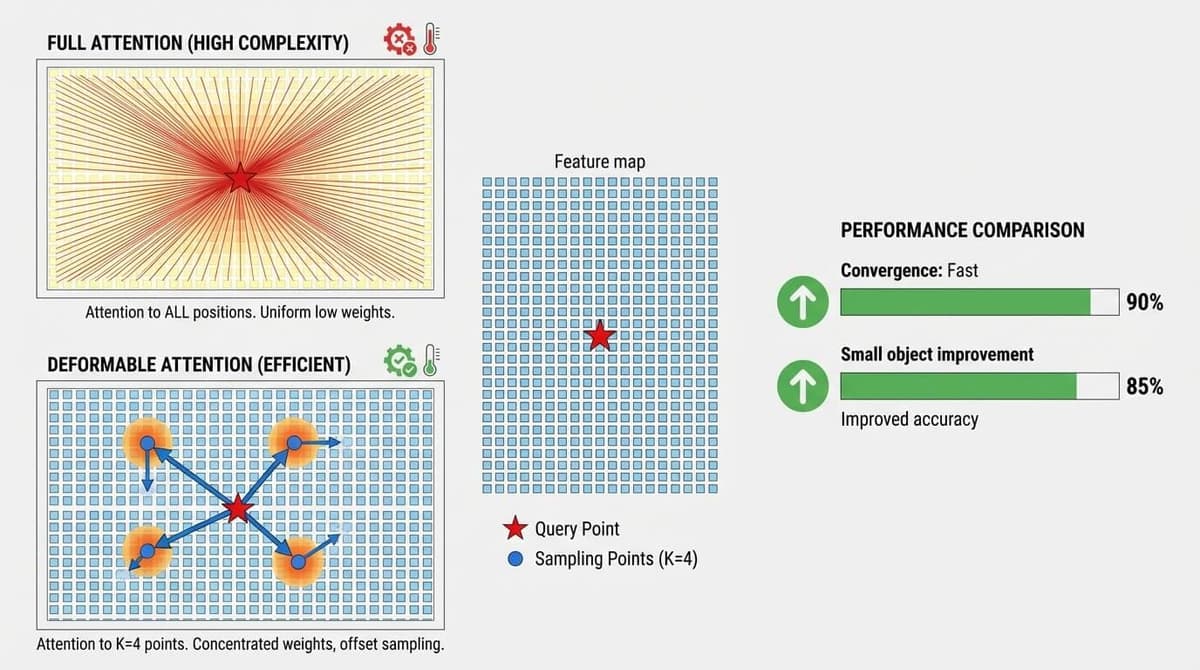
High Computational Cost: The encoder's global self-attention has complexity in the number of spatial positions. For high-resolution images or video applications, this became prohibitive.
Deformable DETR: Fixing Attention (Late 2020)
Published at ICLR 2021 by Xizhou Zhu, Weijie Su, Lewei Lu, Bin Li, Xiaogang Wang, and Jifeng Dai, Deformable DETR directly tackled the efficiency and convergence problems through a novel attention mechanism.
The Insight: Standard attention attends to all positions uniformly, which is wasteful—most positions aren't relevant to any given query. What if attention only looked at a small number of learned positions?
Deformable Attention: For each query, the model predicts:
- ● sampling point offsets (typically ) relative to a reference location
- ●Attention weights for each sampling point
The attended features are sampled only at these sparse locations via bilinear interpolation, reducing complexity from to per query.
Multi-Scale Features: The efficiency gains enabled processing features from multiple backbone stages (, , resolution), dramatically improving small object detection.
Convergence Improvement: The inductive bias of sparse, localized attention helped the model learn effective patterns much faster—converging in 50 epochs instead of 500.
DN-DETR and DAB-DETR: Understanding Queries (2022)
Two papers published in 2022 provided crucial insights into why DETR struggled with convergence and how to fix it.
DAB-DETR (ICLR 2022, Tsinghua University) reinterpreted object queries as explicit anchor boxes. Rather than learning abstract embeddings, each query directly encodes a anchor that is refined through decoder layers.
This interpretation revealed something profound: DETR was essentially learning to do what anchor-based detectors do explicitly. Making the anchor interpretation explicit improved:
- ●Training stability through clearer learning signals
- ●Generalization by decoupling positional and content information
- ●Convergence speed with comparable final accuracy
DN-DETR (CVPR 2022) identified bipartite matching instability as a key convergence bottleneck. Early in training, matching assignments can oscillate wildly between epochs, preventing consistent learning.
DN-DETR introduced denoising training:
- 1Ground truth boxes are corrupted with random noise (shifted, scaled)
- 2These noisy boxes serve as additional queries with known targets
- 3The model learns to "denoise" them—reconstruct the original boxes
This provides dense, stable supervision that complements the sparse bipartite matching signal, dramatically accelerating convergence.
DINO: The Synthesis (2022)
DINO (DETR with Improved deNoising anchOr boxes), published in July 2022, synthesized insights from Deformable DETR, DAB-DETR, and DN-DETR into a unified state-of-the-art framework.
Contrastive Denoising: DINO extended DN-DETR's denoising with a contrastive formulation:
- ●Positive queries: Small noise, should reconstruct the original box
- ●Negative queries: Large noise, should predict "no object"
This sharpened the boundary between objects and background, improving both precision and recall.
Mixed Query Selection: Rather than using purely learned queries or purely encoder-based proposals, DINO combines both:
- ●Content queries: Learned embeddings capturing semantic patterns
- ●Positional queries: Initialized from top-k encoder features with highest objectness scores
This provides learned prior knowledge while remaining adaptive to input content.
Look Forward Twice: A training technique using both current and next layer box predictions for the denoising loss, providing richer gradient information.
Benchmark Results:
- ●ResNet-50 backbone: 49.4% AP in 12 epochs, 51.3% AP in 24 epochs on COCO
- ●Swin-L backbone with Objects365 pre-training: 63.2% AP on COCO val2017
DINO demonstrated definitively that DETR-based models could match and exceed the accuracy of the best CNN-based detectors.
The Real-Time Era: RT-DETR and Beyond
For industry applications, accuracy alone isn't sufficient—latency matters. The period from 2023 to 2026 saw transformer-based detectors achieve genuine real-time performance while maintaining their accuracy advantages.
RT-DETR: DETRs Beat YOLOs (April 2023)
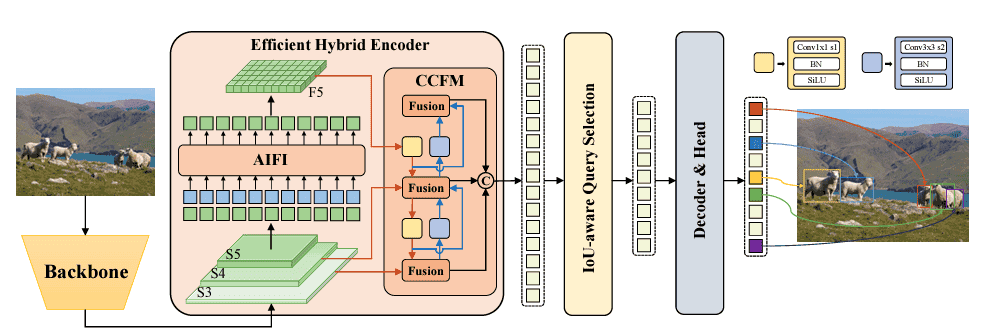
RT-DETR (Real-Time Detection Transformer), developed by Baidu and presented at CVPR 2024, made a bold claim in its title: "DETRs Beat YOLOs on Real-time Object Detection."
The paper delivered on this claim through careful engineering:
Efficient Hybrid Encoder: Rather than processing all scales with expensive self-attention, RT-DETR introduced:
- ●Intra-scale interaction: Efficient self-attention within each feature scale
- ●Cross-scale fusion: Lightweight cross-attention between scales
This reduced encoder computation dramatically while preserving multi-scale feature aggregation.
IoU-Aware Query Selection: Building on DINO's query selection, RT-DETR weighted candidates by predicted IoU quality, prioritizing queries likely to produce accurate boxes.
Flexible Decoder: Configurable decoder depth allows speed-accuracy tradeoffs without retraining. Fewer layers = faster inference at modest accuracy cost.
| Model | Backbone | AP | Latency (T4) | FPS |
|---|---|---|---|---|
| RT-DETR-R50 | ResNet-50 | 53.1% | 4.8ms | 208 |
| RT-DETR-R101 | ResNet-101 | 54.3% | 6.2ms | 161 |
| RT-DETR-L | HGNetv2 | 53.0% | 3.8ms | 263 |
These results demonstrated transformer detectors achieving real-time speeds (>200 FPS) while exceeding contemporary YOLO accuracy.
The RT-DETR Family Evolution
The RT-DETR architecture continued evolving:
RT-DETRv2 (July 2024): Improved training recipes and feature aggregation, pushing RT-DETR-S to 48.1% mAP (+1.6 over RT-DETR-R18).
RT-DETRv3 (2025): Further encoder and decoder refinements achieving higher AP at similar latency.
RT-DETRv4 (October 2025): Introduced a sophisticated knowledge distillation framework:
- ●Deep Semantic Injector (DSI): A lightweight training-only module that aligns deep features with semantically rich representations from Vision Foundation Models (VFMs) like DINOv3-ViT-B
- ●Gradient-guided Adaptive Modulation (GAM): Dynamically adjusts distillation strength based on gradient norm ratios, balancing semantic transfer with detection objectives
The key insight: VFMs contain powerful visual representations learned from massive datasets. RT-DETRv4 transfers this knowledge to lightweight detectors without any inference overhead—the DSI module is removed at deployment time.
D-FINE: Rethinking Regression (October 2024)
D-FINE (arXiv:2410.13842) tackled a different aspect of DETR performance: localization precision.
Traditional DETR models predict bounding box coordinates as point estimates. D-FINE reconceptualized regression as Fine-grained Distribution Refinement (FDR)—predicting probability distributions over coordinate values rather than single points.
Combined with Global Optimal Localization Self-Distillation (GO-LSD), which uses the model's own high-confidence predictions to supervise localization, D-FINE achieved exceptional accuracy:
| Model | Pre-training | AP | Params | Latency |
|---|---|---|---|---|
| D-FINE-S | Objects365+COCO | 50.7% | 10M | 3.49ms |
| D-FINE-M | Objects365+COCO | 55.1% | 19M | 5.62ms |
| D-FINE-L | Objects365+COCO | 57.3% | 31M | 8.07ms |
| D-FINE-X | Objects365+COCO | 59.3% | 62M | 12.89ms |
D-FINE demonstrated that DETR localization could be substantially improved through distribution modeling—an insight applicable to any regression task.
RF-DETR: The Current State-of-the-Art (March 2025)
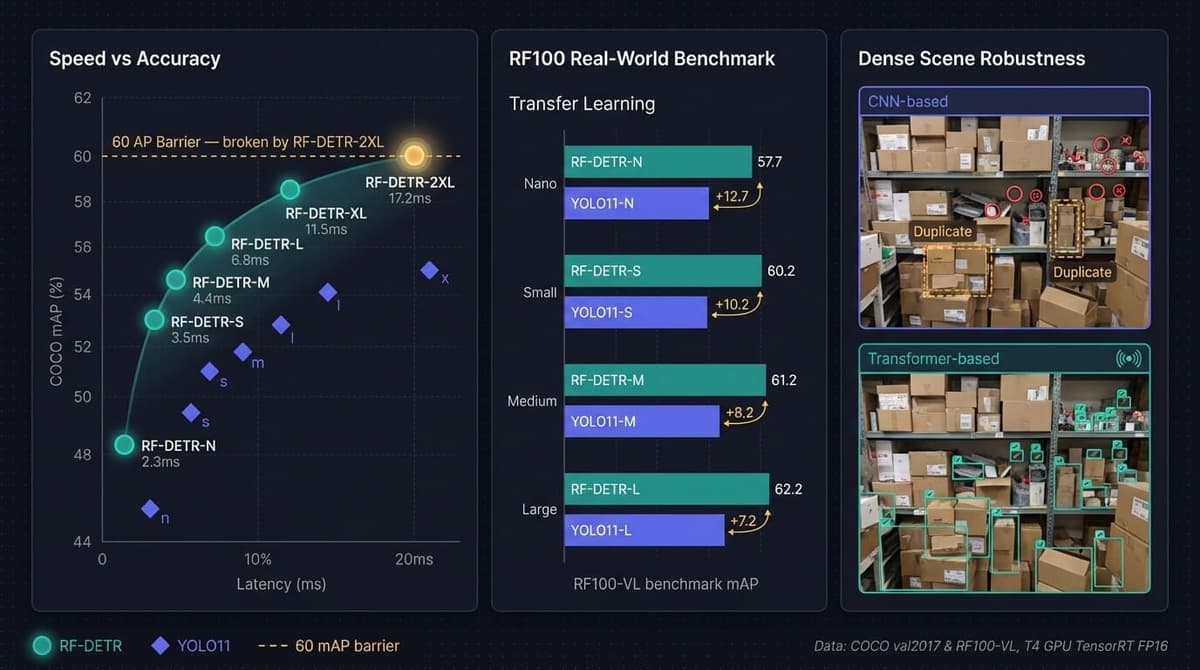
RF-DETR, developed by Roboflow and published at ICLR 2026, represents the current pinnacle of real-time transformer-based detection. Its headline achievement: the first real-time model to exceed 60% mAP on COCO.
Design Philosophy
RF-DETR was designed with a specific goal: optimize for real-world deployment and fine-tuning, not just benchmark numbers. This led to several distinctive architectural choices.
DINOv2 Vision Transformer Backbone: Unlike most DETR variants that use CNN backbones (ResNet, Swin Transformer), RF-DETR leverages the self-supervised DINOv2 ViT backbone.
Why this matters:
- ●DINOv2 was trained on massive unlabeled data, learning robust visual representations
- ●Self-supervised features generalize better across domains than supervised features
- ●The transformer backbone provides native global attention from the first layer
Neural Architecture Search (NAS): RF-DETR uses weight-sharing NAS to discover optimal accuracy-latency tradeoffs for target datasets. Rather than manually designing architecture variants, the search process identifies Pareto-optimal configurations automatically.
Transfer Learning Excellence: Pre-trained on COCO, Objects365, and Roboflow 100 datasets, RF-DETR provides excellent starting points for domain adaptation. The combination of DINOv2's general features and multi-dataset pre-training enables few-shot fine-tuning in many scenarios.
Benchmark Performance
RF-DETR achieves unprecedented results:
Detection Benchmarks (T4 GPU, TensorRT FP16):
| Model | COCO AP50:95 | RF100-VL AP50:95 | Latency | Params |
|---|---|---|---|---|
| RF-DETR-N | 48.4% | 57.7% | 2.3ms | 30.5M |
| RF-DETR-S | 53.0% | 60.2% | 3.5ms | 32.1M |
| RF-DETR-M | 54.7% | 61.2% | 4.4ms | 33.7M |
| RF-DETR-L | 56.5% | 62.2% | 6.8ms | 33.9M |
| RF-DETR-XL | 58.6% | 62.9% | 11.5ms | 126.4M |
| RF-DETR-2XL | 60.1% | 63.2% | 17.2ms | 38.6M |
Key Insight:
RF-DETR-2XL is the first real-time model to exceed 60% AP on COCO. RF-DETR-S outperforms YOLO11-X (the largest YOLO11 variant) by 1.8% AP while being 8.4ms faster. Transformer models now definitively beat CNN-based detectors at comparable sizes.
Instance Segmentation: RF-DETR extends naturally to instance segmentation:
| Model | Box mAP | Mask AP | Latency |
|---|---|---|---|
| RF-DETR-Seg-N | 63.0% | 40.3% | 3.4ms |
| RF-DETR-Seg-M | 68.4% | 45.3% | 5.9ms |
| RF-DETR-Seg-XL | 72.2% | 48.8% | 13.5ms |
| RF-DETR-Seg-2XL | 73.1% | 49.9% | 21.8ms |
Why RF-DETR Matters for Industry
Apache 2.0 License: RF-DETR is released under a permissive open-source license. Unlike YOLO11's AGPL-3.0 (which may require open-sourcing your code or purchasing an enterprise license), RF-DETR can be used commercially without restrictions.
Better Transfer Learning: The DINOv2 backbone's self-supervised features transfer better to novel domains. For organizations fine-tuning on custom datasets, this means:
- ●Faster convergence (fewer training epochs)
- ●Better final accuracy with limited data
- ●More robust performance on out-of-distribution inputs
Complex Scene Handling: Transformers' global attention excels at scenes with occlusion, overlapping objects, and dense arrangements—common in industrial applications.
DETR vs. YOLO: Making the Right Choice
With both DETR and YOLO families achieving state-of-the-art results, choosing between them requires understanding their fundamental tradeoffs.
Architectural Differences Summary
| Aspect | DETR Family | YOLO Family |
|---|---|---|
| Core Architecture | Transformer encoder-decoder | CNN backbone + neck + head |
| Post-Processing | None (end-to-end) | NMS required (except v10+) |
| Feature Processing | Global attention | Local convolutions + FPN |
| Training Complexity | Simpler (single loss) | More components to tune |
| Convergence | Historically slower, now comparable | Fast convergence |
| GPU Optimization | Excellent (attention is GPU-friendly) | Excellent |
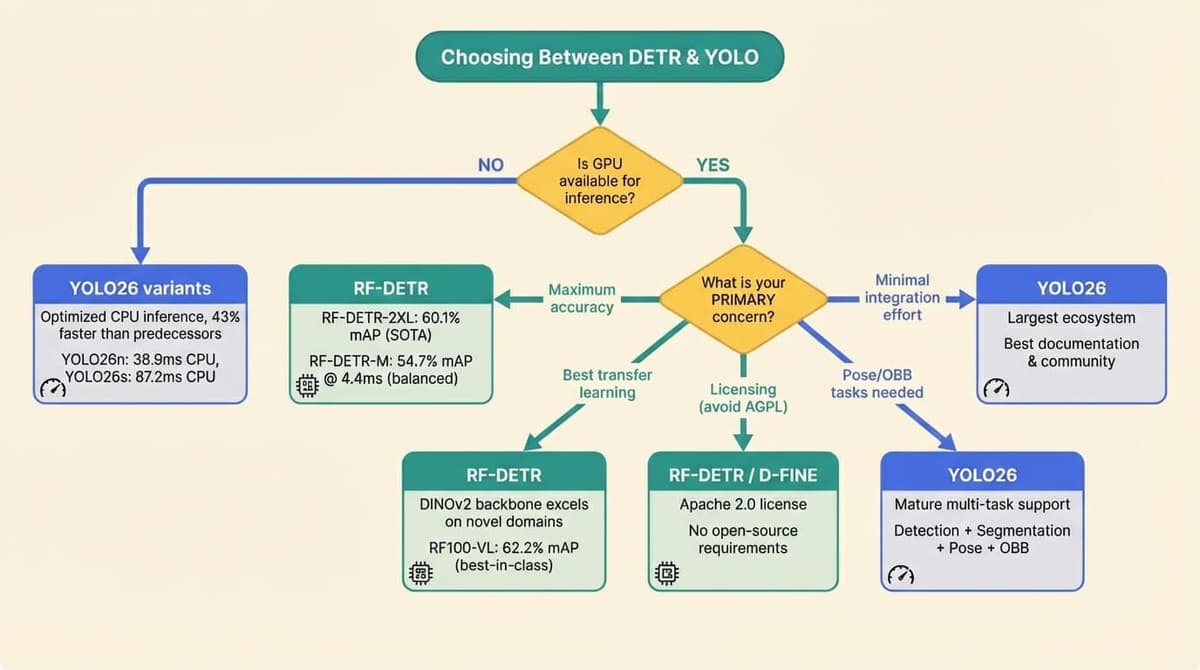
| CPU Performance | Moderate | Strong (YOLO26: 43% faster) |
When to Choose DETR-Based Models
Accuracy is paramount: If you need the absolute highest accuracy and have GPU resources, RF-DETR's 60+ mAP is unmatched.
Transfer learning matters: When fine-tuning on custom data, especially with limited samples, DINOv2's self-supervised features provide better starting points.
Complex scenes: Dense scenes with heavy occlusion, overlapping objects, and unusual viewpoints benefit from global attention.
End-to-end deployment: No NMS means more predictable latency and simpler deployment pipelines. TensorRT optimization is straightforward.
Permissive licensing needed: RF-DETR's Apache 2.0 license enables commercial use without restrictions.
When to Choose YOLO-Based Models
Edge/CPU deployment: YOLO26's 43% CPU speedup makes it preferable for devices without GPU acceleration—industrial cameras, mobile applications, IoT devices.
Extreme resource constraints: YOLO nano variants remain more efficient than comparable DETR models for the smallest deployment targets.
Multi-task applications: YOLO's mature support for pose estimation, oriented bounding boxes, and segmentation in a unified framework is more battle-tested.
Ecosystem maturity: YOLO's longer history means better documentation, more community examples, and more deployment tools.
Video applications: YOLO's simpler architecture may have lower memory footprint for video processing with temporal context.
A Decision Framework
For new projects in 2026, consider this framework:
Implementation Considerations
Training DETR Models
Hardware Requirements: DETR training is memory-intensive due to the transformer's attention computation.
| Model | Typical Training Memory (batch=2) |
|---|---|
| DETR (ResNet-50) | 16-24 GB |
| Deformable DETR | 12-16 GB |
| RF-DETR-M | 16-24 GB |
| RF-DETR-L | 32-40 GB |
Learning Rate Strategy: DETR models benefit from different learning rates for backbone and transformer:
- ●Backbone (pre-trained): 1e-5
- ●Transformer: 1e-4
This allows the pre-trained backbone to adapt gradually while the transformer learns from scratch.
Data Augmentation: Key augmentations for DETR training:
- ●Scale jittering ( to )
- ●Random crop (maintaining aspect ratio)
- ●Horizontal flip
- ●Color jittering (subtle)
Training Duration: Modern DETR variants converge much faster than the original:
| Model | Typical Epochs to Convergence |
|---|---|
| Original DETR | 500 |
| Deformable DETR | 50 |
| DINO | 12-24 |
| RF-DETR | 24-36 |
Deployment Optimization
TensorRT Conversion: Both RT-DETR and RF-DETR support TensorRT export with significant speedups:
Python
# RF-DETR TensorRT export example
from rfdetr import RFDETRBase
model = RFDETRBase()
model.export(format='tensorrt', fp16=True)
Typical speedup: over PyTorch inference.
Quantization Considerations: INT8 quantization is more challenging for transformers than CNNs due to activation distributions. Recommendations:
- ●Use calibration datasets representative of deployment conditions
- ●Consider post-training quantization (PTQ) first; quantization-aware training (QAT) if accuracy loss exceeds 1%
- ●Attention layers are most sensitive; consider keeping them in FP16
Batch Processing: DETR's fixed query count simplifies batching:
- ●All images produce the same number of outputs (e.g., 100)
- ●Padding is uniform, enabling efficient tensor operations
- ●No variable-length NMS to complicate batching
Common Pitfalls
Query Count Mismatch: The number of object queries must match between training and inference. If deploying to scenes with more objects than queries, increase the query count and retrain.
Resolution Sensitivity: DETR models are more sensitive to input resolution changes than CNNs. Fine-tune at your target resolution for best results.
Missing Positional Encodings: Unlike CNNs, transformers lose all spatial information without positional encodings. Ensure they're correctly applied during export and deployment.
Small Object Handling: If small objects are critical, use multi-scale variants (Deformable DETR, RF-DETR) and consider increasing input resolution.
The Future of DETR-Based Detection
Current Research Directions
Foundation Model Integration: RT-DETRv4's semantic distillation from VFMs points toward deeper integration with foundation models. Future detectors may leverage:
- ●Multi-modal understanding from vision-language models
- ●Temporal reasoning for video from video foundation models
- ●3D understanding from depth-aware foundation models
Unified Vision Models: DETR's architecture naturally extends beyond detection. Research is progressing toward single models handling:
- ●Object detection
- ●Instance segmentation
- ●Semantic segmentation
- ●Panoptic segmentation
- ●Pose estimation
- ●Object tracking
Efficient Attention Variants: Linear attention mechanisms, sparse attention patterns, and hardware-aware attention designs continue reducing the gap between transformer and CNN efficiency.
Open-Vocabulary Detection: Models like GroundingDINO combine DETR architectures with language models for zero-shot detection. While currently slower than closed-vocabulary models, this capability is rapidly improving.
Industry Implications
For practitioners making long-term architectural decisions:
- 1DETR is no longer "experimental": With RF-DETR at 60+ mAP and real-time speeds, transformer-based detection is production-ready for GPU-equipped deployments.
- 2The accuracy ceiling favors transformers: As benchmarks saturate for CNN-based methods, transformers' global reasoning provides headroom for continued improvement.
- 3Transfer learning advantages compound: Organizations building custom models across multiple domains benefit disproportionately from DETR's superior transfer learning.
- 4Hybrid approaches may dominate: The combination of CNN efficiency for feature extraction with transformer flexibility for detection may become the default architecture.
Summary: Key Takeaways
The DETR family has evolved from an elegant but impractical concept to the accuracy leader in real-time object detection. Key milestones:
| Year | Milestone | Impact |
|---|---|---|
| May 2020 | Original DETR | Established end-to-end transformer detection paradigm |
| Late 2020 | Deformable DETR | Solved efficiency and convergence through sparse attention |
| 2022 | DAB-DETR, DN-DETR | Explained and accelerated query learning |
| July 2022 | DINO | Achieved SOTA accuracy (63.2% AP with Swin-L) |
| April 2023 | RT-DETR | First real-time transformer detector matching YOLO |
| October 2024 | D-FINE | Pushed localization precision through distribution refinement |
| October 2025 | RT-DETRv4 | Integrated foundation model knowledge without deployment cost |
| March 2025 | RF-DETR | First 60+ mAP real-time model; best transfer learning |
For industry practitioners:
- ●If accuracy matters most and GPU is available: RF-DETR is the clear choice, offering both superior accuracy and permissive licensing.
- ●If edge/CPU deployment is required: YOLO26 remains preferable for its optimized CPU inference.
- ●For transfer learning to custom domains: RF-DETR's DINOv2 backbone provides measurable advantages in convergence speed and final accuracy.
- ●For complex scenes: Global attention's ability to reason about object relationships makes DETR models more robust to occlusion and dense arrangements.
The next article in our series will explore models that go Beyond Detection: open-vocabulary detectors, foundation models for vision, and the emerging landscape of unified visual understanding. These models represent the frontier where detection meets language, enabling capabilities that neither YOLO nor DETR alone can provide.
What's Next in This Series
- 1YOLO in 2026: The Complete Evolution from Research Prototype to Industry Standard (Part 1)
- 2The DETR Revolution: How Transformers Redefined Object Detection (You are here)
- 3Beyond Detection: Open-vocabulary and foundation models that generalize beyond training categories
- 4The Benchmarking Reality Check: Why benchmark numbers don't tell the whole story
- 5The Industry Playbook: A framework for choosing the right model for your specific business context
- 6From Prototype to Production: Deployment strategies, optimization techniques, and operational considerations
Our Perspective
At Robolabs AI, we started experimenting with DETR-family models in 2022, back when convergence times and accuracy gaps made them hard to justify for production. The transformation since then has been remarkable.
Our practical experience aligns with—and sometimes challenges—the benchmark narrative:
- ●RF-DETR's transfer learning advantage is real and measurable. On custom industrial datasets, we consistently see 2–4% mAP improvement over CNN-based detectors with the same training data.
- ●The 'DETR or YOLO' framing is increasingly artificial. In our production pipelines, we often run both—DETR for high-accuracy offline analysis and YOLO for real-time edge inference on the same data streams.
- ●Global attention matters most in cluttered, occluded scenes. For warehouse robotics and dense manufacturing environments, DETR models handle overlapping objects significantly better than anchor-based alternatives.
- ●Training infrastructure requirements are non-trivial. Teams with limited GPU budgets should factor in the higher training cost before committing to transformer-based architectures.
The DETR revolution isn't about replacing YOLO—it's about having the right tool for the right problem. The best detection pipelines we've built use both paradigms, each where it excels.
References & Further Reading
Subscribe to Our Blog
Get the latest insights on robotics and AI delivered to your inbox.
No spam. Unsubscribe anytime.
You Might Also Like
View all posts
Computer Vision
YOLO in 2026: The Complete Evolution from Research Prototype to Industry Standard
A comprehensive technical deep-dive into YOLO's decade-long evolution. Understand what each version does, why it matters, and which models deserve your attention for production deployments.
Feb 17, 202618 min read
Computer Vision
The Benchmarking Reality Check: What the Numbers Really Mean for Your Computer Vision Deployment
A comprehensive technical deep-dive into object detection benchmarks, metrics, and real-world performance. Understand mAP, latency, hardware-specific results, and how to build a practical model selection framework for production deployments.
Feb 25, 202625 min read
Computer Vision
From Prototype to Production: The Complete Guide to Deploying Computer Vision Models at Scale
A comprehensive deployment guide covering model licensing, export optimization (TensorRT, OpenVINO, CoreML), video object tracking (ByteTrack, OC-SORT), cloud GPU cost analysis, edge deployment strategies, production architecture patterns, and monitoring best practices for computer vision systems.
Mar 1, 202633 min read
Ready to Build Something Impactful?
Let's discuss how our team can help bring your AI and robotics vision to life.