Back to Blog
Computer Vision Models for Industry · Part 3 of 6Computer Vision
Beyond Detection: How Open-Vocabulary and Foundation Models Are Democratizing Computer Vision
For decades, computer vision operated under a fundamental constraint: models could only detect what they were explicitly trained to recognize. If your industrial inspection system was trained on 80 COCO classes and you needed to identify a new component, the only option was to collect thousands of labeled images, annotate them painstakingly, and retrain the model. This process could take weeks or months—an eternity in fast-moving production environments.
The emergence of open-vocabulary detection and vision-language foundation models represents perhaps the most significant paradigm shift in computer vision since the transition from hand-crafted features to deep learning. These models understand visual concepts through natural language, enabling them to detect objects they have never been explicitly trained to recognize. More profoundly, foundation models like SAM and DINOv2 provide general-purpose visual representations that transfer across domains without fine-tuning.
This transformation matters deeply for industry applications. Consider a manufacturing client who needs to inspect products for defects. Traditional approaches required collecting examples of every defect type—but what about novel defects that haven't occurred yet? Open-vocabulary models can search for "scratches," "dents," "discoloration," or any other natural language description, detecting problems without prior examples. This capability shifts computer vision from a reactive tool that recognizes known patterns to a proactive system that can identify novel situations.
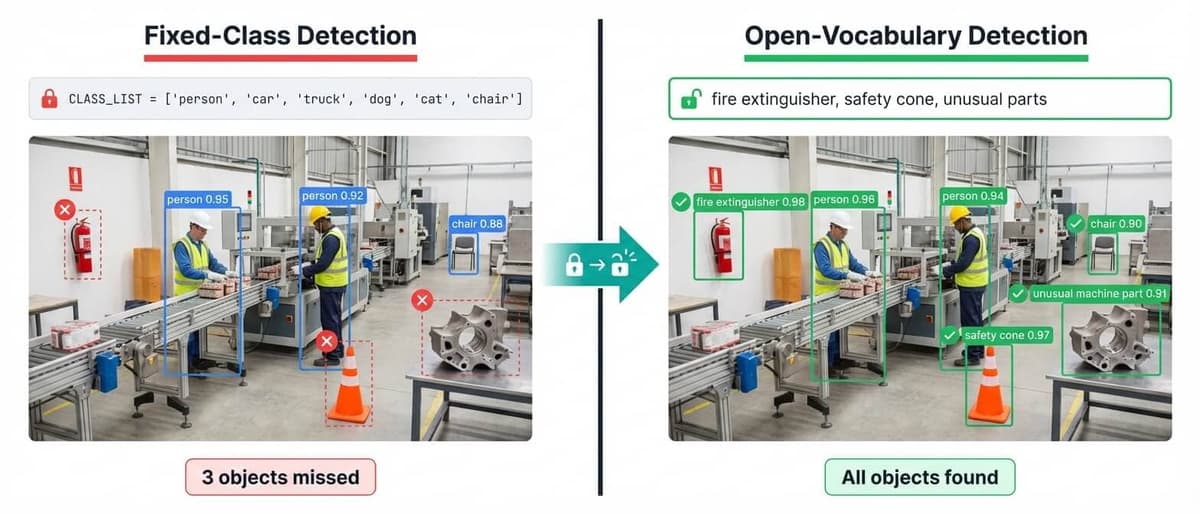
In this third installment of our series, we explore the technologies enabling this revolution: from the foundational CLIP model that first connected vision and language at scale, through specialized open-vocabulary detectors like Grounding DINO and YOLO-World, to universal segmentation with SAM and multi-task foundation models like Florence-2. We will examine not just what these models can do, but critically evaluate when each approach makes sense for production deployment.
Part 1: The Foundation of Vision-Language Understanding
CLIP: The Model That Started It All
To understand open-vocabulary detection, we must first understand how computers learned to connect images and text. In January 2021, OpenAI released CLIP (Contrastive Language-Image Pre-training), a model that fundamentally changed how we think about visual understanding.
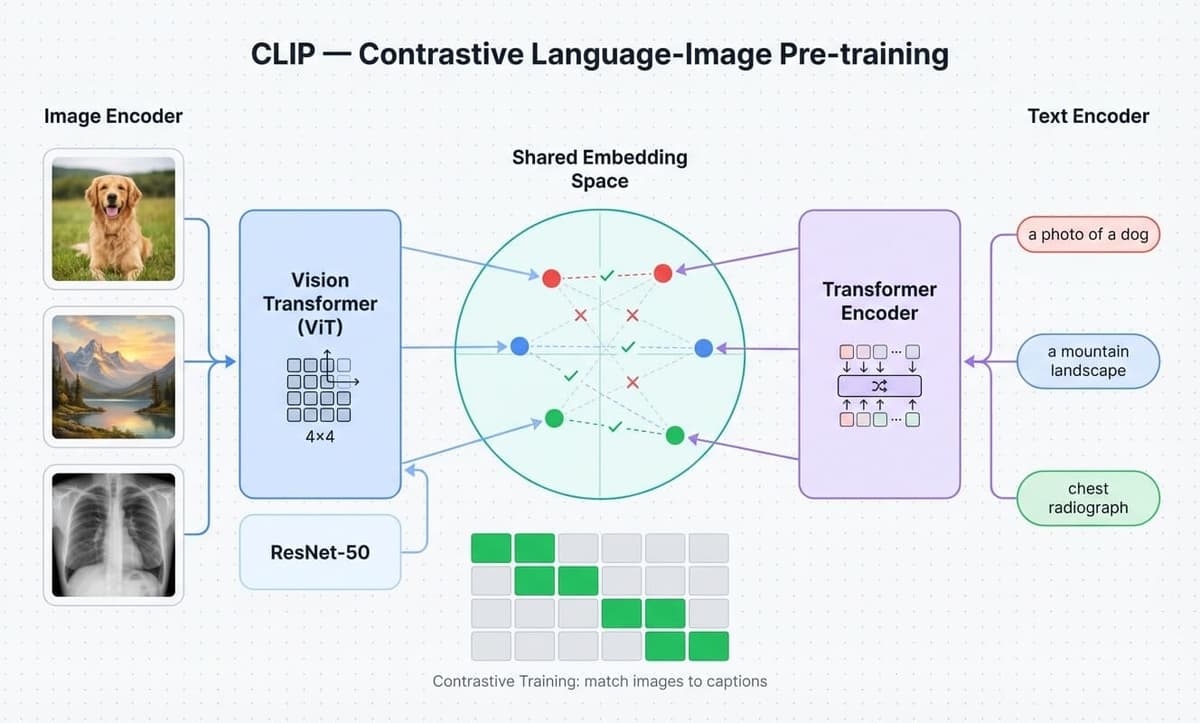
CLIP's innovation was deceptively simple: train a model to predict which text captions match which images from a massive dataset of 400 million image-text pairs scraped from the internet. The model consists of two encoders—one for images (a Vision Transformer or ResNet) and one for text (a Transformer)—that project both modalities into a shared embedding space where semantically similar concepts cluster together.
The training objective is contrastive: given a batch of 32,768 image-text pairs, the model must identify which image goes with which caption. This seemingly straightforward task, when performed at massive scale, produces remarkable emergent capabilities:
- ●Zero-shot classification: CLIP can classify images into any set of categories by encoding the category names as text and finding which text embedding is closest to the image embedding. Without any fine-tuning, CLIP matched the accuracy of ResNet-50 on ImageNet while being able to handle arbitrary class names.
- ●Compositional understanding: CLIP understands not just object categories but their attributes and relationships. It can distinguish "a red car" from "a blue car" or "a person riding a horse" from "a horse next to a person."
- ●Domain transfer: Because CLIP learned from diverse internet data, it generalizes remarkably well across domains—from natural images to medical scans, satellite imagery to artwork.
However, CLIP has limitations that matter for detection applications. It produces image-level embeddings, not localized detections. It cannot tell you where in an image the red car appears or provide bounding boxes around objects. This limitation sparked a wave of research into adapting CLIP's vision-language understanding for localized visual tasks.
DINOv2: Self-Supervised Visual Features Without Language
While CLIP pioneered vision-language alignment, Meta AI pursued a complementary approach with DINOv2, released in April 2023. Rather than learning from image-text pairs, DINOv2 learns visual representations purely from images through self-supervised learning—specifically, a combination of self-distillation and masked image modeling.
DINOv2 was trained on 142 million curated images from a diverse dataset called LVD-142M, without any text annotations. The model learns by predicting features of masked image patches and ensuring consistency between augmented views of the same image. This approach produces representations that capture visual structure at multiple levels:
- ●Image-level features suitable for classification and retrieval, achieving 86–87% linear accuracy on ImageNet with a frozen backbone (ViT-L).
- ●Pixel-level features suitable for segmentation and depth estimation, outperforming supervised methods on several benchmarks without task-specific training.
- ●Strong out-of-distribution generalization, as the model learns fundamental visual concepts rather than dataset-specific patterns.
DINOv2 comes in multiple sizes:
| Model | Parameters | ImageNet Linear Accuracy |
|---|---|---|
| ViT-S | 21M | ~82% |
| ViT-B | 86M | ~85% |
| ViT-L | 300M | ~87% |
| ViT-g | 1B | ~87.5% |
For industry applications, DINOv2's value lies in providing universal visual features that transfer across domains. If you are building a custom classifier for industrial components, you can use DINOv2 as a feature extractor and train a simple linear classifier on top—often achieving strong results with just dozens of examples rather than thousands.
Key Insight:
DINOv2 does not understand language natively—it cannot respond to text queries. But its visual representations are often more robust for tasks where language is not needed, such as visual similarity search, clustering, or dense prediction tasks like depth estimation. Choose CLIP when you need vision-language alignment; choose DINOv2 when you need the best pure visual features.
Part 2: Open-Vocabulary Object Detection
Grounding DINO: The Accuracy Champion
Grounding DINO emerged in March 2023 as the first open-vocabulary detector to achieve truly impressive zero-shot performance. Developed by IDEA Research and officially published at ECCV 2024, it combines two powerful ideas: the DINO transformer-based detector (not to be confused with DINOv2) and grounded pre-training on vision-language data.
The architecture is elegant: Grounding DINO uses a Swin Transformer as its visual backbone and BERT as its text encoder. A sophisticated feature enhancer enables cross-modality fusion at multiple levels, allowing the model to attend to relevant image regions based on the text query and vice versa. The decoder then predicts bounding boxes for regions that match the input text description.
The key insight is tight coupling between visual and textual information throughout the network. Unlike approaches that simply use CLIP features, Grounding DINO allows language to influence visual feature extraction from the earliest stages, enabling more nuanced understanding of what to detect.
Performance on the COCO zero-shot benchmark tells the story:
| Model | Zero-Shot COCO AP | Notes |
|---|---|---|
| GLIP-T | 26.0% | Early open-vocab detector |
| DetCLIPv2 | 40.4% | Improved training recipe |
| Grounding DINO T | 27.4% | Swin-T backbone |
| Grounding DINO L | 52.5% | Swin-L backbone |
| Grounding DINO 1.5 Pro | 54.3% | May 2024 |
| Grounding DINO 1.6 Pro | 55.4% | Latest version (2025) |
The 52.5% zero-shot AP achieved by Grounding DINO-L is remarkable—this is performance on par with supervised detectors from just a few years ago, achieved without seeing any COCO training images. The model has learned general concepts of "car," "person," "dog," etc., from diverse pre-training data and can apply this knowledge to new images.
Grounding DINO's Unique Capabilities
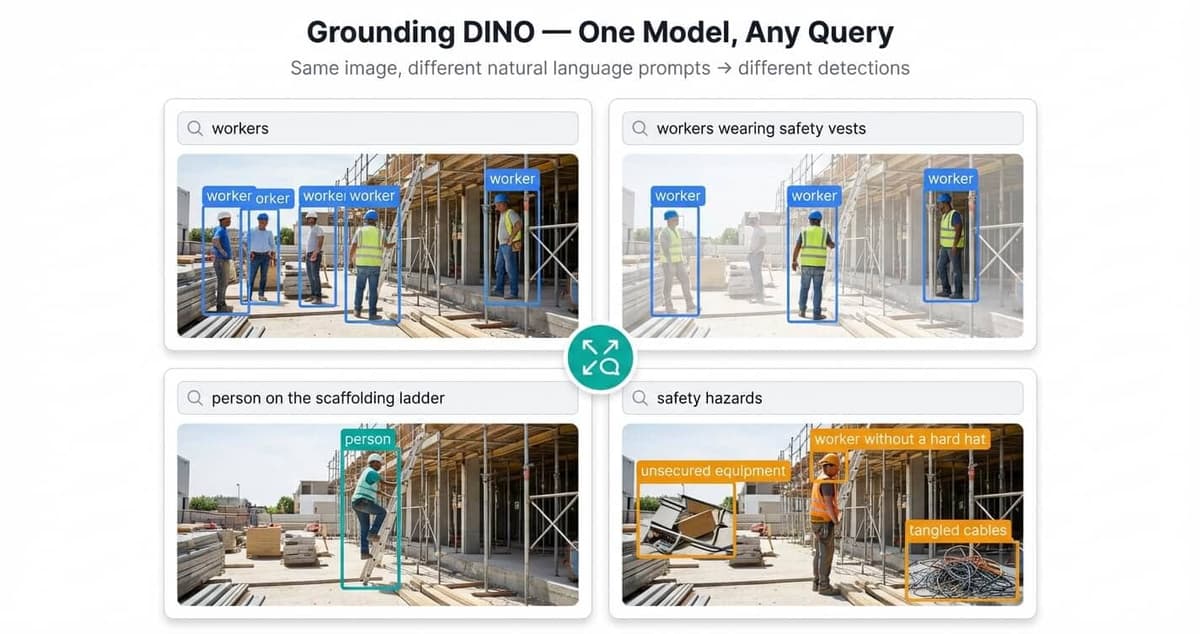
Beyond basic detection, Grounding DINO excels at referring expression comprehension—understanding complex natural language descriptions that go beyond simple category names:
- ●"The person wearing a red hat": Detects only people with red hats, not all people or all red objects.
- ●"The leftmost chair": Understanding spatial relationships.
- ●"The dog that is running": Understanding actions and states.
This capability transforms how we interact with detection systems. Instead of training separate models for "person," "person with hard hat," and "person without hard hat," a single Grounding DINO model can respond to any of these queries—and any new query you can express in language.
Practical Considerations
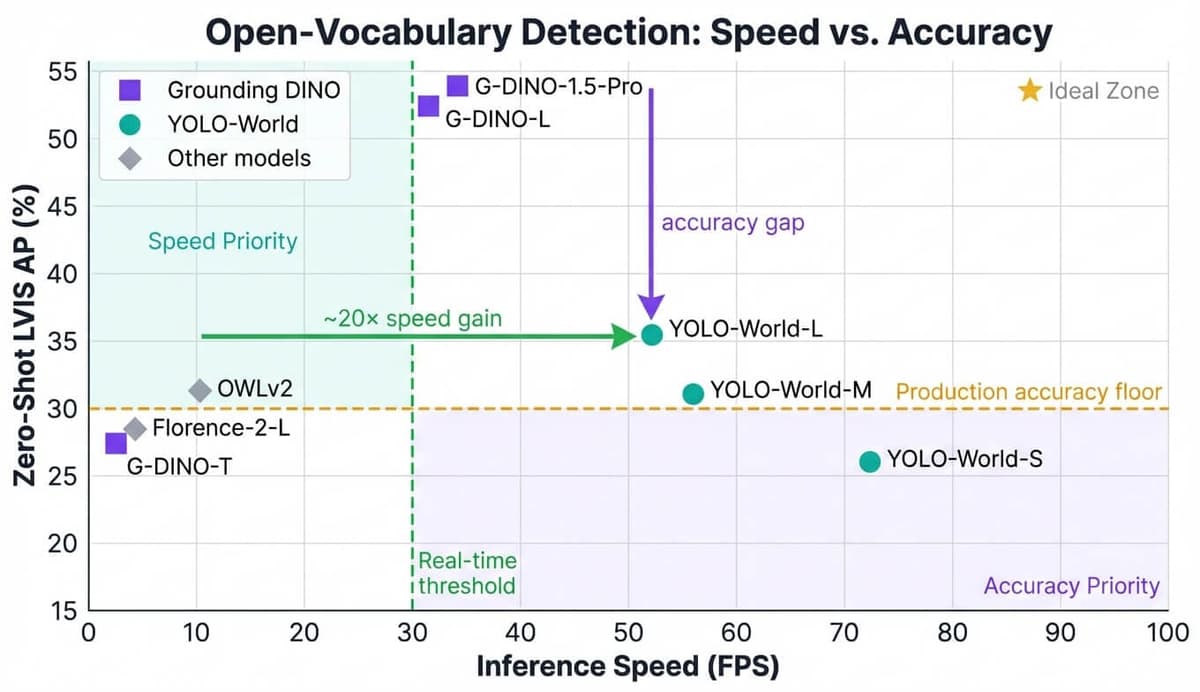
The trade-off for Grounding DINO's accuracy is speed. The model runs at approximately 3 FPS on a V100 GPU—far from real-time. This makes it unsuitable for applications like autonomous navigation or real-time video analytics. However, for batch processing, quality inspection where each image can take a second, or applications where accuracy trumps speed, Grounding DINO remains the strongest option.
The Grounding DINO 1.5 update (May 2024) improved accuracy to 54.3% zero-shot COCO AP and 55.7% on LVIS-minival, while introducing two distinct variants: Pro for maximum accuracy and Edge for faster inference on resource-constrained devices (using EfficientViT-L1 as the image backbone and a streamlined feature enhancer).
More recently, Grounding DINO 1.6 Pro pushed the state of the art further, establishing new benchmarks: 55.4% AP on COCO, 57.7% AP on LVIS-minival, and 51.1% AP on LVIS-val. The 1.6 release particularly improved performance on LVIS rare classes—categories with very few training examples—which matters enormously for industrial applications where the objects you most need to detect are often the ones with the least training data.
YOLO-World: Real-Time Open-Vocabulary Detection
Where Grounding DINO prioritizes accuracy, YOLO-World prioritizes speed. Released by Tencent's AI Lab in January 2024 and published at CVPR 2024, YOLO-World brings open-vocabulary capabilities to the YOLO family's real-time inference paradigm.
The core innovation is Re-parameterizable Vision-Language PAN (RepVL-PAN), a feature pyramid network that fuses text and visual features. During training, the model learns to associate visual features with text embeddings from BERT. At inference time, for a fixed vocabulary, text embeddings can be pre-computed and fused into the model weights, eliminating the text encoder entirely.
This "prompt-then-detect" paradigm yields dramatic speed advantages:
| Model | Zero-Shot LVIS AP | Speed (V100) |
|---|---|---|
| YOLO-World-S | 26.2% | 74.1 FPS |
| YOLO-World-M | 31.0% | 57.3 FPS |
| YOLO-World-L | 35.4% | 52.0 FPS |
74 FPS with open-vocabulary capability represents a breakthrough. While the zero-shot accuracy trails Grounding DINO significantly (35.4% vs 52.5% on comparable metrics), the 20x speed advantage opens entirely different application scenarios.
When to Choose Each Model
The choice between Grounding DINO and YOLO-World is not simply "accuracy vs. speed"—it reflects fundamentally different deployment philosophies.
Choose Grounding DINO when your application tolerates per-image latency of 300ms or more and demands the highest possible detection quality. Quality inspection workflows exemplify this: a manufacturing line producing one unit every two seconds can afford 300ms per image if it catches defects that a faster model would miss. Grounding DINO also excels when your detection queries are compositional or context-dependent—queries like "the person not wearing a hard hat" or "the cracked component near the conveyor belt" require the deep language understanding that Grounding DINO's tight vision-language coupling provides. Research labs and annotation teams benefit from its accuracy during dataset creation, where each image is processed once and quality trumps throughput.
Choose YOLO-World when real-time response is non-negotiable. Robotics systems, autonomous navigation, and live video analytics require processing at 30+ FPS, which YOLO-World delivers comfortably. Its "prompt-then-detect" paradigm—where text embeddings are pre-computed and fused into model weights—makes it behave like a traditional closed-set detector at inference time, with the added flexibility of changing the vocabulary without retraining. This makes YOLO-World particularly valuable in retail and warehouse environments where product catalogs change weekly: update the text embeddings, and the model immediately recognizes new items.
Key Insight:
For many industry applications, a hybrid approach proves most effective: deploy YOLO-World for continuous high-speed monitoring, flagging frames that exceed an anomaly threshold, and then route those flagged frames to Grounding DINO for detailed analysis with complex queries. This architecture captures the throughput of YOLO-World with the analytical depth of Grounding DINO, and it maps naturally onto edge-cloud deployment patterns where the fast model runs on local hardware and the accurate model runs in the cloud.
OWL-ViT and OWLv2: Google's Alternatives
For completeness, we should mention OWL-ViT (2022) and OWLv2 (2023) from Google Research. These models adapt CLIP-style pretraining specifically for detection by adding a simple detection head to the ViT image encoder.
OWL-ViT achieved approximately 31% zero-shot AP on LVIS, while OWLv2 improved efficiency through self-training on pseudo-labels. For teams invested in the TensorFlow/Google Cloud ecosystem, OWLv2 provides a well-integrated option. However, for most use cases, Grounding DINO (accuracy) or YOLO-World (speed) will be preferable choices given their stronger benchmarks and more active development communities.
Part 3: The Segment Anything Revolution
SAM: Segmenting Anything from Any Prompt
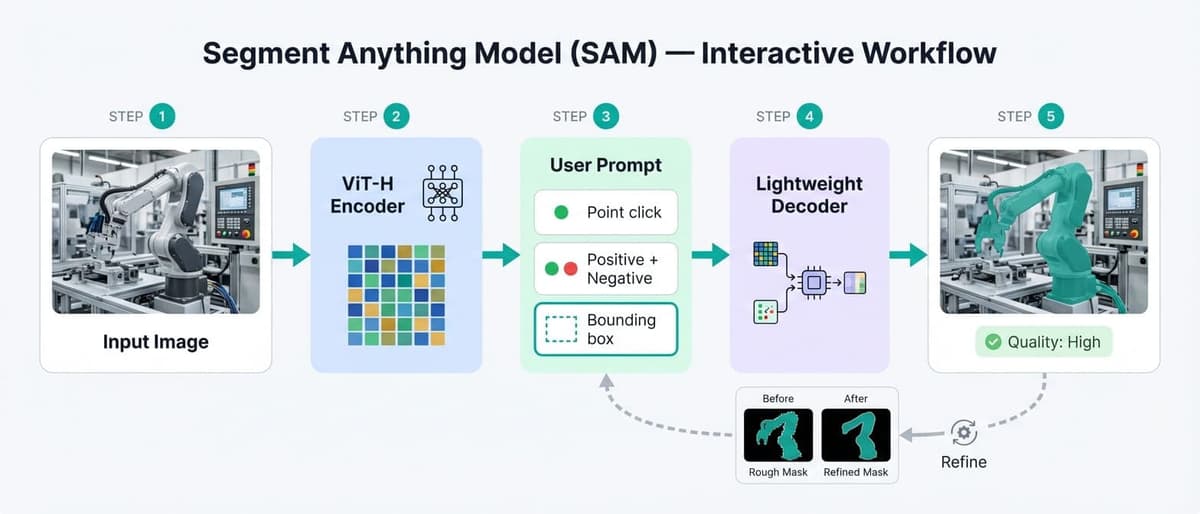
If open-vocabulary detection was revolutionary, Segment Anything Model (SAM) from Meta AI (April 2023) was nothing short of transformative. SAM introduced the concept of promptable segmentation: given any prompt—a point click, a bounding box, or text—SAM produces a high-quality segmentation mask.
The scale of SAM's training is staggering: 1.1 billion masks on 11 million images, collected through a carefully designed data engine that combined automatic annotation with human verification. This dataset, SA-1B, is the largest segmentation dataset ever created.
SAM's architecture separates image encoding from prompting:
- 1Image Encoder: A Vision Transformer (ViT-H by default) processes the image once, producing dense feature embeddings.
- 2Prompt Encoder: Encodes the user's prompt (points, boxes, or text) into tokens.
- 3Mask Decoder: A lightweight transformer that combines image features and prompt tokens to predict segmentation masks.
This design enables real-time interactive segmentation: the expensive image encoding happens once, and then users can try different prompts with fast mask decoder inference. This makes SAM ideal for annotation tools where users click to select objects.
SAM's Industry Impact
SAM democratized high-quality segmentation. Before SAM, building a segmentation model for a new domain required collecting domain-specific images, hiring annotators to draw pixel-precise masks (expensive and slow), training a specialized model, and iterating on edge cases.
With SAM, the process becomes: run SAM on your images, quickly correct any errors with point prompts, and export masks for downstream use or model training. For industry applications, this transformation is profound:
- ●Medical imaging: Radiologists can segment tumors, organs, or anomalies with single clicks rather than painstaking manual tracing.
- ●Manufacturing inspection: Segment defects of any shape without predefined masks for each defect type.
- ●Agricultural analysis: Segment individual plants, leaves, or fruit from aerial imagery for yield estimation.
- ●Robotics: Segment objects for grasping without training specialized instance segmentation models.
SAM 2: Segmentation Meets Video
SAM 2, released in July 2024, extended SAM's capabilities to video with the concept of Promptable Visual Segmentation (PVS). A single prompt on any frame—a click, box, or mask—propagates through the entire video, maintaining consistent segmentation across frames.
The technical advancement is a memory mechanism that tracks object appearances across frames, handling occlusions, appearance changes, and camera motion. SAM 2 achieves state-of-the-art results on video segmentation benchmarks including DAVIS, MOSE, LVOS, and YouTube-VOS.
For industry applications, SAM 2 enables:
- ●Object tracking in manufacturing: Prompt once on a defective product, track it through the entire production line video.
- ●Sports and fitness: Single-click athlete selection propagates through entire game footage.
- ●Surveillance and security: Track persons or vehicles of interest across multiple cameras with minimal annotation.
- ●Robotics: Track objects during manipulation tasks for closed-loop control.
According to Meta, SAM 2 is approximately 6x faster than the original SAM on image segmentation tasks while also being more accurate and adding video capabilities, making it the superior choice for most applications.
The Future: SAM 3 and Concept-Driven Segmentation
Segment Anything 3 (SAM 3), released by Meta on November 19, 2025, represents a substantial leap beyond SAM 2 by introducing concept prompting—the ability to segment objects from natural language descriptions, visual exemplars, or a combination of both, without requiring an intermediate detector.
SAM 3 was trained on the SA-Co (Segment Anything with Concepts) dataset, one of the most comprehensive segmentation training sets ever assembled: 5.2 million high-quality images, 52,500 videos, over 4 million unique noun phrases, and approximately 1.4 billion masks. This massive multi-modal training set enables SAM 3 to understand visual concepts at a level of granularity that previous SAM versions simply could not achieve. Where SAM 2 required a user to click a point or draw a bounding box, SAM 3 accepts a text query like "segment all safety helmets" and produces pixel-precise masks directly.
Alongside SAM 3 for 2D imagery, Meta also released SAM 3D, extending concept-driven segmentation into three-dimensional reconstructions. While still in its early stages for industry adoption, SAM 3D opens possibilities for volumetric segmentation in medical imaging (CT/MRI volumes) and 3D scene understanding for robotics.
For production deployments, SAM 3's native text prompting substantially reduces pipeline complexity. Previously, segmenting objects by description required a two-model pipeline—Grounding DINO for detection, then SAM for segmentation. SAM 3 collapses this into a single model call. However, Grounded-SAM (combining Grounding DINO with SAM) retains clear advantages in specific scenarios:
- ●Structured output requirements: When your pipeline needs both bounding boxes and segmentation masks as separate outputs for downstream logic, Grounded-SAM provides both natively.
- ●Domain-specific detectors: If you have already fine-tuned a specialized detector for your domain (e.g., a defect detection model trained on proprietary data), pairing it with SAM for segmentation leverages that domain expertise.
- ●Licensing flexibility: SAM 3 ships under a custom SAM License that, while permissive, differs from standard open-source licenses. Grounded-SAM's components (Grounding DINO + SAM 2) are both Apache 2.0, providing clearer commercial licensing terms.
Part 4: Multi-Task Foundation Models
Florence-2: One Model, Many Tasks
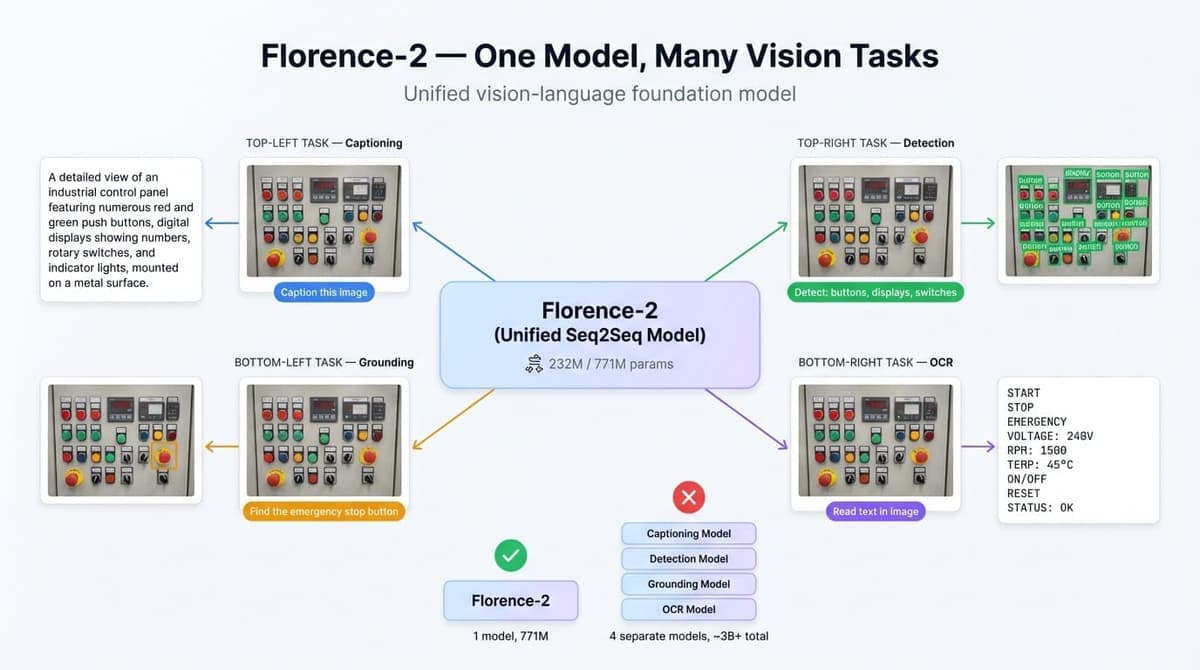
Florence-2 from Microsoft, published at CVPR 2024, takes a different approach to foundation models: rather than excelling at a single task, it provides competent performance across many tasks through a unified interface.
Florence-2's capabilities span:
- ●Image captioning: Generate brief, detailed, or comprehensive descriptions
- ●Object detection: Predict bounding boxes for specified objects
- ●Visual grounding: Locate objects described in natural language
- ●Region-level captioning: Describe specific image regions
- ●Segmentation: Produce masks for detected objects
- ●OCR: Read text in images
All tasks use the same model with a sequence-to-sequence formulation: the input is an image plus a task prompt (e.g., "Detect: person, car"), and the output is a text sequence encoding the results (e.g., bounding box coordinates).
The FLD-5B Dataset
Florence-2's versatility comes from its training data: FLD-5B, consisting of:
- ●126 million images
- ●500 million text annotations
- ●1.3 billion region-text annotations
- ●3.6 billion text-phrase-region annotations
This comprehensive annotation enables learning at image, region, and pixel levels simultaneously, producing a model that understands images at multiple granularities.
Florence-2 Performance
Florence-2 comes in two sizes:
| Model | Parameters |
|---|---|
| Florence-2-Base | 232M |
| Florence-2-Large | 771M |
While Florence-2 does not lead on any single benchmark—Grounding DINO is better at detection, specialized captioning models win on captioning—its strength is versatility:
| Task | Florence-2-L | Best Specialist |
|---|---|---|
| COCO Caption (CIDEr) | 140.0 | 145.8 (CoCa) |
| RefCOCO Grounding | 83.6% | 89.6% (G-DINO) |
| COCO Detection | 41.4% | 63.3% (RF-DETR) |
For applications requiring multiple capabilities, Florence-2's 771M parameter model provides all of them, versus deploying separate multi-gigabyte models for each task.
Industry Use Cases for Florence-2
Automated documentation and maintenance databases: In asset-heavy industries (energy, transportation, facilities management), technicians photograph equipment during inspections. Florence-2 can process these images to simultaneously detect components, generate structured descriptions of their condition, and read serial numbers via OCR—all in a single inference pass. This eliminates the need to run separate models for each task, reducing deployment complexity and infrastructure cost. A single 771M parameter model replaces what would otherwise require three or four specialized models totaling several gigabytes.
Visual search over industrial image archives: Combining Florence-2's captioning and detection capabilities enables powerful natural language search over large image databases. An engineer searching for "corroded pipe fitting near valve assembly" benefits from Florence-2's ability to understand both the visual content and the spatial relationships in archived inspection photos. The model generates captions and region-level descriptions that can be indexed for full-text search, turning unstructured image collections into queryable knowledge bases.
Multi-stage quality inspection pipelines: Florence-2 serves as a versatile first-pass analyzer in complex inspection workflows. It identifies regions of interest through detection, describes anomalies through captioning, and reads part numbers through OCR. Downstream systems can then route specific findings to specialized models—sending suspected cracks to a fine-tuned defect classifier, for example—while Florence-2 handles the initial triage across all defect types without requiring separate models for each.
Content analysis for media and e-commerce: For companies managing large visual content libraries—product photography, marketing assets, user-generated content—Florence-2 provides automated tagging, description generation, and content categorization. Its multi-task nature means a single deployment handles what would traditionally require separate captioning, classification, and OCR systems.
Choosing Between Foundation Models
The foundation model landscape can be confusing. Here is a decision framework:
| Need | Best Choice |
|---|---|
| Pure segmentation from any prompt | SAM 2 / SAM 3 |
| Universal visual features (no language) | DINOv2 |
| Image-level vision-language understanding | CLIP / OpenCLIP |
| Localized vision-language understanding | Grounding DINO (accuracy) or YOLO-World (speed) |
| Multi-task single model | Florence-2 |
| Video segmentation and tracking | SAM 2 |
Part 5: Efficient Models for Edge Deployment
While foundation models and open-vocabulary detectors capture headlines, many industry applications require models that run on embedded systems, mobile devices, or edge computers with limited compute budgets. This section covers the efficient detector landscape.
EfficientDet: Principled Efficiency Through Compound Scaling
EfficientDet from Google (CVPR 2020) introduced two ideas that remain influential: BiFPN (Bidirectional Feature Pyramid Network) and compound scaling.
BiFPN improves upon standard FPN by adding bottom-up path aggregation (like PANet), using learnable weights for feature fusion rather than equal weighting, and removing nodes with single input edge for efficiency.
Compound scaling addresses the challenge of scaling detectors. Rather than arbitrarily increasing depth or width, EfficientDet uses a single coefficient to jointly scale the backbone network depth and width, BiFPN depth and width, and input resolution. This produces a family of models (D0 through D7) that efficiently trade accuracy for compute:
| Model | Input Size | Params | COCO AP |
|---|---|---|---|
| EfficientDet-D0 | 512 | 3.9M | 34.6% |
| EfficientDet-D1 | 640 | 6.6M | 40.5% |
| EfficientDet-D2 | 768 | 8.1M | 43.9% |
| EfficientDet-D4 | 1024 | 21M | 49.7% |
| EfficientDet-D7 | 1536 | 52M | 53.7% |
| EfficientDet-D7x | 1536 | 77M | 55.1% |
EfficientDet models are 4x–9x smaller and use 13x–42x less computation than prior state-of-the-art at equivalent accuracy. For TensorFlow deployments, EfficientDet remains a strong choice due to excellent tooling and optimization.
MobileNet-SSD: The Edge Detection Pioneer
MobileNet-SSD combines Google's MobileNet backbone with the SSD (Single Shot Detector) head, creating one of the most widely deployed edge detection architectures.
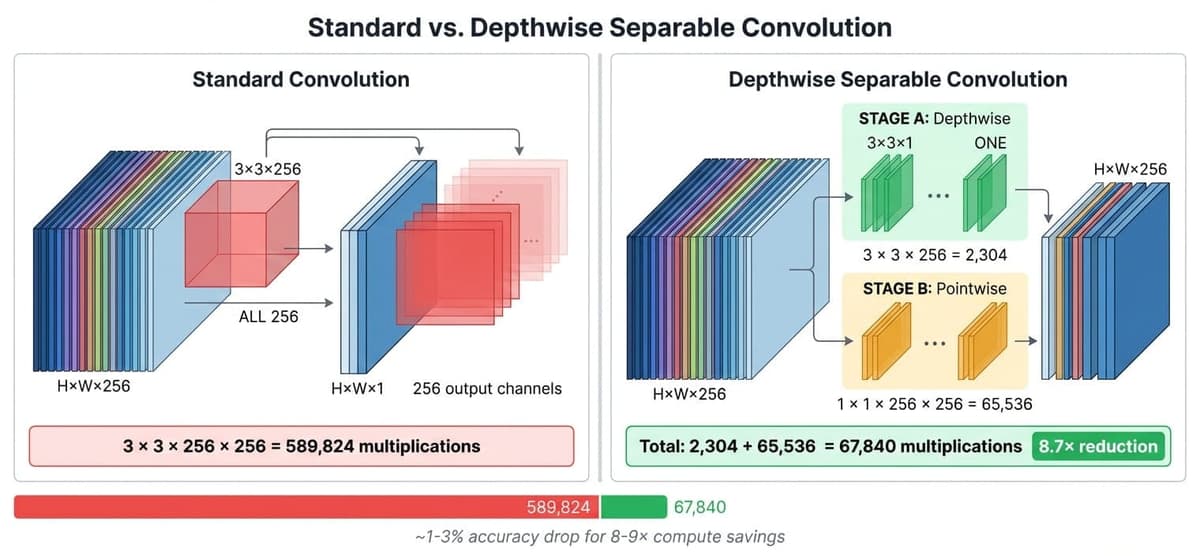
MobileNet's efficiency comes from depthwise separable convolutions, which factorize a standard convolution into a depthwise convolution (one filter per input channel) and a pointwise convolution (mixing channels). This factorization reduces computation by a factor of roughly 8–9x compared to standard convolutions while maintaining most representational capacity.
The architecture has evolved through three generations:
- ●MobileNetV1 (2017): Introduced depthwise separable convolutions. Simple and efficient.
- ●MobileNetV2 (2018): Added inverted residuals and linear bottlenecks, improving accuracy while reducing memory.
- ●MobileNetV3 (2019): Applied neural architecture search (NAS) and introduced hard-swish activation, achieving the best efficiency-accuracy tradeoff.
SSDLite, the detection variant, replaces standard convolutions in the SSD head with depthwise separable convolutions, further reducing compute.
MobileNet-SSD's strength is ubiquitous deployment support: TensorFlow Lite for mobile, ONNX for cross-platform, OpenVINO for Intel hardware, TensorRT for NVIDIA edge devices, and CoreML for Apple devices. For applications requiring maximal compatibility and years of deployment experience, MobileNet-SSD remains relevant despite newer alternatives.
Modern Efficient Detectors
The efficient detector space has seen rapid innovation:
- ●NanoDet: Achieves sub-1MB model sizes while maintaining usable accuracy, ideal for extremely resource-constrained devices.
- ●PP-PicoDet: From PaddlePaddle, optimizes specifically for mobile deployment with specialized architecture designs.
- ●YOLO-NAS-S: From Deci AI, uses neural architecture search to find optimal efficiency-accuracy tradeoffs.
- ●YOLO26n: The YOLO ecosystem's nano variant provides state-of-the-art small-model performance.
Key Insight:
For most new edge deployments, YOLO26n or YOLO-World-S provide the best combination of accuracy, speed, and ecosystem support. Legacy deployments may still benefit from MobileNet-SSD's extensive tooling, while TensorFlow-native workflows align naturally with EfficientDet.
Part 6: Combining Models—Grounded-SAM and Beyond
Grounded-SAM: Detection Meets Segmentation
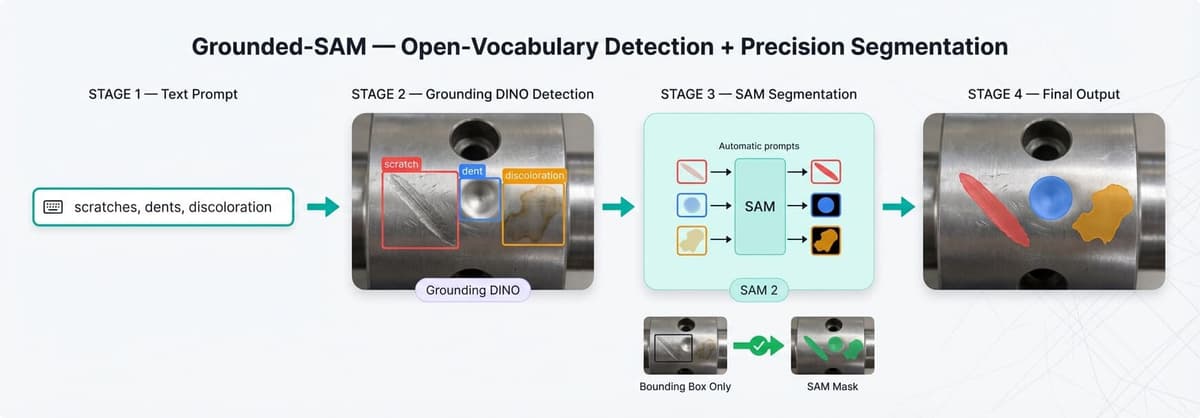
One of the most powerful combinations in modern computer vision is Grounded-SAM: using Grounding DINO for open-vocabulary detection, then SAM for high-quality segmentation of detected objects.
The pipeline:
- 1Text prompt → Grounding DINO → Bounding boxes for objects matching the prompt
- 2Bounding boxes → SAM → Segmentation masks for each detected object
This modular approach delivers the best of both worlds: Grounding DINO's language understanding for flexible, open-vocabulary detection combined with SAM's exceptional segmentation quality for pixel-precise masks.
For industry applications, Grounded-SAM enables workflows like:
- ●"Segment all damaged components" → Get precise masks for each defect
- ●"Segment product XYZ" → Instance-level masks without training data
- ●"Segment safety equipment on workers" → Compliance monitoring with detailed outputs
Grounded-SAM 2 extends this to video, combining Grounding DINO with SAM 2 for open-vocabulary object tracking and segmentation across frames.
Building Custom Pipelines
The modular nature of modern foundation models enables powerful custom pipelines. Consider this quality inspection workflow:
- 1YOLO-World (fast): Detect all components in frame
- 2DINOv2: Extract features for similarity comparison to reference images
- 3Grounding DINO: For anomaly candidates, run open-vocabulary detection for specific defect types
- 4SAM 2: Generate precise segmentation masks for confirmed defects
- 5Florence-2: Generate natural language descriptions of defects for reports
Each model contributes its strength: YOLO-World's speed, DINOv2's feature quality, Grounding DINO's accuracy, SAM's segmentation, Florence-2's language generation.
Part 7: Industry Deployment Considerations
Licensing and Legal Considerations
Foundation models come with varying licenses that significantly impact commercial use:
| Model | License | Commercial Use |
|---|---|---|
| SAM / SAM 2 | Apache 2.0 | ✅ Fully permissive |
| SAM 3 | SAM License (Custom) | ⚠️ Permissive but review terms |
| Grounding DINO | Apache 2.0 | ✅ Fully permissive |
| YOLO-World | GPL-3.0 / Enterprise | ⚠️ Requires license for proprietary use |
| Florence-2 | MIT | ✅ Fully permissive |
| DINOv2 | Apache 2.0 | ✅ Fully permissive |
| CLIP | MIT | ✅ Fully permissive |
| EfficientDet | Apache 2.0 | ✅ Fully permissive |
Key Insight:
YOLO-World inherits the Ultralytics GPL-3.0 license. Commercial applications using YOLO-World in proprietary products should obtain an Ultralytics Enterprise license or consider alternatives like Grounding DINO with custom distillation for faster inference.
Compute and Infrastructure Requirements
Foundation models have significant compute requirements compared to traditional detectors:
| Model | GPU Memory | Inference Time (V100) |
|---|---|---|
| SAM ViT-H | ~8 GB | ~500 ms per mask |
| SAM 2 | ~6 GB | ~50 ms per frame (after encoding) |
| Grounding DINO-L | ~10 GB | ~300 ms |
| YOLO-World-L | ~4 GB | ~19 ms |
| Florence-2-L | ~6 GB | ~100 ms |
| DINOv2-L | ~4 GB | ~30 ms |
| YOLO26m | ~2 GB | ~8 ms |
For production deployment, consider:
- ●Batch processing: If real-time inference is not required, foundation models can process images in batches during off-peak hours.
- ●Model caching: SAM's image encoder can be run once and cached, with fast mask decoder inference for multiple prompts.
- ●Quantization: INT8 quantization can reduce memory and increase speed with minimal accuracy loss for most models.
- ●Distillation: Train smaller student models on foundation model outputs for specific tasks, combining foundation model quality with efficient inference.
When to Use Foundation Models vs. Task-Specific Training
Foundation models shine in scenarios characterized by uncertainty and change. When your detection categories are not predetermined—for instance, a general-purpose inspection system that must adapt to new product lines without retraining—open-vocabulary models eliminate the expensive cycle of data collection, annotation, and retraining. They are equally valuable when labeled data is scarce or expensive to obtain: foundation model backbones like DINOv2 and CLIP have already learned rich visual representations from web-scale data, so fine-tuning on just dozens of examples often yields competitive results. Rapidly changing requirements, common in research and prototyping phases, also favor foundation models because they can respond to new queries immediately. Annotation tools and human-in-the-loop systems particularly benefit from interactive models like SAM, where a single-click prompt produces instant segmentation feedback.
Task-specific training remains preferable when you have a well-defined, stable set of detection classes and enough labeled data to train a focused model. In manufacturing quality control, for example, defect categories are typically fixed (scratches, dents, misalignments) and large datasets accumulate naturally over months of production. A task-specific YOLO26 or RF-DETR model, fine-tuned on this data, will outperform any foundation model on these specific classes while running faster and requiring less compute. Edge deployment with tight power and latency budgets further tilts the scale toward smaller, task-specific models—a YOLO26n running at 40ms on CPU is far more practical than a 300ms foundation model query on the same hardware.
Key Insight:
The most effective production systems often employ a hybrid strategy: foundation models handle exploration, annotation, and edge cases (novel defects, new product types), while task-specific models handle the high-volume, well-understood detection workload. Foundation model outputs can also serve as training data generators—use Grounded-SAM to auto-label images for a domain-specific dataset, then train a focused model on those labels for production inference.
Part 8: Practical Guide for Industry Selection
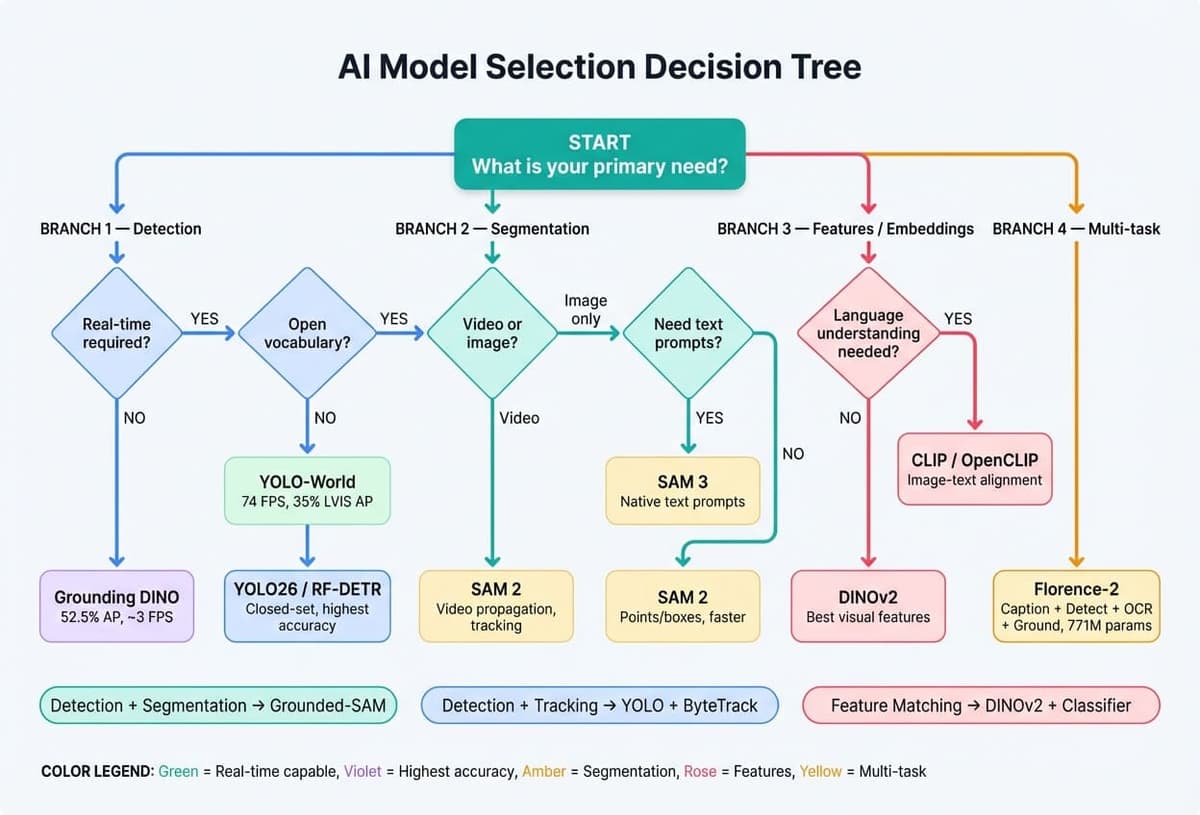
Decision Framework
Based on your requirements, here is how to select the right approach:
Need: Detect objects from natural language descriptions
- ●High accuracy required → Grounding DINO
- ●Real-time required → YOLO-World
- ●Multiple tasks → Florence-2
Need: Segment objects interactively
- ●Images only → SAM 3
- ●Videos required → SAM 2
- ●Need boxes and masks → Grounded-SAM
Need: Universal visual features
- ●Language understanding needed → CLIP / OpenCLIP
- ●Pure vision tasks → DINOv2
Need: Efficient edge deployment
- ●Best accuracy/speed → YOLO26n
- ●TensorFlow ecosystem → EfficientDet-D0/D1
- ●Maximum compatibility → MobileNet-SSD
Need: Multi-task understanding
- ●Detection + captioning + OCR → Florence-2
- ●Detection + segmentation → Grounded-SAM
Implementation Recommendations
For teams beginning with open-vocabulary and foundation models:
- 1Start with Grounded-SAM: The combination of Grounding DINO and SAM provides excellent accuracy for experimentation and annotation. Use it to understand capabilities and generate training data.
- 2Profile your latency requirements: If Grounded-SAM is too slow, try YOLO-World. If you need video, move to SAM 2.
- 3Consider fine-tuning: Both Grounding DINO and YOLO-World can be fine-tuned on domain-specific data to improve accuracy on your categories while retaining open-vocabulary capabilities.
- 4Plan for model updates: Foundation models improve rapidly. Design systems with model swapping in mind—the best choice today may not be the best choice in six months.
- 5Evaluate licensing early: Ensure your chosen models' licenses align with your commercial deployment plans before building production systems.
Conclusion: The Democratization of Visual Understanding
The emergence of open-vocabulary detection and vision-language foundation models represents a fundamental shift in how we build and deploy computer vision systems. The constraint that limited detection to predetermined classes—a constraint that shaped the field for decades—has been lifted.
For industry applications, this means:
- ●Faster prototyping: Test detection capabilities for new object types instantly, without data collection or training.
- ●Reduced data requirements: Foundation models transfer knowledge, reducing the labeled data needed for new domains.
- ●Natural interfaces: Interact with vision systems through natural language rather than class indices.
- ●Compositional capabilities: Combine foundation models like building blocks to create sophisticated pipelines.
However, foundation models are not universally superior. They require more compute than task-specific models, may not achieve peak accuracy on specialized tasks, and come with licensing considerations. The most effective deployments often combine foundation model capabilities for flexibility with task-specific models for efficiency.
As we continue this series, the next installment will dive deep into benchmarking—examining how these models perform in real-world conditions beyond academic datasets, and providing frameworks for evaluating models in your specific deployment context.
The tools are available. The question is no longer "can we detect this?" but "how should we detect this?" That shift—from capability limitations to architectural choices—marks the maturation of computer vision as an engineering discipline.
What's Next in This Series
- 1YOLO in 2026: The Complete Evolution from Research Prototype to Industry Standard (Part 1)
- 2The DETR Revolution: How Transformers Redefined Object Detection (Part 2)
- 3Beyond Detection: Open-Vocabulary and Foundation Models (You are here)
- 4The Benchmarking Reality Check: Why benchmark numbers don't tell the whole story
- 5The Industry Playbook: A framework for choosing the right model for your specific business context
- 6From Prototype to Production: Deployment strategies, optimization techniques, and operational considerations
Our Perspective
At Robolabs AI, foundation models have fundamentally changed how we approach new projects. Where we once spent weeks collecting and labeling data before knowing if a detection task was even feasible, we now get initial results in hours using open-vocabulary models.
Here's what we've learned deploying these models in real-world settings:
- ●Grounded-SAM pipelines are exceptional for rapid prototyping. We routinely use them to validate customer use cases before committing to custom model development—saving weeks of back-and-forth.
- ●Foundation models rarely replace task-specific models in production. They accelerate the path to production by bootstrapping data labeling, validating feasibility, and generating training data for specialized detectors.
- ●YOLO-World occupies a unique middle ground. For applications where object categories change occasionally—retail planograms, dynamic warehouse layouts—its real-time open-vocabulary capability avoids constant retraining.
- ●The licensing landscape matters more than benchmarks. We've seen teams build entire pipelines around models with restrictive licenses, only to face painful migrations when scaling commercially.
Foundation models haven't made traditional computer vision obsolete—they've made it more accessible. The fastest path to production now starts with foundation models for exploration and ends with optimized, task-specific models for deployment.
References & Further Reading
Subscribe to Our Blog
Get the latest insights on robotics and AI delivered to your inbox.
No spam. Unsubscribe anytime.
You Might Also Like
View all posts
Computer Vision
The Benchmarking Reality Check: What the Numbers Really Mean for Your Computer Vision Deployment
A comprehensive technical deep-dive into object detection benchmarks, metrics, and real-world performance. Understand mAP, latency, hardware-specific results, and how to build a practical model selection framework for production deployments.
Feb 25, 202625 min read

Computer Vision
The Industry Playbook: Choosing the Right Computer Vision Model for Your Business
A comprehensive industry guide mapping computer vision models to real-world deployment scenarios across manufacturing, healthcare, retail, automotive, agriculture, and security. Practical model selection frameworks with evidence-backed recommendations.
Feb 27, 202626 min read
Computer Vision
YOLO in 2026: The Complete Evolution from Research Prototype to Industry Standard
A comprehensive technical deep-dive into YOLO's decade-long evolution. Understand what each version does, why it matters, and which models deserve your attention for production deployments.
Feb 17, 202618 min read
Ready to Build Something Impactful?
Let's discuss how our team can help bring your AI and robotics vision to life.